What do you do when the Record of Rights (RoR) says you just bought 2.5 acres, but Bhu Naksha Odisha shows your physical boundary only covers 2.1 acres (Bhulekh Odisha portal)? Here is what I tell every client who walks into my office: the text document does not physically protect your land. In 2026, as Odisha rapidly digitises its cadastral maps, this exact area-versus-boundary mismatch is trapping buyers. Last month alone, 42 disputes crossed my desk in Dhenkanal where buyers paid full price based on the RoR, only to discover their mapped plot was significantly smaller. The solution is simpler than you think, but it requires looking beyond the basic text records. We rely heavily on the written word in property transactions. We check the Khata number, we verify the owner's name, and we feel secure. But land is physical. If the digital map does not align with the text, your legal title means nothing when the neighbour's fence moves three feet into your property.
The ₹28 Lakh Dhenkanal Boundary Trap
Let me share something that could save you lakhs. In early 2026, a non-resident buyer purchased a prime agricultural plot in Dhenkanal. The negotiated price was ₹28 lakhs. The buyer did everything that standard advice dictates. They pulled the RoR from Bhulekh Odisha portal. The text clearly stated the plot area was 1.5 acres. The seller's name matched perfectly. There were no active loans listed in the remarks section. They executed the sale deed and paid the stamp duty. Two months later, when the buyer hired an Amin (surveyor) to construct a boundary wall, the reality hit. The physical land available on the ground was only 1.1 acres. The neighbouring landowner had encroached on 0.4 acres decades ago. When we pulled the digital map, the system reflected the encroached boundary, not the original 1.5-acre rectangle. The buyer had paid for 1.5 acres but legally inherited a boundary dispute over 0.4 acres. Because the sale deed was already registered, recovering the proportional cost from the seller became a civil nightmare (IGR Odisha (Inspector General of Registration)).
This happens because buyers verify the text but completely ignore the geometry. The digital map is the visual truth of your property's borders.
What is Bhu Naksha Odisha? The Bhu Naksha Odisha is the official digitised cadastral mapping system maintained by the Revenue and Disaster Management Department. It translates the text-based Record of Rights (RoR) into a visual, georeferenced plot map, allowing citizens to verify exact boundaries, adjacent plot numbers, and physical dimensions online. Think of mutation like updating the name tag on a box, while Bhu Naksha defines the actual size and shape of that box. You cannot have a secure property transaction without verifying both. The Bhu Naksha platform integrates directly with Bhulekh, meaning any change in the text record should theoretically trigger an update in the map. In reality, this synchronization is where the problems begin.
RoR vs Map: Why the 2026 Vectorization Fails
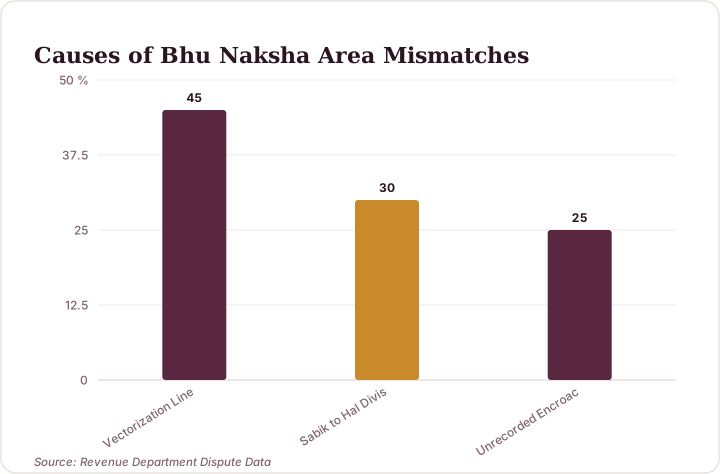
Before we panic, let us understand what is actually happening behind the scenes at the Revenue Department. Historically, Odisha's land maps were drawn on thick cloth during the Sabik (old) and Hal (current) settlements. These cloth maps were stored in the Tahasildar's record room. Over the last few years, the government has been vectorizing these maps. Vectorization is the process of scanning the old cloth maps and tracing them into digital polygons. Here is the secret most people do not know: the ink lines on those 1970s cloth maps were thick. When digitised, a line that was two millimetres wide on cloth translates to a 0.5-decimal variance on the ground. If your plot borders a government road or a water body, this vectorization error often eats into your recorded area. The RoR text remains untouched, showing your full area, but the Bhu Naksha polygon shrinks. If you rely solely on the text, you are buying a phantom area. This is why a Bhu Naksha Cross Reference for Chain of Title Verification is mandatory for any 2026 transaction.
How to Verify Bhu Naksha in 4 Steps
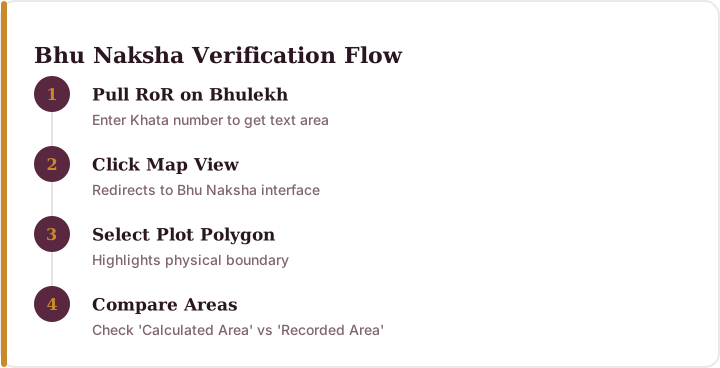
I have helped hundreds of families with exactly this problem. You do not need technical expertise to spot a glaring mismatch. You just need to know where to look before you hand over the advance payment. 1. Visit the official bhulekh.ori.nic.in portal and select your district, tehsil, and village. 2. Enter the Khata number or Plot number to generate the RoR text view. 3. Click the "Map View" button located at the bottom of the RoR page, which redirects you to the Bhu Naksha interface. 4. Click directly on your plot polygon. A left-hand sidebar will appear showing the "Calculated Area" versus the "Recorded Area". If the Calculated Area (the digital geometry) is smaller than the Recorded Area (the RoR text) by more than 2%, you have a red flag. Do not proceed with the registration until this is resolved.
The Legal Fix Under the Settlement Act
If You Discover A Mismatch You Cannot Simply Ask
If you discover a mismatch, you cannot simply ask the seller to rewrite the map. The geometry of land is governed by strict statutory rules. Under Section 15(b) of the Odisha Survey and Settlement Act, 1958, any discrepancy between the record of rights and the map must be corrected through a formal revenue court process. The seller must file an application before the Tahasildar for map correction. The Tahasildar will dispatch a government Amin to measure the physical land using a Differential Global Positioning System (DGPS) rover. The Amin cross-references the physical possession with the Sabik map, the Hal map, and the current digital vector. Only after the Amin submits a field report can the Tahasildar issue an order to correct the Bhu Naksha database. This process takes time, and you should never take on this burden as a buyer. Make it a condition of sale that the seller resolves the Section 15(b) anomaly before executing the final deed. For more context on how revenue officers handle these timelines, our guide on the Odisha Land Reforms Act, 1960 details the administrative hierarchy.
The Section 17 Registration Blind Spot
Many buyers assume that if the Sub-Registrar allows the sale deed to be registered, the land must be safe. This is a dangerous misconception. The registration process in India is entirely blind to map mismatches. Under Section 17 of the Registration Act, 1908, the registration of documents for immovable property above ₹100 is compulsory. However, the Sub-Registrar's duty under this Act is merely to verify that the stamp duty is paid and the parties are identified (IGR Odisha fee schedule). They do not verify the physical map. Furthermore, Section 54 of the Transfer of Property Act, 1882, defines a sale as a transfer of ownership in exchange for a price. It does not mandate that the geometric map matches the text document at the moment of transfer. When you book an appointment through IGR Odisha, the software checks the benchmark valuation based on the text area. It does not ping the Bhu Naksha database to see if the boundary actually exists. The government secures its revenue; you take on the geographic risk.
Cost and Timeline for Map Correction
If you are already trapped in a mismatch, or if you are negotiating with a seller to fix one, you need to know the real-world costs and timelines in 2026. Do not let brokers quote arbitrary figures for "settling" map issues.
| Procedure | Authority | 2026 Official Fee | Typical Timeline |
|---|---|---|---|
| Map Correction Application | Tahasildar | ₹100 | 1 Day |
| Official Amin Field Visit | Revenue Inspector | ₹1,500 | 15-30 Days |
| Boundary Dispute Hearing | Tahasildar Court | Nil | 45-90 Days |
| Digital Map Update | DLR Odisha | Nil | 14-21 Days |
The Total Process Takes Roughly 75 To 140 Days
The total process takes roughly 75 to 140 days. This is why you must identify the mismatch before signing the agreement to sell. If you are looking at high-growth zones, like the 4 Bhubaneswar Areas Set to Triple in Value by 2027, a 90-day delay can completely derail your investment timeline.
Sabik vs Hal Maps: The Historical Root of the Problem
To truly protect your investment, you must understand the history of the land. In districts like Dhenkanal and Mayurbhanj, many plots still suffer from the Sabik-to-Hal transition gap. The Sabik settlement refers to the older land surveys conducted before the 1970s, while the Hal settlement is the current, modernized record. During the transition, a single large Sabik plot was often subdivided into multiple Hal plots to reflect family partitions. However, the draft maps drawn during the Hal settlement sometimes failed to account for minor village roads or drainage channels that had formed naturally over the decades. Today, when the Bhu Naksha system overlays the Hal map onto satellite imagery, these unaccounted physical features cause the digital polygon to shrink. The text record carried forward the exact mathematical division of the Sabik plot, but the physical map lost ground to reality.
What to Do Next: Your 2026 Action Plan
We have covered the risks, the laws, and the historical context. Now, let us secure your transaction. Never rely on a printed screenshot of a map provided by a broker. Digital records update dynamically, and a screenshot from last month might not reflect a boundary correction made yesterday. Always demand the seller's original registered deed, pull the fresh RoR online, and immediately cross-reference the "Calculated Area" on the Bhu Naksha portal. If the variance exceeds 2%, pause the transaction. Require the seller to initiate a correction under the Odisha Survey and Settlement Act. Do not become the next ₹28 lakh case study in Dhenkanal. Verify the geometry, not just the text.