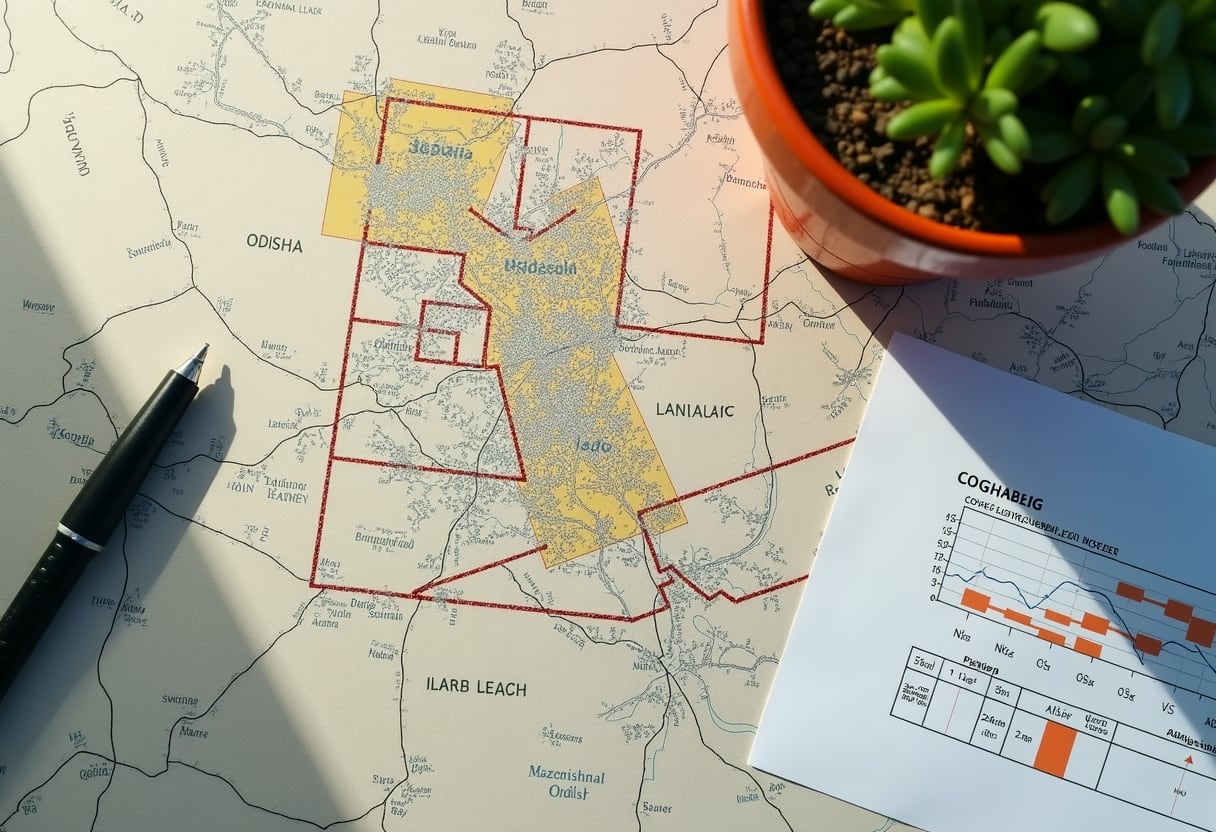
The Angul-Talcher belt sits at the centre of Odisha's coal and aluminium industrial economy — Mahanadi Coalfields Limited (MCL), National Aluminium Company (NALCO), Jindal Steel & Power's Angul facility, and a cluster of downstream metals and power-generation units. Land prices reflect that gravity: parcels within 5 km of NALCO's smelter or MCL's mining belt have appreciated 3-5× since 2015 in catchment areas. But the same industrial proximity that creates the price uplift also brings four distinct downside risks — Coal Bearing Areas Act 1957 acquisition exposure, Odisha Pollution Control Board (OSPCB) restrictions on certain land uses, displacement-and-rehabilitation history that creates challenging title chains, and exit-liquidity concentration where a single anchor's project decision dominates the local market. This walks through each, plus the verification path before buying.
If you are looking at Angul-Talcher land in 2026, the question to ask is not "what's the appreciation potential?" — it's "which industrial activity drives this parcel's value and what is that activity's regulatory exposure?" Get the answer wrong and a 5-acre plot bought at ₹15 lakh/acre can be acquired under CBA Act 1957 for compensation only, with no negotiation upside.
The Coal Bearing Areas Act 1957: investor's biggest hidden risk
The Coal Bearing Areas (Acquisition and Development) Act 1957 is a Union law giving the Central Government power to acquire any land found to contain coal-bearing strata. Under Section 4 the Central Government issues a preliminary notification; Section 9 is the declaration of acquisition; Section 14 is the divestment of all rights to the Government. Compensation is fixed under Sections 13 and 30 based on market value at the date of notification — generally below current market rates for coal-region land where market is already running hot.
Implication for Angul-Talcher investors:
- Parcels overlying suspected coal seams can be CBA-notified at any time
- Once notified, you receive compensation at the notification date's market rate
- Pre-notification negotiation is the only window — once gazette notification issues under Section 4, the buyer is committed to the compensation framework
Pre-purchase check: Search the Coal Ministry's gazette notifications for the specific Mauza. The MCL block boundaries are public. Any parcel within a notified MCL block carries notification risk. The seller may not disclose this; verify independently.
For context, Talcher Coalfield alone has had multiple CBA Act notifications since the 1990s. Some parcels acquired in early notifications are still under compensation dispute in 2026.
The pollution zone overlay
Angul-Talcher's industrial concentration creates ambient air-quality and groundwater issues that the Odisha State Pollution Control Board (OSPCB) addresses through use-restriction notifications. Within designated buffer zones around MCL mining areas, NALCO's smelter complex and Talcher Thermal Power Station, certain land uses are restricted:
- New residential construction within 500m of active mining → restricted under OSPCB siting guidelines
- Agricultural cultivation within heavy-metal-contaminated buffer → restricted by the Department of Agriculture
- Industrial commissioning requires consent-to-establish + consent-to-operate from OSPCB (Air Act 1981 + Water Act 1974)
Land marketed for "future residential development" within these zones may not be developable. Verify OSPCB consent status and any active buffer notifications before assuming a parcel is buildable.
Displacement-and-rehabilitation title-chain history
Much of the Angul-Talcher belt has been through one or more rounds of land acquisition since the 1970s for MCL mining expansion, NALCO's smelter, and Talcher Thermal Power Station. The acquired-then-released parcels carry a particular title-chain pattern:
- Original khatadars compensated and dispossessed
- Some parcels released back when project boundaries were revised
- Rehabilitation grants creating dual claims (the original owner's heirs vs the rehabilitated allottee)
The verification implication: When you walk the Sabik/Hal khata chain on a parcel in this belt, expect to find a government acquisition entry followed by a re-allotment or release. The release order, rehabilitation allotment order, or de-notification order must be on file at the Tahasil — without it the title is challengeable by descendants of the original khatadars who never accepted compensation.
Pull the 30-year Form 25 EC from igrodisha.gov.in for any Angul-Talcher parcel — government acquisitions and re-allotments appear on the EC as registered transactions and the chain becomes legible.
The four micro-belts and how their economics differ
Micro-belt 1 — NALCO smelter catchment (Angul Sadar, parts of Athmallik): Industrial-residential mix; workforce housing demand. Annual appreciation 8-15%. Pollution buffer matters for residential plots.
Micro-belt 2 — MCL mining belt (Talcher block, Bantala, parts of Chhendipada): Industrial land for ancillary services (logistics, equipment yards). 15-25% appreciation possible but CBA Act 1957 notification risk concentrated here.
Micro-belt 3 — Talcher Thermal Power Station periphery: Power-sector-anchored. Stable demand; lower variance returns 6-10%. Less notification risk than mining belt.
Micro-belt 4 — Outer Angul (Pallahara, Banarpal): Agricultural to industrial-transition zones. Higher variance but cheaper entry. Conversion under Section 8-A of the Orissa Survey and Settlement Act 1958 framework takes 6-24 months.
For comparable regional analyses see our SEZ land economics breakdown and Bhubaneswar commercial plot pricing.
Indicative 2026 rates by Angul-Talcher micro-belt
| Belt | Indicative ₹/acre | Use | Liquidity |
|---|---|---|---|
| Angul Sadar municipal | 15-35 lakh | Mixed residential-commercial | 30-60 days exit |
| NALCO catchment 5-10 km | 10-20 lakh | Workforce housing, retail | 60-90 days exit |
| MCL mining belt | 8-25 lakh (industrial) | Ancillary services, logistics | 90-180 days exit |
| Talcher Thermal periphery | 6-15 lakh | Stable residential | 60-120 days exit |
| Pallahara, Banarpal | 2-8 lakh | Agri or conversion-pending | 6-12 months exit |
These ranges reflect headline broker pricing. Government dues (5% stamp duty + 2% registration + ₹500-2,000 mutation) add ~7.2% to acquisition cost. Conversion charges (if applicable) add another 5-15% of Benchmark Value.
Verification checklist before buying Angul-Talcher land
- CBA Act 1957 gazette search for the specific Mauza — any active or past notification
- MCL block boundary map — is the parcel within or adjacent to a notified mining block
- OSPCB buffer-zone notifications — restricted use overlays
- 30-year Form 25 EC — surfaces every prior acquisition / release
- Bhulekh ROR — current ownership and Kissam (industrial vs agricultural)
- Tahasildar conversion order (if originally agricultural) — must be current and on portal
- Sub-Registrar Office authentication of the sale deed under Section 17 Registration Act 1908
- OSPCB consent-to-establish (if commercial/industrial use intended)
- Tahasildar Form 11 site demarcation — physical boundaries vs cadastral map
The verification overhead is meaningfully higher than for Tier A urban parcels. Plan for ₹25,000-50,000 in advocate fees alone, plus 60-90 days due diligence before deal closing.
When BhoomiScan helps in industrial-belt due diligence
Title verification surfaces the prior acquisition history that buyers in this belt routinely miss — government acquisition entries that appear on the EC as registered transactions but don't immediately read as "this parcel was once subject to CBA Act 1957 notification". The three-document cross-check (ROR + EC + Sale Deed) brings those signals to the surface within 48-72 hours. See Title Verification for the full review.