


In Odisha - across all 30 districts - Imagine landing at Biju Patnaik International Airport in 2028. You drive down to your ancestral property in Ganjam, expecting to see the vacant plot you have been paying property taxes on for a decade. Instead, you find a boundary wall you did not build, a foundation you did not lay, and a title document bearing your cousin's name. In land fraud against Non-Resident Indians (NRIs), the perpetrator is often not a faceless land mafia syndicate but a trusted family member. NRIs who fail to proactively monitor family land in India from abroad are walking into a trap. The mechanism they use is not brute force; it is a quiet, administrative manipulation of the Bhulekh Odisha portal and local revenue courts while you are thousands of miles away. Today is when we dissect exactly how this happens, the specific legal loopholes your relatives might exploit, and the unshakeable framework you must use to secure your title chain permanently.
What is an Ex-Parte Partition?
The Ex-Parte Partition Trap is a legal maneuver where a co-sharer or relative files a civil partition suit or mutation claim in a local Odisha court, intentionally sending the legal notice to your old, defunct local address rather than your overseas residence (Orissa High Court). When you fail to appear, the court grants an ex-parte order dividing or transferring the property in their favour. This definition captures the essence of the vulnerability. Relatives know that the Indian legal system relies heavily on physical service of notice. If the postman returns a summons marked "unclaimed" or if a relative signs for it on your behalf and buries it, the revenue court assumes you have chosen not to contest the claim. By the time you check the records two years later, the statutory appeal period has expired, and reversing the mutation requires a decade-long civil battle.
How a Relative Mutates Your Land
If a relative submits a fabricated "memorandum of family settlement" alongside an application under Section 19 of the Odisha Land Reforms Act 1960, the Tahasildar will issue a proclamation. This proclamation is pinned to a physical notice board at the Tehsil office and published in a local Odia daily newspaper (IGR Odisha SRO directory). Obviously, an NRI sitting in Dubai or New Jersey will never see it. Consider an NRI doctor whose uncle combines an old Sabik record with an unregistered family settlement deed and mutates the Hal (current) record entirely into his own name. The NRI discovers the theft only when he applies for a bank loan against the property and the bank's panel advocate pulls the current Encumbrance Certificate.
The 4-Step Ancestral Land Hijack Pattern
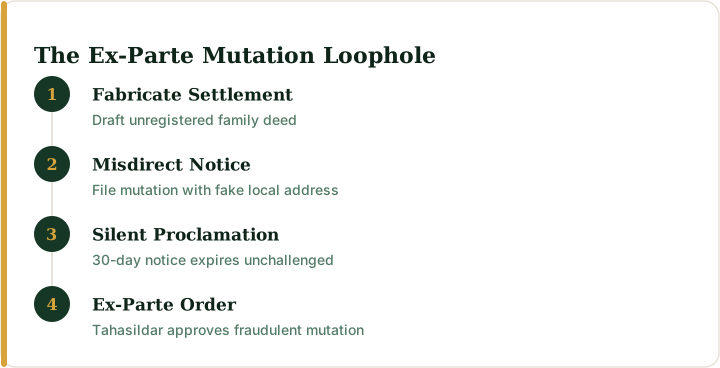
To monitor family land in India from abroad effectively, you must understand the exact sequence of events that leads to a hijacked title. Fraudsters rarely invent new methods; they rely on this predictable four-step sequence. 1. The Fabricated Settlement: The relative drafts an unregistered family settlement deed. They will claim this document merely "records a past oral partition" to bypass stamp duty and registration scrutiny (IGR Odisha fee schedule). 2. The Misdirected Notice: They file a mutation case at the local Tahasildar office, providing your last known Indian address or a fabricated local address where an accomplice resides. 3. The Silent Proclamation: The objection period ticks down. The notice sits on a physical board in the Tehsil office. No objections are filed because you do not know the case exists. 4. The Ex-Parte Order: The Tahasildar, seeing no objections and presented with sworn affidavits from local witnesses (often neighbors bribed or coerced by the relative), approves the mutation. The Bhulekh database updates automatically. The risk is real. Verify your title chain before you book your next flight home.
Now let us examine the legal mechanism that should protect you, provided you enforce it properly.
Section 17 of the Registration Act 1908
Your strongest defense against family land theft is grounded in Section 17 of the Registration Act, 1908. This specific statute mandates that any document which creates, declares, assigns, limits, or extinguishes any right, title, or interest in immovable property valued at more than ₹100 must be compulsorily registered at the Sub-Registrar's office. Relatives attempting to steal land will almost always use an unregistered document to initiate the fraud. Why? Because registering a partition deed or a gift deed requires the physical presence and biometric authentication (fingerprints and photographs) of all parties involved, including you. Since you are abroad, they cannot register the deed. Instead, they attempt a legal sleight-of-hand. They draft a "Memorandum of Past Oral Partition". Indian courts have historically held that if a family partitioned property orally in the past, a subsequent written document merely recording that historical fact does not strictly require registration under Section 17. Fraudulent relatives exploit this nuance aggressively. They present this unregistered memorandum to a pliable Tahasildar, claiming the family divided the assets years ago and you relinquished your share. If you are not actively monitoring the mutation process in Odisha, this unregistered piece of paper can effectively rewrite your family history.
How to Monitor Bhulekh Odisha From Abroad
You do not need to rely on the word of your relatives. The digitisation of land records means you have direct, unfiltered access to the exact same data the Tahasildar sees. You must build a habit of checking these primary sources every six months. First, access the official Bhulekh Odisha portal. This is the state government's definitive database for the Record of Rights (RoR). You will need your district, tehsil, village (mauza), and specifically your Khata number or Plot number. When you pull the RoR, look immediately at the "Owner Name" (Pattadar) section. Has a new name been added? Has your fraction of ownership been altered? Furthermore, check the "Remarks" column. If a mutation case is pending or a civil court injunction has been filed, it will often be noted here as a red flag. Second, you must verify the encumbrance status. The RoR only shows the current revenue record; it does not show if your relative has secretly mortgaged the property or registered a lease agreement. For this, you must navigate to the IGR Odisha portal and pull a current Encumbrance Certificate Odisha (Form 25). The EC will reveal every registered transaction on that plot for the period you specify. If your relative registered a Power of Attorney (PoA) that you allegedly signed, it will appear here.
The Sabik vs Hal Khata Exploitation
Let me show you the pattern that catches NRIs completely off guard. It involves the historical transition of land records in Odisha, specifically the gap between the Sabik (old settlement) and Hal (new settlement) records. During a major settlement operation, the government surveys all land and creates new Hal records. If your family owned a large tract of land under a Sabik Khata, the new Hal Khata is supposed to reflect the exact same ownership shares. However, this transition phase is highly vulnerable to manipulation. A relative on the ground in Odisha can approach the settlement officers during the draft publication phase. They can present forged consent letters or unregistered partition deeds, claiming that the family agreed to a new division of the Sabik vs Hal khata assets. Because you are abroad and not present to file an objection under Section 22 of the Orissa Survey and Settlement Act, 1958, the final Hal RoR is published with the altered ownership shares. Once the final publication occurs, challenging it requires filing a revision petition before the Board of Revenue or a civil suit, a process that can take years in Odisha courts. This is why retrospective monitoring is insufficient; you must monitor the records proactively.
The Unregistered Power of Attorney Threat
Many NRIs leave a Power of Attorney with a sibling or parent to manage local affairs, pay property taxes, or handle minor disputes. This is a catastrophic vulnerability if not executed with extreme precision. Under the law, a Power of Attorney used to sell or mutate immovable property must be registered. However, relatives often misuse a general, unregistered PoA intended for simple management tasks to execute complex property transactions. They might use the PoA to sign a development agreement with a local builder or to consent to a municipal land acquisition without your knowledge. If you must leave a PoA, it must be a Specific Power of Attorney. It must explicitly state what the agent cannot do: "This PoA does not grant the authority to sell, gift, mortgage, partition, or mutate the property located at Plot X." Furthermore, if you execute a PoA while abroad, it must be authenticated by the Indian Embassy or Consulate in your resident country and then stamped by the District Collector in Odisha within three months of its arrival in India, as per the Indian Stamp Act, 1899. Failure to follow this exact sequence renders the document legally invalid, yet Tahasildars frequently overlook this unless challenged.
The 2026 NRI Land Protection Checklist
To stop being a passive observer and start defending your assets, you must implement a rigorous verification schedule. Relying on WhatsApp updates from your cousin is not a legal strategy. Here is the exact framework you need to deploy.
| Action Item | Portal / Authority | Frequency | Critical Marker to Check |
|---|---|---|---|
| RoR Verification | Bhulekh Odisha | Every 6 Months | Owner name fractions and remarks column |
| Encumbrance Check | IGR Odisha | Annually | Form 25 for unauthorized mortgages or leases |
| Mutation Status | Revenue Odisha | Post-transaction | Section 19 OLR Act compliance |
| Physical Audit | Local Advocate | Every 2 Years | Boundary wall integrity and squatter presence |
Do not skip these steps. The NRI in the example above could have caught the fraud by checking the IGR portal annually. Fraudsters look for soft targets; your absence makes you the softest target available. If you hold ancestral land in Odisha and have not verified the Hal records against the Sabik records, your title is currently operating on borrowed time. The legal system provides the tools to secure your ownership, but it requires your active participation to enforce them.
By understanding the mechanics of the ex-parte partition trap, leveraging Section 17 of the Registration Act, and maintaining strict surveillance over the Bhulekh and IGR portals, you can safely monitor your family land in India from abroad. The distance is only a vulnerability if you choose to remain blind to the data.