Imagine landing at Biju Patnaik International Airport two years from now. You drive to your ancestral plot in Bhadrak, only to find a boundary wall built by a stranger. You ask your cousin what happened to the sale proceeds they promised to wire to your overseas account. They offer excuses, then silence. The money is gone, parked in an Indian resident account you cannot access, and the land is legally transferred to a third party. Today is when that disaster gets prevented. Here is what I tell every client who walks into my office asking about selling property from abroad. The process of repatriation land sale proceeds NRI families undertake is filled with legal landmines. The Reserve Bank of India has strict rules, and local fraudsters know exactly how to exploit your absence. We are going to secure your title, structure your bank accounts, and ensure every single rupee reaches you safely.
The One Million Dollar FEMA Limit
The Foreign Exchange Management Act FEMA Of 1999 Governs
The Foreign Exchange Management Act (FEMA) of 1999 governs how money moves across Indian borders. Section 3 of FEMA strictly prohibits dealing in foreign exchange without Reserve Bank of India authorization. For Non-Resident Indians selling property in Odisha, the rule is clear but often misunderstood. You are permitted to repatriate up to USD 1,000,000 per financial year from the sale of Indian assets. This is not a lifetime limit. It resets every financial year. Many NRIs assume they can simply sell a plot in Bhubaneswar and wire the money directly to their account in London or Dubai. That is legally impossible. The funds must first land in a Non-Resident Ordinary (NRO) account. Attempting to bypass this by having a buyer deposit cash into a relative's resident savings account is the most common mistake I see. Once the money enters a resident account, repatriating it becomes a nightmare of tax penalties and compliance audits. Furthermore, the property must have been acquired legally under the foreign exchange laws prevailing at the time of acquisition. If you inherited the land, the rules are slightly smoother, but the documentation burden remains heavy. You must prove the chain of title. You must prove your NRI status. You must prove the taxes are paid. Without these proofs, your bank will freeze the transfer, leaving your funds trapped in India while the rupee depreciates against your local currency.
The Bhadrak Ancestral Sale Trap
Let me share something that could save you lakhs. In early 2026, a family from Bhadrak living in Canada decided to sell 3 acres of prime highway-facing land. They trusted a local uncle to handle the transaction. The plot was valued at ₹4.2 crore. The uncle convinced the NRI owners to execute a general Power of Attorney, claiming it was necessary to navigate the local Tahasildar's office and manage the sale deed registration. The uncle sold the land. However, he directed the buyer to split the payment. He took ₹1.2 crore in white money via bank transfer to the NRI's NRO account, and ₹3 crore in cash, which he kept. When the NRI attempted to repatriate the funds, the Chartered Accountant flagged the massive discrepancy between the circle rate and the registered sale value. The Income Tax Department issued a notice for tax evasion. The family lost ₹3 crore to their trusted relative and faced a ₹50,000 daily penalty for FEMA non-compliance. The buyer, meanwhile, had a perfectly valid registered deed under Section 54 of the Transfer of Property Act, 1882, which defines a legal sale as a transfer of ownership in exchange for a price paid. The buyer paid the price. The NRI simply never received it. The risk is real. Verify before you sign.
This happens because NRIs rely on trust instead of verifiable legal frameworks. When you are 8,000 miles away, trust is not a strategy. You need independent verification of the property valuation, direct communication with the buyer, and strict control over the financial routing.
Fake Power of Attorney Risks
A Power Of Attorney POA Is A Dangerous Instrument
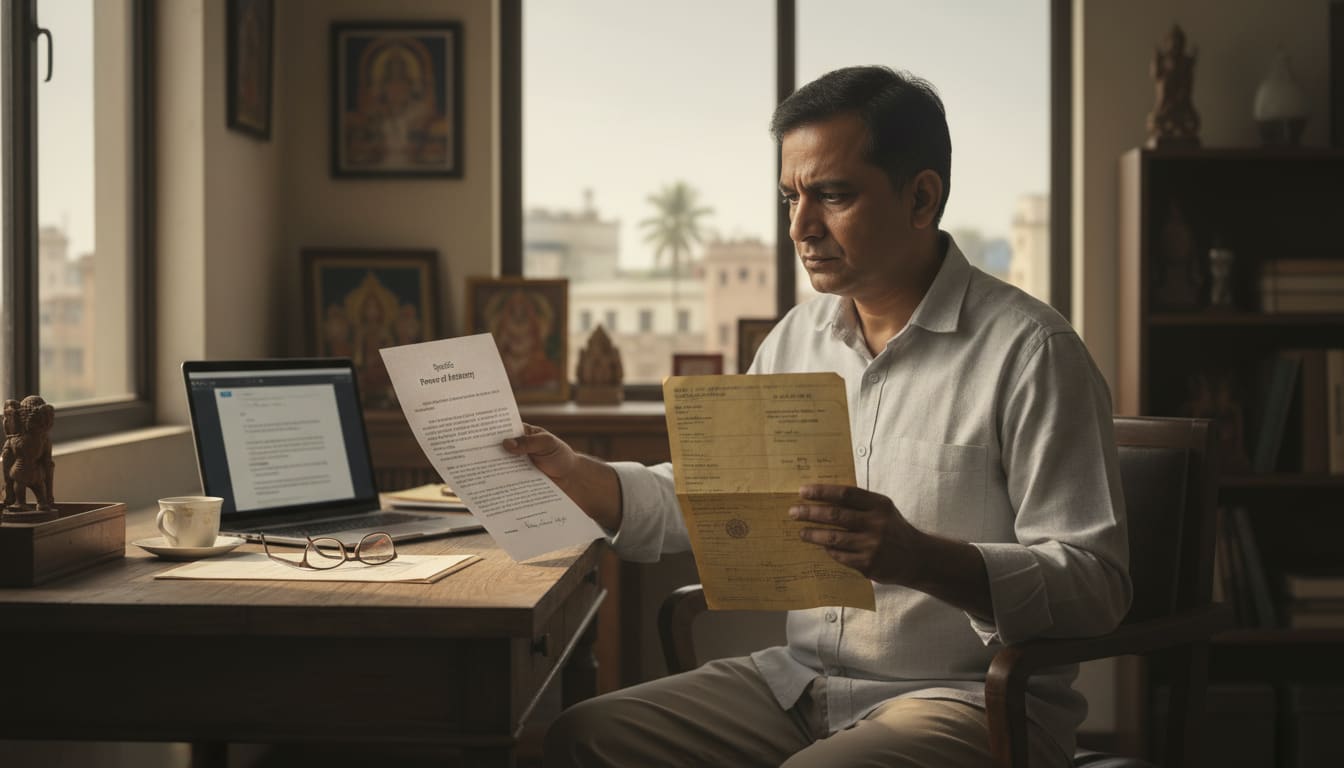
A Power of Attorney (POA) is a dangerous instrument if drafted poorly. If you must use a POA to sell land in Odisha, it must be a Specific Power of Attorney, not a General Power of Attorney. A general POA gives your representative the right to do almost anything with your assets. A specific POA restricts them to a single transaction: selling a specific khata number to a specific buyer for a specific minimum price (Bhulekh Odisha portal). Under Section 17 of the Registration Act, 1908, any document that creates or extinguishes rights in immovable property worth more than ₹100 must be registered. This includes the POA if it authorizes the sale of land. For an NRI, the POA must be drafted, signed in your country of residence, notarized by a notary public there, and then stamped by the Indian Embassy or Consulate. Once it arrives in Odisha, it must be adjudicated by the District Sub-Registrar within three months (IGR Odisha SRO directory). Fraudsters often skip this adjudication step, using forged embassy seals. When the Sub-Registrar eventually catches the fake seal during a subsequent encumbrance certificate check, the entire sale can be declared void. You lose the land, and the buyer sues you for the return of the purchase money.
NRO Account Rules for Property
Think Of Your Bank Accounts As Border Checkpoints
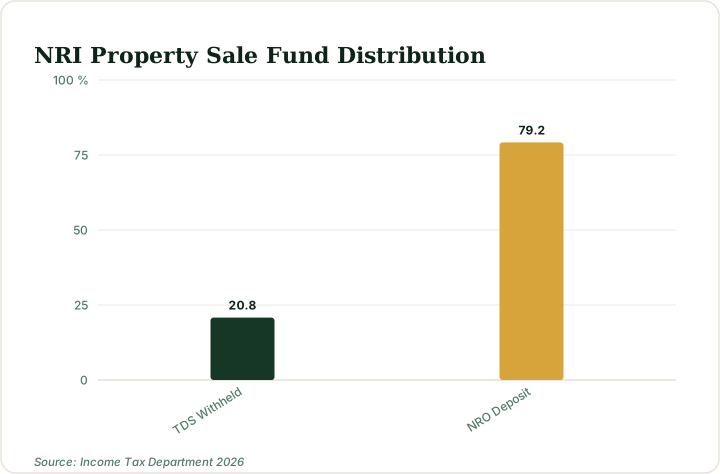
Think of your bank accounts as border checkpoints. You cannot move money across the border without passing through the correct checkpoint. For property sales, that checkpoint is the NRO account. You cannot use a Non-Resident External (NRE) account to receive the initial sale proceeds. Here is the exact framework you must follow. The buyer must deduct Tax Deducted at Source (TDS) before paying you. For NRIs, the TDS rate on long-term capital gains from property sales is 20.8 percent (including cess). The buyer deposits this tax with the government and pays you the remaining 79.2 percent directly into your NRO account.
| Account Type | Allowed for Receiving Sale Proceeds? | Repatriation Limit | Tax Status |
|---|---|---|---|
| Resident Savings | No (Illegal for NRIs) | Zero | Fully Taxable |
| NRE Account | No (Only foreign income) | Unlimited | Tax-Free in India |
| NRO Account | Yes (Mandatory) | USD 1 Million/Year | Subject to TDS |
If the buyer transfers the money to your resident savings account (which you should have converted to an NRO account upon leaving India), you are in violation of FEMA. The Reserve Bank of India monitors these high-value transactions. Once the funds are legally in the NRO account, and taxes are cleared, you can initiate the transfer to your foreign account. See your actual records here - no lawyer needed.
Do Not Let A Buyer Convince You To Accept
Do not let a buyer convince you to accept a lower registered value to save on stamp duty (IGR Odisha fee schedule). If the registered value is lower than the actual money changing hands, the difference is black money. You cannot repatriate black money. It will remain trapped in India, usually in the hands of the relative managing the sale.
Section 17 Registration Act Mandates
The legal transfer of property is not complete when money changes hands. It is complete when the document is registered. Section 17 of the Registration Act, 1908 mandates that all sales of immovable property must be registered at the Sub-Registrar's office having jurisdiction over the land. For NRIs, this means your representative must present the specific POA, the original title deeds, and the buyer at the IGR Odisha office. The Sub-Registrar will verify the identities of all parties. They will check the Record of Rights to ensure the seller actually owns the land. They will verify that the stamp duty, which varies between 4 to 5 percent in Odisha depending on the owner's gender, has been paid. If your relative registers the deed but lists themselves as the recipient of the funds in the document, you have a massive legal problem. The sale deed must explicitly state that the payment was made via demand draft or NEFT directly to your NRO account. If the deed says "cash received by authorized representative," you have lost control of the funds. Always demand a draft copy of the sale deed for your review before the actual registration date.
Three Forms to Clear RBI Compliance
To move the money from your NRO account to your overseas account, you must navigate the Income Tax Department's clearance process. This involves three critical documents. Without them, your bank will simply refuse the international wire transfer. First, you need Form 15CA. This is a declaration of remitter, filed online on the Income Tax portal. It states the nature of the remittance and confirms that taxes have been paid. Second, you need Form 15CB. This is a certificate issued by a practicing Chartered Accountant in India. The CA reviews your sale deed, your TDS certificates, and your capital gains calculation, and certifies that you have met all tax obligations. Third, you need the Form 15G or 15H if you are claiming lower TDS, though this is rare for high-value property sales. You must also provide the bank with a copy of the registered sale deed and the buyer's TDS certificate (Form 16B). The entire compliance process usually takes 14 to 21 days. If you try to rush it, or if your relative hires a shady accountant who files false numbers, the Reserve Bank of India will freeze the transaction pending an audit.
Checking Bhulekh Odisha from Abroad
Before you even list the property for sale, you must verify its current status. Fraudsters often target NRI properties because they know the owners are not physically present to check the boundaries or the revenue records. You might think you own 2 acres in Cuttack, only to discover that a local politician has already mutated the land into their name. You can perform this check from anywhere in the world using the Bhulekh Odisha portal. Search for your district, tehsil, and village. Enter your khata number. The portal will display the current RoR. Check the owner's name carefully. If your deceased father's name is still on the record, you cannot sell the land. You must first complete the mutation process to transfer the title to your name as the legal heir. Mutation under Section 36 of the Odisha Land Reforms Act, 1960 is mandatory. It updates the revenue records. A registered sale deed proves you bought the land, but mutation proves you have the right to pay property taxes and sell it. If your relative claims they have updated the records, do not take their word for it. Log into Bhulekh and verify it yourself. If there is a discrepancy, you need a local advocate to file a correction petition with the Tahasildar immediately.
Secure Your Repatriation in Four Steps
The solution is simpler than you think, provided you follow a rigid sequence. Do not deviate from these steps, no matter how much pressure a buyer or a relative puts on you to close the deal quickly. Speed is the enemy of security in cross-border land transactions. First, secure your own NRO account. Ensure it is fully KYC compliant and linked to your current overseas address and phone number. Second, hire an independent advocate in the district where the land is located. Do not use the buyer's lawyer. Do not use your uncle's lawyer. You need someone who represents only your interests to draft the specific POA and review the sale deed. Third, demand a transparent payment structure. The buyer must deduct the 20.8 percent TDS and deposit the remaining balance exclusively into your NRO account. The sale deed must list the exact UTR (Unique Transaction Reference) numbers of these bank transfers. Fourth, engage a reputable Chartered Accountant to prepare Form 15CB immediately after the registration is complete. By controlling the legal representation and the financial routing, you remove the opportunity for fraud. Your ancestral land should be a blessing, not a source of endless litigation. Protect your title, enforce your rights, and ensure your money comes home to you. Don't wait for a problem. Let's verify together.