
The 8 Documents Every Odisha Land Buyer Must Verify Before Paying Advance
Odisha has its own document mix: Sabik and Hal Khatiyan, the Form 25 EC, Tahasildar mutation, the Section 22 OLR Act permission for tribal and Scheduled Caste land. Generic India guides miss these. The 8-document checklist.
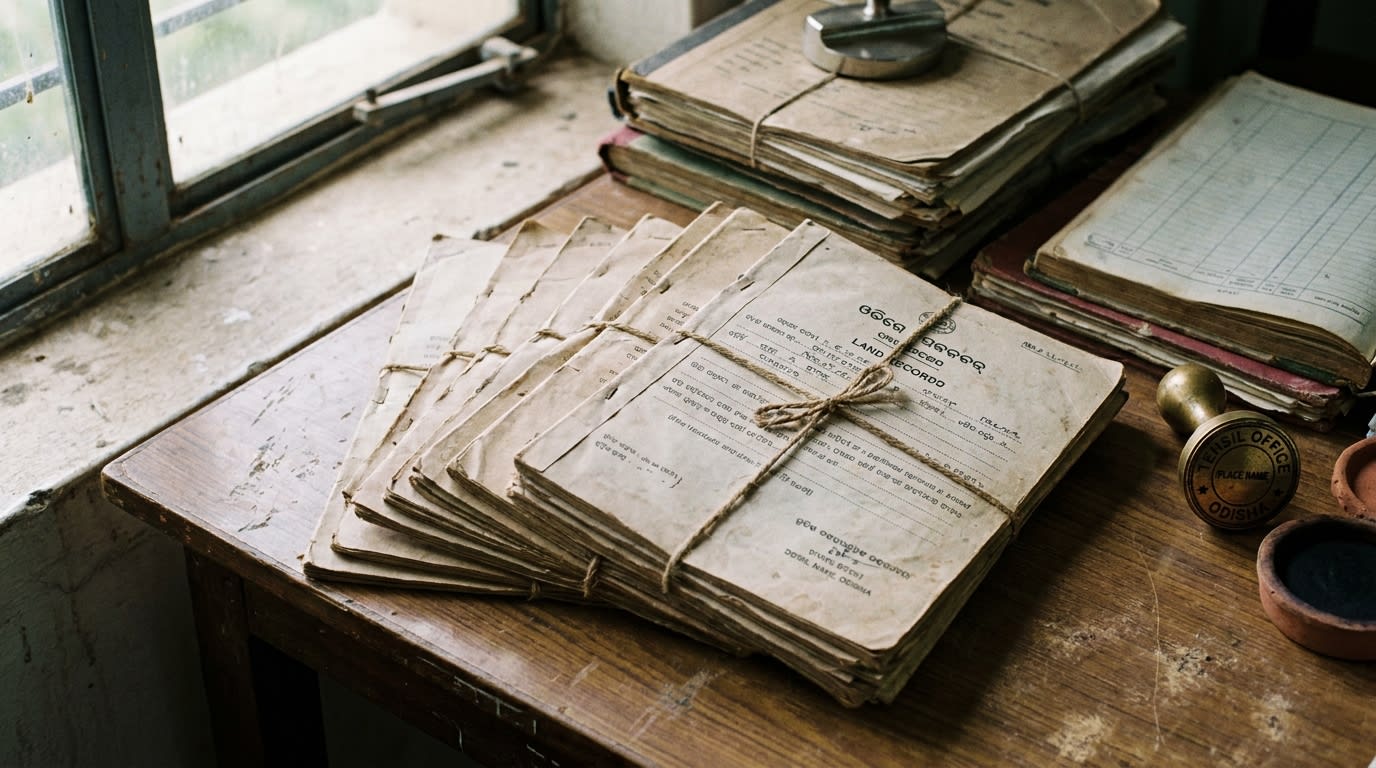
The short answer
Which documents must I verify before buying land in Odisha?
Eight documents are non-negotiable before buying land in Odisha: Sale Deed with 30-year chain, Bhulekh Khatiyan/RoR, Form 25 EC, Tahasildar mutation, conversion certificate (if agricultural), OLR Section 22 permission (for SC/ST sellers; in the Scheduled Areas a sale by an ST seller to a non-tribal is void), NOC from local authority, and approved building plan (if structure exists). The Section 22 check alone can save a buyer from a land dispute.
The 8 documents every Odisha land buyer must verify before paying advance
Odisha land law has its own grammar. Sabik vs Hal Khatiyan, Form 25 Encumbrance Certificate from IGR Odisha, Tahasildar mutation, Section 22 of the OLR Act — generic India-wide property guides do not cover these specifically. This guide walks through every document an Odisha buyer must verify before signing or paying advance, with WhatsApp guidance at +91 99372 26520 if any of it gets stuck.
1. Sale Deed (parent + 30-year chain)
The registered Sale Deed transfers ownership from seller to buyer. The current deed plus every prior conveyance (sales, gifts, partitions, inheritances) back at least 30 years is the chain of title. A 30-year clean chain is the bank-panel standard.
Where to get it: certified copy from the Sub-Registrar Office (SRO) covering the plot's tehsil, via the IGR Odisha portal (igrodisha.gov.in) or in person. Do NOT trust a seller-supplied photocopy.
Fraud signal: missing links in the chain (one deed dated 2010, the next dated 1985 with nothing in between) = unresolved succession or impersonation risk. Read the legal-clearance checklist →
2. Khatiyan / Record of Rights (RoR)
The Khatiyan is the revenue-department record. In Odisha it shows the current tenant, plot numbers, land kisam (classification — Rayati, Sthitiban etc.), area, and the Sabik (old, pre-Settlement) vs Hal (current) khata.
Where to get it: free download at Bhulekh Odisha (bhulekh.ori.nic.in). Select State → District → Tehsil → Village.
Fraud signal: Sabik-vs-Hal mismatch — seller named only in the old Sabik entry, absent from the current Hal record. Means the property has already been transferred. Read a real khatiyan, column by column →
3. Encumbrance Certificate (Form 25)
Form 25 EC from the IGR Odisha registry lists every registered transaction for the search window. Always ask for 30 years for high-value purchases. Shows live mortgages, gifts, releases, pending charges.
Where to get it: apply on igrodisha.gov.in. Fee: Rs 25 first year + Rs 15 per additional year (Rs 460 for 30 years).
Fraud signal: live mortgage not disclosed by seller OR release deed missing for an old mortgage. Read the Form 25 EC field-by-field decoder →
4. Mutation Certificate (Tahasildar)
A registered Sale Deed alone does not put the buyer on the RoR. The mutation pipeline (SRO → Tahasildar → Bhulekh) must complete. An uncontested mutation has a 7-day limit under the Odisha Right to Public Services Act (ORTPS services); on 25 September 2026 the Revenue Department's dashboard showed an average of 38 days.
Fraud signal: deed signed years ago but Hal RoR still shows the previous owner = mutation pending. You are buying a paper-only claim. Read the land mutation guide →
5. Conversion Certificate (if buying agricultural land)
Agricultural land in Odisha cannot be used for non-agricultural purposes without a conversion order under Section 8-A of the OLR Act. If you intend to build on agricultural land, the conversion order must exist BEFORE Sale Deed registration. Apply at the Tahasildar / Sub-Collector's office.
Fraud signal: no conversion certificate but seller says "the previous owner converted it informally" — this is not a conversion. Authorities can demolish.
6. OLR Act Section 22 permission (the check no other guide covers)
Section 22 of the OLR Act 1960 protects SC/ST/tribal landholders from non-tribal acquisition. A non-tribal buyer cannot purchase land from a tribal seller without prior written permission from the Sub-Collector. The same section bars the Sub-Registrar from registering such a deed without that permission (Section 22(4)), and a transfer made without it is void (Section 22(1)).
In the six districts wholly in the Scheduled Areas (Malkangiri, Nabarangpur, Rayagada, Mayurbhanj, Sundargarh, Koraput) and in parts of seven more (the list), Section 22 gives way to Regulation 2 of 1956 (OSATIP), under which a transfer by a Scheduled Tribe member to a non-member is void even with the seller's consent (Section 3).
A breach of Section 22 or Regulation 2 can end in a civil court dispute. Read the fraud patterns →
7. NOC from local authority (BDA / CDA / PDA / Panchayat)
Plots inside Development Authority jurisdictions need an NOC certifying the plot is not under acquisition, road widening, or master-plan reservation. Outside DA areas, the Gram Panchayat or Municipal NOC plays the same role.
Fraud signal: seller claims "non-DA / Panchayat land" but Bhulekh shows the plot inside the DA boundary. Common in fast-growing Bhubaneswar / Cuttack peripheries.
8. Approved plan / land-use permit (if buying built-up)
If buying a plot with an existing structure, the approved building plan + occupancy certificate must exist. Unauthorised construction is liable to demolition irrespective of plot ownership.
Read the master verification guide →
Smart ROR — what changed in October 2025
The Odisha Revenue Department rolled out Smart ROR in October 2025: tamper-proof digital pattas with QR-verified Khatiyan entries. Practical change for buyers: always download the latest Hal RoR yourself from bhulekh.ori.nic.in. The digital record is now authoritative; a paper RoR from the seller is supplementary only.
5 Odisha fraud patterns to watch for
- Sabik vs Hal mismatch — seller named only on the old Sabik Khatiyan.
- EC missing a live mortgage — the EC search window was too short OR an entry is hidden.
- Section 22 bypass: a non-tribal buyer being sold tribal land without the Revenue Officer's permission.
- Plot ID drift — Khatiyan, EC, and Sale Deed reference different plot numbers.
- Mutation never completed — Sale Deed signed years ago but RoR still shows the previous owner.
Free WhatsApp guidance
Stuck on any of these for a specific plot? Free WhatsApp consult at +91 99372 26520. Send the Khatiyan number, district, and the document you are stuck on — we walk you through what to verify next. No upload, no signup.
<!-- W3.A4 hub block (money pillar) -->
Other essential reading
Companion guides — read these alongside this one:
- Bhulekh Odisha: How to check land records online across all 30 districts
- Read the Encumbrance Certificate (Form 25) line-by-line
- Spot land fraud patterns in Odisha
- Land mutation in Odisha: process, fees and timeline
- The 8 documents every buyer must verify
- Khatiyan in Odisha: meaning, columns and how to search it
- NRI land investment in Odisha
Top-traffic district guides:
Official portals: IGR Odisha, the Bhulekh portal and the Odisha Revenue Department.
Frequently Asked Questions
Which documents are absolutely mandatory before buying land in Odisha?
The non-negotiable set is six: Sale Deed (with 30-year chain), Khatiyan/RoR from Bhulekh, Form 25 Encumbrance Certificate (30-year search), Mutation certificate, the Revenue Officer's permission under OLR Section 22 (if the seller is SC/ST; in a Scheduled Area a sale by an ST seller to a non-tribal is void), and NOC from the local development authority or Panchayat. Conversion certificate is mandatory only if the land was agricultural and you intend non-agricultural use. Approved building plan is mandatory only if the plot has a structure.
Is a registered Sale Deed enough to make me the legal owner?
No. A registered Sale Deed transfers ownership in law but does NOT update the public revenue record. Until the mutation pipeline completes (SRO → Tahasildar → Bhulekh), the recorded tenant on the Bhulekh RoR is still the seller. Until then, the seller can — in bad faith — register a second sale to a different buyer. Always release the final payment / retention against mutation completion, not Sale Deed registration.
What is Section 22 of the OLR Act and why does it matter?
Section 22 of the Odisha Land Reforms Act 1960 prohibits an SC/ST/tribal seller from transferring land to a non-tribal buyer without prior written permission from the Sub-Collector. A Sale Deed registered without this permission is void ab initio — the buyer loses both the land and the money. The Sub-Collector permission letter must be on file with the deed. For plots in the Scheduled Areas (8 districts), the OSATIP regulation applies even more restrictively.
What changed with the October 2025 Smart ROR rollout in Odisha?
The Odisha Revenue Department rolled out Smart ROR in October 2025 — tamper-proof digital pattas with QR-verified Khatiyan entries. Pre-Smart-ROR pattas (issued before October 2025) are still valid but can be cross-verified against the digital record. For buyers, the practical change is: ALWAYS download the latest Bhulekh RoR yourself; do not rely on a paper RoR the seller hands you, as the digital record is the authoritative source.
How much does it cost to verify all 8 documents myself in Odisha?
Form 25 EC: Rs 25 first year + Rs 15 per additional year (Rs 460 for a 30-year search). Sale Deed certified copy: Rs 5 per page. RoR Khatiyan: free download from Bhulekh. Mutation case search: free. NOC application fees vary by DA (Rs 500-2,000 typical). Total out-of-pocket: roughly Rs 1,500-3,000 for thorough self-verification.
I am an NRI buying land in Odisha — anything different?
Same 8 documents apply. Two additions: (1) the Power of Attorney you give to a local representative must be specifically worded to authorise SRO registration and mutation filing — generic POAs get rejected, and (2) FEMA compliance requires the purchase consideration to flow through your NRO / NRE account with a documented audit trail. Agricultural land cannot be purchased by NRIs under FEMA — only residential or commercial land.
Where do I get free help if I am stuck on a specific document?
Free WhatsApp consult at +91 99372 26520. Send the property details (Khatiyan number, district, tehsil, village) and the document you are stuck on, and BhoomiScan walks you through what to check next.