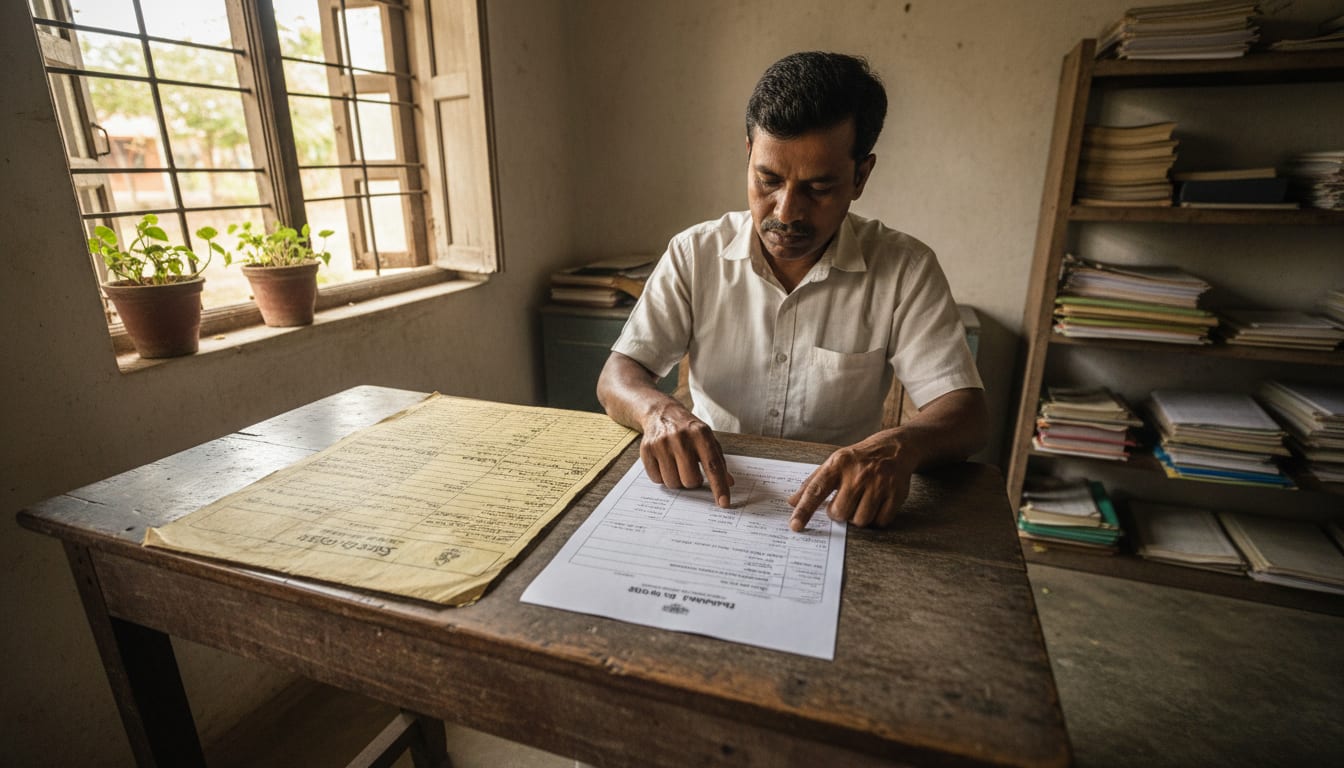

A client sat across my desk yesterday holding a sale agreement for a plot near the Kalinganagar industrial gate. He agreed to pay the projected 2025 rate of ₹1,450 per square foot. The registration window closes Saturday. The documents looked flawless to the naked eye. But a quick check of the Bhulekh Odisha portal revealed the land was still classified as 'Sarad' (agricultural) under the Hal settlement (Bhulekh Odisha portal). If he had signed, he would have walked straight into a ₹42 lakh loss because he could never legally build a house on that land. Here is what I tell every client who walks into my office looking to invest in Jajpur's booming real estate market. The rising property rates are hiding a wave of un-converted land sales, and understanding the legal mechanics is your only defense. As part of our comprehensive NRI Land Investment Handbook, we track these patterns closely. Jajpur is transforming rapidly, but the legal infrastructure governing land titles remains rooted in historical settlement records. Let us look at the numbers and the exact legal checks you need to perform.
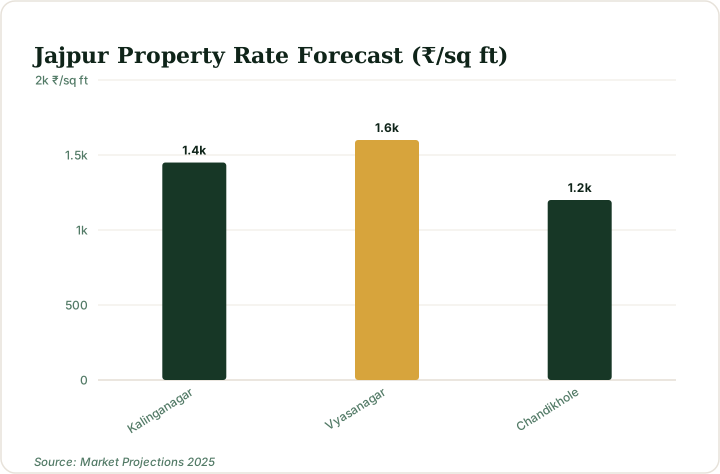
Jajpur Property Rate Forecast 2025
The industrial expansion driven by the steel sector in Kalinganagar and the logistical growth in Chandikhole are pushing land valuations to unprecedented levels. Sellers are capitalizing on this urgency. Buyers are rushing to lock in deals before the 2025 benchmark valuation revisions by the Inspector General of Registration (IGR) Odisha (IGR Odisha (Inspector General of Registration)).
| Location | 2024 Average (₹/sq ft) | 2025 Projected (₹/sq ft) | Key Driver |
|---|---|---|---|
| Kalinganagar | 1,100 | 1,450 | Steel hub expansion |
| Vyasanagar | 1,300 | 1,600 | Commercial infrastructure |
| Chandikhole | 950 | 1,200 | Highway corridor growth |
| Panikoili | 800 | 1,050 | Transport node demand |
These rising valuations create a dangerous incentive. Sellers take large agricultural tracts, draw boundary walls, and market them as premium residential plots. They charge the ₹1,450 per square foot residential rate for land that the government values at a fraction of that cost because it is legally meant for farming (IGR Odisha fee schedule).
The Section 8A Agricultural Trap
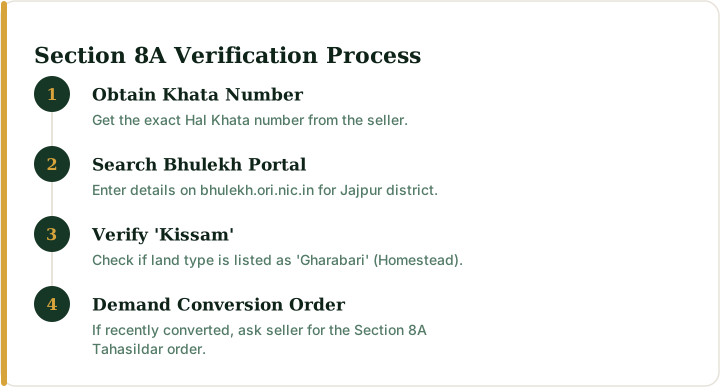
What is Land Conversion in Odisha? Land conversion is the legal process under Section 8A of the Odisha Land Reforms Act, 1960, where the Tahasildar officially changes the land use category from agricultural to homestead (Gharabari), allowing residential construction and commercial use. Without an explicit order under Section 8A of the Odisha Land Reforms Act, 1960, agricultural land cannot be used for residential purposes. I have seen families sink their life savings into a plot, only to have their building plan rejected by the local planning authority. The seller disappears with the money, and the buyer is left holding a piece of farmland they cannot develop.
The Financial Damage Goes Beyond The Purchase Price
The financial damage goes beyond the purchase price. If you buy unconverted land at residential rates, you are also paying inflated stamp duty. Later, if you attempt to convert it yourself, you will face hefty conversion fees based on the latest benchmark valuation, plus potential penalties for unauthorized plotting. This is exactly how the ₹42 lakh trap springs shut on unsuspecting investors.
Kalinganagar Industrial Corridor Pressures
The pressure to acquire land near the Kalinganagar Industrial Complex is intense. Corporate executives, NRIs, and local investors are all competing for a limited supply of clear-title plots. This competition blinds buyers to the fundamental requirement of title verification. They assume that because a plot has a boundary wall and an electricity pole nearby, it is legally cleared for housing. Under Section 17 of the Registration Act, 1908, any sale of immovable property exceeding ₹100 must be registered. The Sub-Registrar's office will register the sale deed based on the documents presented. They do not visit the site to check if the land is actually a farm or a housing society. The burden of due diligence falls entirely on you, the buyer. Furthermore, Section 54 of the Transfer of Property Act, 1882, defines a sale as a transfer of ownership in exchange for a price paid. But if the seller transfers an agricultural title when you paid for a residential title, you have purchased a defective asset. The legal remedy for this takes years in civil court.
Sabik vs Hal Khata Mismatches
One of the most common issues we find in Jajpur land records is the discrepancy between historical and current records. The land administration in Odisha relies on settlement records. The older record is the Sabik khata, and the current computerized record is the Hal khata. During the transition from manual Sabik records to digital Hal records on the Bhulekh portal, data entry errors occurred. Sometimes, the land classification did not update correctly. A plot that was legally converted years ago might still show as agricultural on the portal, or worse, a plot that was never converted might be falsely marketed using forged Sabik documents.
To verify this, you must demand the Record of Rights (Parcha) from the seller and cross-reference the Khata number and Plot number directly on the official government portal. Look specifically at the 'Kissam' (land type). If it says 'Sarad', 'Taila', or 'Biali', it is agricultural. If it says 'Gharabari', it is homestead.
Form 25 Encumbrance Certificate Checks
Before Finalizing Any Property Rate Negotiation In Jajpur You
Before finalizing any property rate negotiation in Jajpur, you must secure an Encumbrance Certificate (EC). Issued under Form 25 of the Indian Stamp Rules, the EC is the definitive record of all registered transactions on a specific plot over a given period. Many sellers in Vyasanagar and Kalinganagar will offer you an EC that is only a few months old. This is a massive red flag. A proper title search requires a minimum 15-year EC, and ideally a 30-year EC. You need to trace the chain of ownership back to the original settlement record to ensure no previous owner took a bank loan against the property and defaulted, leaving an active mortgage on the land you are about to buy. We frequently uncover cases where a seller partitioned a joint family property without the legal consent of all coparceners. They register a sale deed for their portion, but the other family members later file a civil suit challenging the partition. If you buy that land, you become a party to that lawsuit.
What the Jajpur Tahasildar Requires
After you register the sale deed, you must apply for mutation to update the land records in your name. This process is governed by the Odisha Survey and Settlement Rules. The Jajpur Tahasildar will scrutinize your application strictly. 1. Submit Form 6 for mutation via the online portal. 2. Provide the registered Sale Deed copy. 3. Submit the up-to-date rent receipt (Khajana) paid by the previous owner. 4. Provide the Encumbrance Certificate covering the last 15 years. 5. Attach the RoR (Record of Rights) showing the seller's name. 6. Provide an affidavit stating the land is free from ceiling surplus limits under the OLR Act. If the Tahasildar finds that you purchased a fragmented agricultural plot without proper conversion, they can reject your mutation process application. You will hold a registered sale deed, but the government records will still show the previous owner. This makes it impossible for you to secure a home loan or resell the property later.
Securing Your Jajpur Land Investment
The projected 2025 property rates in Jajpur represent a significant financial commitment. Do not let the fear of missing out push you into skipping critical legal checks. The ₹42 lakh Kalinganagar trap is entirely avoidable if you follow the evidence. Always verify the land classification under Section 8A of the OLR Act. Always demand a 30-year Encumbrance Certificate. And never accept a seller's verbal assurance that the land is ready for construction. The only truth is what is written in the Tahasildar's register and the Sub-Registrar's archives. Protect your capital by verifying every single document before you transfer the advance payment.
Navigating ORERA Mandates in Vyasanagar and Kalinganagar
As property rates in Jajpur climb toward the ₹42 lakh mark for premium plots, developers are rushing to launch new gated layouts across Vyasanagar and the Kalinganagar industrial corridor. However, many of these new plotted developments bypass the Odisha Real Estate Regulatory Authority (ORERA). Under Section 3 of the Real Estate (Regulation and Development) Act, any commercial or residential project exceeding 500 square meters or containing more than eight units must be registered with ORERA before a single plot is advertised.
Buying into an unregistered layout in Jajpur exposes you to severe risks, including the lack of basic infrastructure like drainage and electricity, which the local Vyasanagar Planning Authority (VPA) will refuse to sanction. To ensure your investment is legally sound, demand the following from the developer:
- ORERA Registration Certificate: Must be valid and explicitly list the Jajpur project site.
- Approved Layout Plan: Stamped by the local planning authority (such as the VPA or the District Town Planning Unit).
- Quarterly Progress Reports: Available on the ORERA portal showing the developer's adherence to promised timelines.
- Designated Bank Account: Proof that 70% of buyer funds are parked in a separate escrow account as mandated by law.
If a developer violates these rules, Section 59 of the Act imposes penalties of up to 10% of the estimated project cost, which can indefinitely stall the development.
Takeaway: Never pay a booking amount for a Jajpur plot without first verifying the project's unique ORERA registration number on the official Odisha RERA website.
Calculating Hidden Registration Costs and Benchmark Valuations
A common financial misstep for buyers eyeing Jajpur real estate in 2025 is failing to budget for statutory registration expenses. When you negotiate a ₹42 lakh purchase price, the actual out-of-pocket cost will be significantly higher due to Odisha’s stamp duty and registration fee structures. Furthermore, the Inspector General of Registration (IGR) Odisha updates the Benchmark Valuation (BMV) periodically. If your agreed purchase price is lower than the government-fixed BMV for that specific Mouza in Jajpur, you must pay taxes based on the higher BMV, or face scrutiny under Section 47A of the Indian Stamp Act for undervaluation.
For a property valued at exactly ₹42,00,000, the statutory costs break down as follows:
- Stamp Duty (Male Owner): 5% of the property value (₹2,10,000).
- Stamp Duty (Female Owner): Odisha offers a concession for women, reducing this to 4% (₹1,68,000).
- Registration Fee: A flat 2% of the property value across the state (₹84,000).
- User Charges and E-stamping Fees: Minor administrative fees payable to the Stock Holding Corporation of India Ltd (SHCIL) for generating the e-stamp certificate.
Remember that once the e-stamp paper is generated, the final sale deed must be presented before the Sub-Registrar within 30 days. Delaying this process will render the stamp paper invalid, forcing you to forfeit the paid amount and restart the payment cycle.
Takeaway: Always check the current Benchmark Valuation for your specific Jajpur Mouza on the IGR Odisha portal before finalizing your budget, and consider registering the property in a female family member's name to save 1% on stamp duty.