
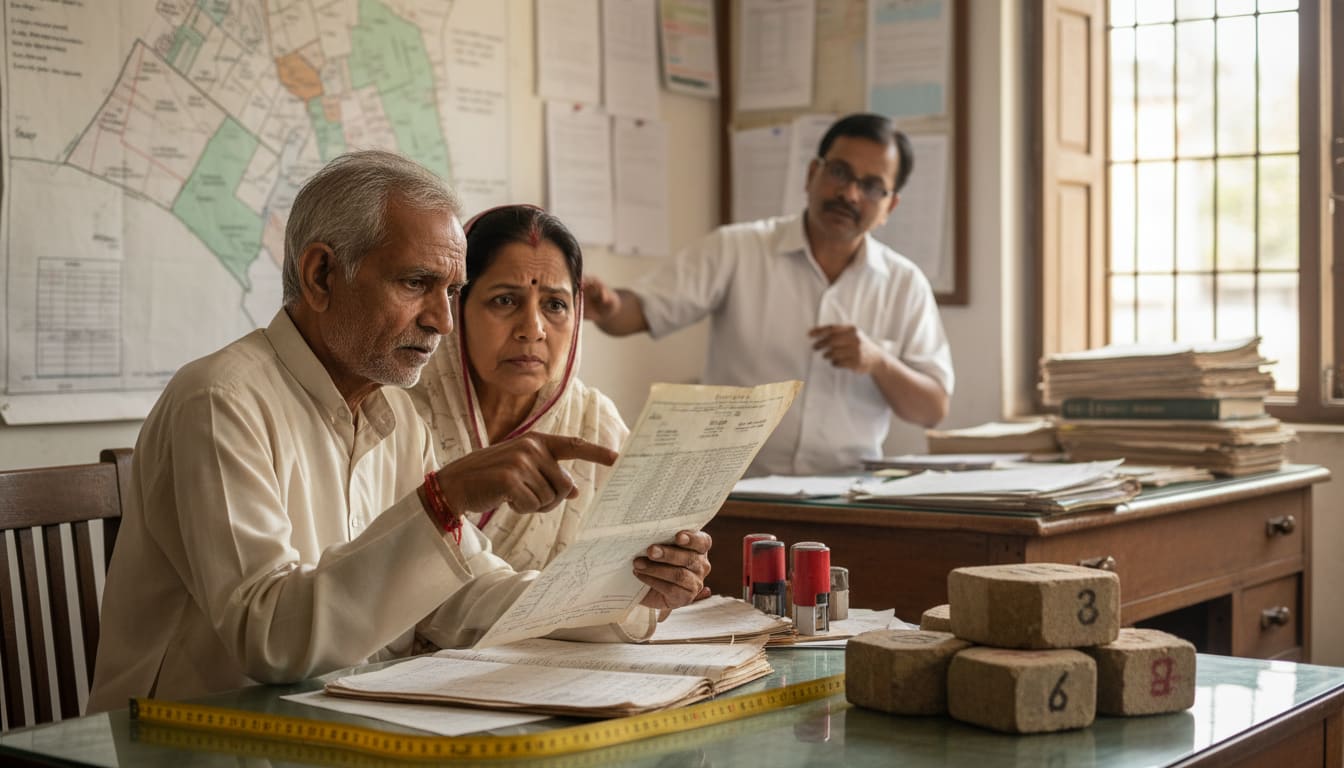
A completely clean Encumbrance Certificate proves absolutely nothing about true ownership if the root document is a forgery. Here is what I tell every client who walks into my office with a stack of property papers. You can pull 30 years of transaction history, pay the highest stamp duty, and register your deed perfectly, but if the underlying Khatian is fabricated, you have purchased zero legal rights to that land. Last quarter, an out-of-state investor looking at a commercial plot near the Mahabodhi Temple in Gaya learned this the hard way. They lost ₹74,00,000 because they trusted a stamped document without verifying its historical origin.
The solution is simpler than you think, provided you know exactly which Bihar government portals to check and which revenue terms to look for. We are going to examine the exact mechanics of Khatian forgery in Bihar, how the historical survey systems are weaponised against modern buyers, and the precise steps you can take to secure your investment in 2026.
The Anatomy of a Gaya Khatian Fraud
Let me share something that could save you lakhs. The ₹74,00,000 Bodhgaya case did not involve a crude, poorly photoshopped document. The fraudster presented a genuine-looking, physically aged paper document complete with faded revenue stamps and illegible signatures from a bygone era. The buyer, eager to secure prime real estate in a booming tourism corridor, assumed the document was an authentic Revisional Settlement (RS) Khatian.
In reality, the seller had taken a genuine but entirely outdated Cadastral Settlement (CS) Khatian from the 1911 survey, altered the Khata (account) and Khesra (plot) numbers, and presented it as current proof of ownership. The buyer's local broker pulled an Encumbrance Certificate for the last 15 years, which came back completely clean. Why? Because the fraudster had never transacted on this specific plot before. The clean certificate gave the buyer a false sense of security. They executed the sale deed, paid the ₹74,00,000 consideration, and only discovered the fraud six months later when their application for Dakhil Kharij (mutation) was summarily rejected by the Circle Officer.
The true owner, whose name was correctly recorded in the modern Jamabandi Panji (Register-II), had been paying the Lagaan (land tax) every year. The buyer was left holding a highly expensive, legally worthless piece of paper.
This specific pattern of exploiting historical record confusion is rampant across Bihar. Fraudsters know that buyers rarely understand the difference between survey eras, and they use that knowledge gap to orchestrate devastating financial traps.
What is a Khatian and Why Does it Get Forged?
What is the Khatian?
The Khatian, often referred to as the Record of Rights, is the foundational legal document prepared during a state land survey that details the rights of the Raiyat (landholder) over a specific parcel of land. It contains the Khata (account number), Khesra (plot number), Mauja (village name), and the total area of the holding.
To understand why this document is the primary target for forgery, we must look at how land records evolved in Bihar. The state has undergone multiple comprehensive land surveys. The first major exercise was the Cadastral Survey, conducted roughly between 1905 and 1915 depending on the district. This resulted in the CS Khatian. Decades later, the government initiated the Revisional Survey to update these records, resulting in the RS Khatian.
In many parts of Bihar, including vast stretches of Gaya, the transition from CS to RS records was fraught with clerical errors, disputed boundaries, and incomplete digitisation. A fraudster will often locate a plot where the RS Khatian is disputed or where the digital Bihar Bhumi entry is incomplete. They then fabricate a document that bridges the gap between the old 1911 records and the modern day, creating a phantom chain of title. Because the physical archives in many Anchal (Block) offices are fragile, cross-referencing a physical document against the original register requires significant effort, an effort most buyers skip.
Understanding this historical context is your first line of defence. Whenever you are handed a Khatian, your immediate question must be whether it represents the Cadastral Survey, the Revisional Survey, or a subsequent Chakbandi (consolidation) effort.
Three Signs Your Bihar Khatian is Fake
I have helped hundreds of families with exactly this problem, and the forged documents almost always share the same critical flaws. Here are the three most common signs that the Khatian you are holding is a fabrication.
- The Jamabandi Panji Disconnect
The most glaring red flag is a Khatian that does not correspond to an active Jamabandi (Register-II) entry. The Jamabandi is the ongoing, living ledger of land ownership maintained by the Halka Karamchari (revenue clerk) and overseen by the Circle Officer. If a seller shows you a Khatian claiming ownership, but their name, or their direct ancestor's name, is absent from the Jamabandi Panji, walk away immediately. A Khatian without a corresponding Jamabandi means the state does not recognise the seller's current right to pay Lagaan (tax) on that land.
- Mismatched Khata and Khesra Volumes
Every authentic Khatian is bound in specific volumes corresponding to the Mauja and the Thana number. Fraudsters often copy Khata and Khesra numbers from adjacent villages. When you cross-reference the Thana number on the document with the official Bihar Revenue Department directory, the numbers will conflict. For example, a document might list a Khesra number of 4500, but the official survey for that specific Mauja only goes up to 3200.
- The Phantom Lagaan Rasid
Fraudsters know that buyers will ask for tax receipts. To bypass this, they forge the Lagaan Rasid (rent receipt). However, modern Bihar land taxes are paid online. If the seller provides a handwritten receipt dated 2024, or an online printout where the transaction ID cannot be verified on the official portal, the underlying Khatian is almost certainly fake. The state stopped issuing purely manual receipts for most standard holdings years ago.
The 12-Year Encumbrance Search Gap in Gaya
Before we assume that a Sub-Registrar check solves everything, let us understand the limitations of the Encumbrance Certificate (EC). The EC is a vital document, but it is frequently misunderstood.
Section 17 of the Registration Act, 1908 mandates the registration of non-testamentary instruments transferring immovable property valued at one hundred rupees and upwards. When you apply for an EC, the Sub-Registrar's office searches their indices to see if any registered transactions, such as sale deeds, mortgages, or lease agreements, have occurred on that specific property over the requested period. The standard search period in Bihar is 12 years.
Fraudsters exploit this system by targeting dormant properties. They find a plot owned by an absentee landlord, an NRI, or a family embroiled in a multi-generational civil dispute. They forge the Khatian and simply wait. Because the true owner has not transacted on the property, a 12-year EC search will return a "Nil Encumbrance" result. The buyer sees the clean EC, assumes the title is clear, and proceeds with the purchase. The Sub-Registrar registers the new sale deed because their mandate under the Registration Act is to register documents, not to verify the historical authenticity of the seller's title. The trap snaps shut the moment the buyer attempts Dakhil Kharij and the Circle Officer identifies the forged root document.
How to Verify Apna Khata Online in 2026
The Bihar government has made significant strides in digitising land records. You can verify the core details of any Khatian from your smartphone. Here is the exact process you should follow before handing over a single rupee of advance payment.
First, navigate to the official Bihar Bhumi portal. Do not use third-party aggregator apps, as their databases are often months out of date. Click on the "Apna Khata Dekhen" (View Your Account) section. You will be presented with a digital map of Bihar. Select the district, in our case, Gaya. Next, select the specific Anchal (Block) where the land is situated.
You will then need to select the Mauja (village). The portal allows you to search by several parameters: Mauja name, Khata number, or the name of the recorded Raiyat. Enter the Khata number provided on the seller's document.
If the portal returns a "No Record Found" error, do not panic immediately, but treat it as a severe warning. Sometimes, genuine records are missing due to digitisation backlogs. In such cases, the seller must apply through the Parimarjan portal to have the digital record corrected. In 2026, the official processing timeline for a Parimarjan application is 40 days. Do not proceed with the purchase until the seller has successfully updated the digital record and you can verify the Khata and Khesra numbers online yourself.
The Sub-Registrar Cross-Check Method
Online verification is necessary, but it is not sufficient. You must cross-check the digital record against the registered deed history. This is where we look at the Kewala (registered sale deed) via the Bhumijankari portal.
Section 54 of the Transfer of Property Act, 1882 defines a sale as a transfer of ownership in exchange for a price paid or promised. For that transfer to be legally binding, the seller must actually possess the ownership they are attempting to transfer.
Log into the Bhumijankari portal and navigate to the advanced search section. Enter the party names, the Mauja, and the registration year if known. Your goal is to trace the chain of title backward. If the seller claims they bought the land in 2015, pull that specific Kewala. Does the Khata and Khesra on the 2015 Kewala match the Khata and Khesra on the Khatian they are presenting today? Fraudsters often buy a small, cheap parcel of land legally, then use that genuine Kewala to try and sell a much larger, adjacent parcel by altering the Khesra numbers on the supporting documents.
If there is any discrepancy between the Khatian, the Jamabandi Panji, and the registered Kewala, you are looking at a broken chain of title. A broken chain means litigation, and litigation in Bihar revenue courts can span decades.
Legal Remedies Under the Bihar Tenancy Act
If you find yourself caught in a dispute over a forged Khatian, it is crucial to understand the governing law. The Bihar Tenancy Act, 1885 is the cornerstone of land rights in the state.
Section 21 of the Bihar Tenancy Act, 1885 deals with the rights of settled Raiyats. A person who has continuously held land as a Raiyat in a village for a period of twelve years becomes a settled Raiyat of that village, acquiring occupancy rights. Fraudsters often attempt to claim occupancy rights based on forged Lagaan receipts, arguing that they have been cultivating the land continuously.
When a forged Khatian is discovered, the true owner must file a title suit in the civil court for a declaration of title and cancellation of the fraudulent deed. Simultaneously, an application must be moved before the Circle Officer to halt any pending mutation proceedings. If the fraudster has already managed to secure mutation based on the fake Khatian, an appeal must be filed before the Deputy Collector Land Reforms (DCLR) for the cancellation of that fraudulent Jamabandi. This is a gruelling process. The legal fees, the stress, and the time lost far outweigh the cost of conducting rigorous due diligence upfront.
Your Next Steps Before Paying an Advance
Do not let the complexity of Bihar's land records rush you into a bad decision. Brokers will often push for a quick ₹5,000 or ₹10,000 token advance to "lock in" the plot. Refuse. Until you have verified the following documents, the plot is not safe to buy.
| Verification Step | Target Document | Authority / Portal | Expected Timeline | Expected Cost |
|---|---|---|---|---|
| 1. Online Record Check | Apna Khata & Jamabandi | Bihar Bhumi Portal | Immediate | Free |
| 2. Encumbrance Search | 12-Year EC (Form 25) | Sub-Registrar / Bhumijankari | 3 to 5 Days | ₹25 (1st yr) + ₹10/yr |
| 3. Deed Verification | Previous Kewala | Bhumijankari Portal | Immediate | Free (Online view) |
| 4. Tax Verification | Current Lagaan Rasid | Bihar Bhumi (Lagaan section) | Immediate | Free |
If the seller cannot produce a current online Lagaan Rasid matching the Jamabandi Panji, or if the Khata numbers on the Khatian do not perfectly align with the digital records on Bihar Bhumi, halt the transaction. The ₹74 Lakh loss in Bodhgaya happened because the buyer trusted the paper in front of them instead of verifying the administrative reality behind it. Protect your capital, demand the right documents, and cross-check every single number.
Authoritative sources: Bihar Bhumi · India Code - central statutes incl. the Registration Act, 1908
Related guide: how to spot property fraud in India