

What do you do when a broker quotes a price per square foot for a Balasore plot, but the official government benchmark value is half that amount, and the seller insists on a cash difference? The Balasore land market in 2026 is a minefield of pricing illusions. A family can lose its money in a local transaction by trusting an online listing portal instead of verifying the government revenue record. The gap between what is advertised online and what the Sub-Registrar accepts is causing massive legal headaches for buyers (IGR Odisha (Inspector General of Registration)). Before we panic, let's understand what is actually happening with Balasore land prices right now, and how we can secure your hard-earned money using the official verification tools available to us.
The Balasore Price Illusion in 2026
If you have been searching for property recently, you have likely noticed that Balasore land prices in 2024 and 2025 show an incredibly wide spread. The publicly visible listing market is much higher than the lower starting rates shown by some portals. Different pages on the same listing site can show very different averages and starting prices for Balasore. This inconsistency is dangerous. Public listings in Balasore show the kind of spread that buyers absolutely must test against official value data. These portal prices are not official. They are marketing numbers designed to generate leads. When buyers anchor their expectations to these online listings, they lose their negotiating power. Worse, they skip the critical step of checking the official state records. For 2026, the Odisha government registration valuation check is the key current price reference, not generic online listing rates. If you negotiate based purely on a MagicBricks average, you might end up overpaying by lakhs, or you might walk into a trap where the land is priced suspiciously low because it has a hidden legal defect.
Why Cheap Plots Can Hide Expensive Legal Problems
The most important fraud pattern in Odisha land deals today is the mismatch between the land being shown physically and the land recorded in the revenue system. This commonly happens when the seller shows one beautiful, road-facing plot physically but drafts the deed for a completely different plot number located near a swamp or without access (Bhulekh Odisha portal). A price that looks exceptionally cheap compared with the benchmark can signal massive under-reporting, disputed access, or a complete location mismatch. Another common Odisha fraud pattern is the sale of land that is not cleanly transferable because the seller's name or share is not fully reflected in the revenue records. Buyers should never rely on oral family claims like "my brother will sign later" or "the mutation is pending but we own it." If the record details do not match the seller and all co-sharers perfectly, treat it as a high-risk transaction and do not proceed to registration. The consequence is severe. If the plot identity and seller title are not checked together, you can end up paying for land that is impossible to register, impossible to resell, or exposed to a title challenge in court years later.
The IGR Benchmark Valuation Verification Step
What is the Benchmark Valuation?
The Benchmark Valuation is the official minimum rate set by the Odisha government for land registration in a specific mauza. It determines the minimum stamp duty and registration fees payable (IGR Odisha fee schedule). Registering a property below this value triggers legal penalties and deed impounding. For buyer verification in Odisha, the official reference point is the IGR Odisha Benchmark Valuation page, which includes Balasore in the district selector. That is the government source you should use to check the circle or benchmark value before paying any token money or executing the deed. Here is a quick comparison of how pricing scenarios play out at the Sub-Registrar office:
| Price Scenario | Registration Outcome | Buyer Risk Level |
|---|---|---|
| Below Benchmark | Deed impounded for undervaluation | High (Legal notices, fines) |
| Exactly at Benchmark | Smooth registration process | Low (Standard procedure) |
| Far Above Benchmark | Higher stamp duty paid | Medium (Overpaying for unverified premium claims) |
If the rate is far below the benchmark, the buyer will face downstream problems during registration because the deed value can be challenged as unrealistic. If the rate is far above the benchmark, you must insist on a written explanation tied to a specific Balasore location, frontage, road width, or development feature. Otherwise, the seller may be pricing in unverifiable claims. Always use the benchmark valuation check first, then compare it with the seller's quoted rate.
A Road Access Dispute
Consider a plot that the seller had marketed as a premium residential space with a 20-foot approach road. The price was significantly higher than the local benchmark, but the buyer was willing to pay the premium for immediate road access. The buyer had already paid an advance. The records on the Bhulekh Odisha portal told a completely different story. The land classification was still listed as agricultural (Sarad). More importantly, the cadastral map (Bhunaksha) showed absolutely no government-approved approach road touching the plot. The "20-foot road" the seller showed on site was actually a private dirt path belonging to a neighbor, who could block access at any time. Because the land was agricultural, it required a formal conversion under Section 8-A of the Odisha Land Reforms Act, 1960. The seller had hidden this fact to justify the price tag. The buyer then had to issue a legal notice to recover the advance. This entire nightmare could have been avoided if the buyer had checked the land classification and map before transferring the token money. A third fraud pattern is exactly this misrepresentation of road access or converted status. In Balasore, plots are frequently marketed as residential even when the revenue record or ground reality does not support that claim.
Three Red Flags in Balasore Revenue Records
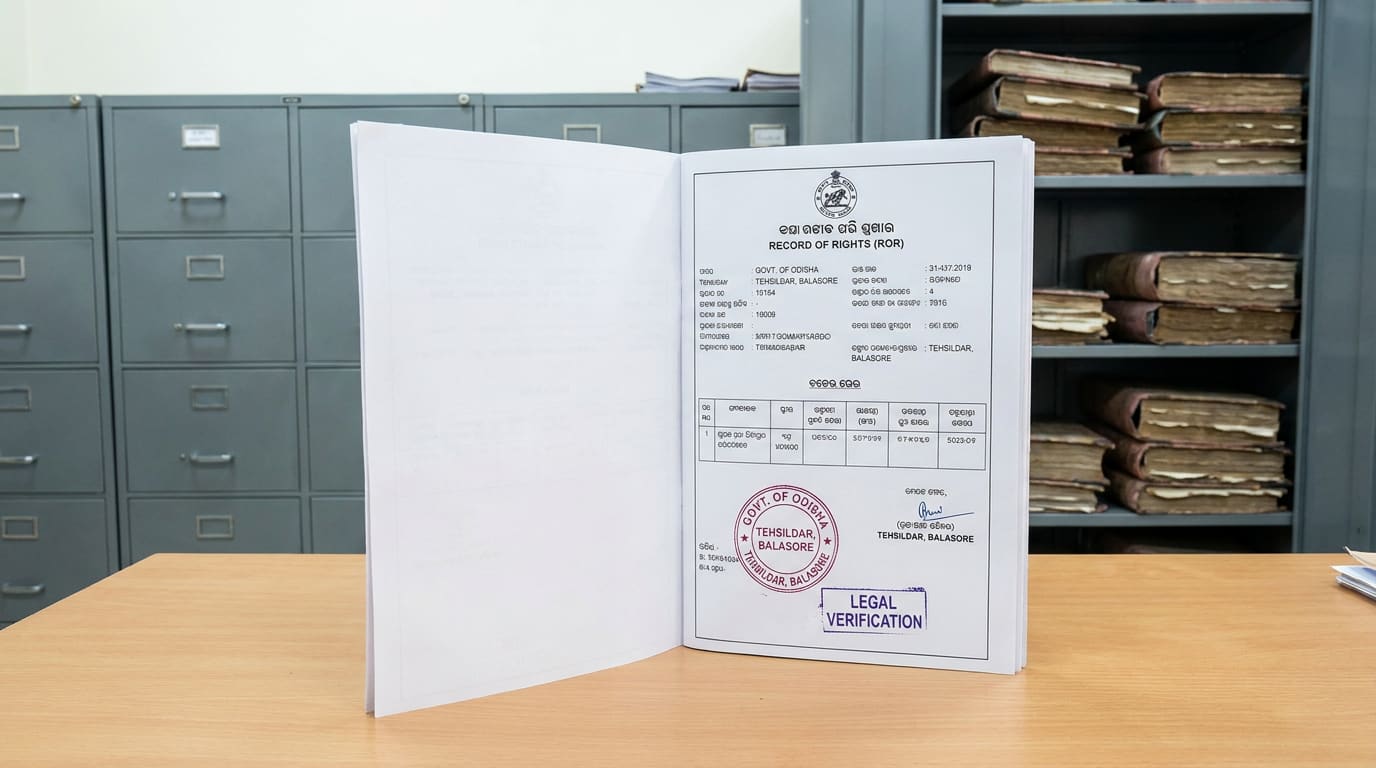
When you are reviewing a property in Balasore, the revenue record is your single source of truth. The official Odisha land record portal is bhulekh.ori.nic.in, and the revenue department site is revenue.odisha.gov.in. Here are the three massive red flags we look for during an advocate review. First, we look for a Sabik versus Hal record mismatch. The Sabik (old) and Hal (current) settlement records must align. If the seller claims ownership based on an old Sabik khata but the Hal record shows the land belongs to the government or a different family branch, the title is defective. You cannot buy land based on outdated settlement records. Second, we look for unrecorded co-sharers. A common issue in Balasore is inherited family land where the mutation process was never completed. The seller might be one brother, but the record shows the deceased father's name. Until a legal heir certificate is processed and all heirs sign the deed, you cannot get a clean title. Third, we check the encumbrance certificate for mortgage entries. Many sellers take loans against their property and attempt to sell without clearing the bank charge. If you see an active mortgage entry in Form 25, the bank has the first right to the property, not you.
Step by Step 2026 Buyer Verification Sequence
The solution is simpler than you think. A safe, Odisha-specific buyer verification sequence relies on matching the physical reality with the digital government records. Here is the exact workflow you should follow for any Balasore property. 1. Check the Balasore benchmark valuation on the IGR Odisha portal before starting any negotiation. Know the floor price. 2. Request the seller's document set, including the latest RoR (Record of Rights) and previous sale deeds. 3. Match the village, khata number, and plot details on Bhulekh Odisha against the seller's documents. 4. Pull a fresh Encumbrance Certificate for the last 30 years to check for hidden loans or prior sales. 5. Inspect the site physically with a local Amin (surveyor) to ensure the plot boundaries and access match the revenue map. 6. Proceed to draft the sale deed registration only after the deed description exactly matches the record and the negotiated price is explainable against the benchmark. Current Odisha verification workflow demands that you confirm the record of rights and plot identity first, then proceed to deed execution only after both match the seller's story perfectly.
Section 47A Undervaluation and Registration Blocks
Many buyers try to save on the 5 percent stamp duty by declaring a property value lower than the actual purchase price. In 2026, this is a terrible strategy. Under Section 47A of the Indian Stamp Act, 1899, if the Sub-Registrar believes the property is undervalued compared to the official benchmark, they have the authority to impound the sale deed. Once a deed is impounded under Section 47A, it is sent to the District Sub-Registrar or Collector for valuation assessment. Your registration is frozen. You will not get your original documents back until you pay the deficit stamp duty plus a hefty penalty. This process can drag on for months, leaving your ownership in a dangerous legal limbo. Furthermore, Section 17 of the Registration Act, 1908 makes the registration of immovable property compulsory. An unregistered sale deed has no evidentiary value in an Odisha court. If you try to execute an agreement on a ₹100 stamp paper to avoid registration fees, you do not legally own the land. The seller can turn around and sell the exact same plot to someone else the next day, and the law will recognize the registered buyer, not you.
Finalizing Your Balasore Sale Deed Safely
We have covered a lot of ground, but the core message remains straightforward: never trust a price tag or a physical boundary without verifying the government record. The official Odisha valuation and record portals are specifically designed to reduce your risk. As Balasore continues to grow in 2026, the property market will only become more complex. You will see more online listings with inflated prices, and more brokers pushing for quick cash advances. Take a breath, pull the benchmark valuation, read the Bhulekh entry, and match every single digit before you sign. Protecting your family's investment requires patience and a strict adherence to the legal verification steps. Do not let the pressure of a "hot deal" force you into a lifetime of court battles.