


A missed Dakhil Kharij can cost you the plot. Picture this: 3 AM. A knock on the door. The police are there with a court order. The plot you bought in Bihta last year? It belongs to someone else. The paperwork looked clean. Too clean. You paid the stamp duty. You received the registered Kewala. You thought you owned the land.
Here is what they do not want you to know. Registration does not prove ownership in Bihar. It only proves a transaction took place. If the seller did not actually own the land, your registered deed is legally worthless. First-time buyers pour their life savings into Patna's booming peripheries. They trust the broker. They trust the shiny stamp paper. They fail to check the underlying revenue records.
These losses come from three specific, predictable mistakes. Each one is preventable with a check on the Bihar Bhumi portal.
A Double-Sale Example
Consider an example. A buyer found a prime residential plot. The seller produced a pristine registered Kewala. The buyer took the documents to a local broker. The broker glanced at the deed, nodded, and gave the green light. The buyer paid the seller via bank transfer. He registered the new sale deed under Section 17 of the Registration Act, 1908.
Two months later, the buyer applied for Dakhil Kharij. The application was summarily rejected by the Circle Officer.
The documents told a different story. The seller had indeed bought the land years earlier. But he later sold it to someone else. That second buyer immediately updated the Jamabandi Panji. The seller then used his original Kewala to sell the exact same land again, to this buyer. Because the buyer never checked the current Jamabandi, he bought a ghost plot. He lost everything he had paid in a single afternoon.

Trusting Kewala Over Jamabandi
This is the single biggest mistake first-time buyers make in Patna. They believe a registered sale deed is the ultimate proof of title. It is not.
Under Section 54 of the Transfer of Property Act, 1882, a sale is a transfer of ownership in exchange for a price. But if the transferor has no valid title, no ownership transfers to you. The Sub-Registrar's job is to collect stamp duty and record the document. They do not verify if the seller actually owns the land today.
The true test of ownership in Bihar is the Jamabandi Panji, also known as Register-II. This is the government's live ledger of who currently holds the rights to the land and pays the Lagaan. If the seller's name is not in the Jamabandi, they cannot legally sell the land. Period.
Before you sign any agreement, you must pull the seller's details from the Bihar Bhumi portal. You need the specific Khata number and Khesra number. Match the name on the portal exactly with the name on the seller's Aadhaar card. A mismatch of even a single initial is a massive red flag.
Skipping the Encumbrance Certificate
Another common trap involves hidden mortgages. A seller holds a valid Jamabandi. They own the land. But they have secretly pledged the original Kewala to a cooperative bank for a heavy loan.
The buyer checks the Jamabandi. It looks clean. They buy the land. Six months later, the bank auctions the plot to recover the seller's unpaid debt.
You prevent this by pulling an Encumbrance Certificate. The EC is a public record maintained by the Registration Department. It lists every registered transaction, mortgage, or lease on a specific plot over a set period. In Bihar, you can search this online via the Bhumijankari portal.
Do not settle for a standard 12-year check. For high-value plots in Patna, insist on a 30-year EC. It costs slightly more in search fees, but it uncovers old disputes, family partitions, and dormant court attachments that a 12-year search misses. If the seller hesitates to provide the previous owner's details for the Chain of Title search, walk away immediately.
Confusing CS and RS Khatian
Bihar's land records are based on historical surveys. The Cadastral Survey occurred roughly a century ago, producing the CS Khatian. Decades later, the Revisional Survey produced the RS Khatian.
Fraudsters exploit the gap between these two records. They find a plot where the CS Khatian shows one family, but the RS Khatian shows another due to an unrecorded sale in the 1960s. The fraudster tracks down the descendants of the original CS Khatian holder. They buy the land cheaply using the obsolete CS record, then attempt to sell it to an unsuspecting IT professional in Patna.
When you check the Apna Khata section on Bihar Bhumi, you must verify which survey record is currently active for that specific Mauja. If the seller's claim relies on a CS Khatian but the local revenue office operates on the RS Khatian, the title is defective. The Circle Officer will reject your mutation.
The Bhu-Naksha Boundary Mismatch
Picture a buyer with perfect paperwork. The Jamabandi was correct. The EC was clean. The Kewala was flawless. But when they went to build their boundary wall, the neighbors called the police.
The mistake? They never matched the Khesra number to the physical Bhu-Naksha.
A Khesra is a specific parcel of land on the revenue map. Fraudsters will show you a beautiful, flat plot next to a main road. But the Khesra number on the deed actually corresponds to a waterlogged ditch two kilometers away.
You must download the official Bhu-Naksha from the Bihar land records portal. Hire a licensed Amin to physically measure the land. The Amin will use the government map to confirm that the physical boundaries on the ground exactly match the Khesra number written in your draft agreement. Never trust a private builder's brochure map.
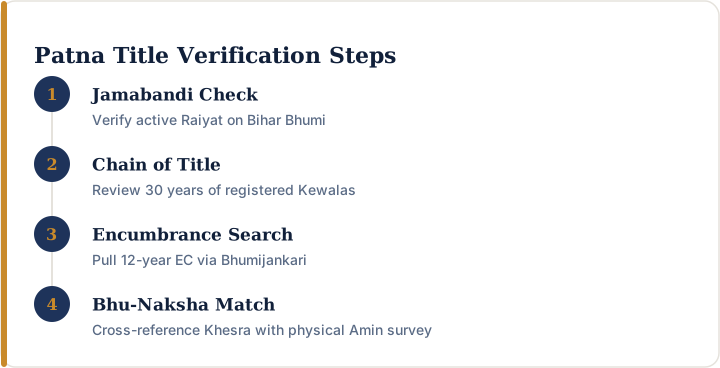
The 4-Point Patna Verification Framework
Do not rely on luck. Rely on a systematic process. Here is the exact framework investigators use to tear apart a suspicious land deal in Bihar.
- Verify the Seller's Jamabandi. Go to Bihar Bhumi. Enter the Mauja and Khata. The seller must appear as the current active Raiyat.
- Trace the Chain of Title. Demand the previous three registered Kewalas. Ensure the transfer sequence is unbroken for at least 30 years.
- Pull the Encumbrance Certificate. Use Bhumijankari to run a minimum 12-year search against the specific Khesra. Look for active mortgages.
- Map the Bhu-Naksha. Cross-reference the revenue map with a physical survey by a certified Amin.
If a property fails even one of these four checks, the title is toxic.
Fixing Errors via Parimarjan
Sometimes, the seller is honest, but the government records are wrong. During the digitization of Bihar's land records, many typographical errors occurred. A name was misspelled. A Khata number was swapped.
If you buy land with a digitized error, your Dakhil Kharij will fail. You will be stuck in bureaucratic limbo.
The solution is the Parimarjan portal. This is Bihar's official online system for rectifying errors in digitized Jamabandi records. Before you pay the advance, force the seller to file a Parimarjan application to fix their records. Do not register the sale deed until the Parimarjan portal shows the corrected, flawless record.
The True Cost of Negligence
First-time buyers skip verification to save a few thousand rupees on legal fees. This is a catastrophic miscalculation. Skipping it is not saving money. It is playing Russian roulette with your life savings.
Your Next Move Before Signing
The Patna real estate market moves fast. Brokers will pressure you. They will say there are three other buyers waiting with cash. Let them buy it. Never let artificial urgency force you to skip the Jamabandi check.
Gather the seller's Kewala, the Khata number, and the Khesra number. Pull the records from Bihar Bhumi yourself. If the documents look overly complex, or if the chain of title involves an unregistered family partition, stop. You are stepping into a minefield.
Authoritative sources: Bihar Bhumi · India Code - central statutes incl. the Registration Act, 1908
Related guide: how to spot property fraud in India
Ignoring Scheduled Area Restrictions on Tribal Land
Another catastrophic mistake buyers make when purchasing plots on the rapidly expanding outskirts of cities is failing to verify the original caste status of the landholders. Across eastern states, strict laws protect indigenous populations from land alienation. In Odisha, this is governed by the strict but necessary Odisha Scheduled Areas Transfer of Immovable Property (By Scheduled Tribes) Regulation, 1956 (OSATIP).
If you purchase land from a person belonging to a Scheduled Tribe in notified districts such as Mayurbhanj, Sundargarh, or Koraput without prior explicit permission from the Sub-Collector or District Magistrate, the transaction is legally void ab initio (invalid from the very beginning).
Under Section 3 of the OSATIP Regulation, the consequences of bypassing this law are severe:
- Immediate Eviction: The state will forcefully eject you from the property without any compensation for the structures you have built.
- Total Financial Loss: The money paid to the seller is forfeited, as illegal contracts cannot be enforced in court to recover funds.
- Statutory Penalties: You may face additional fines and potential rigorous imprisonment for unlawful occupation.
- No Adverse Possession: You cannot claim ownership just because you have lived on the restricted land uncontested for over 12 years.
Concrete Takeaway: Before finalizing any land deal in a scheduled or peri-urban area, demand the seller’s caste certificate alongside the RoR. If the chain of title reveals a Scheduled Tribe owner at any point, hire a specialized local advocate to secure the mandatory Sub-Collector clearance before transferring a single rupee.