

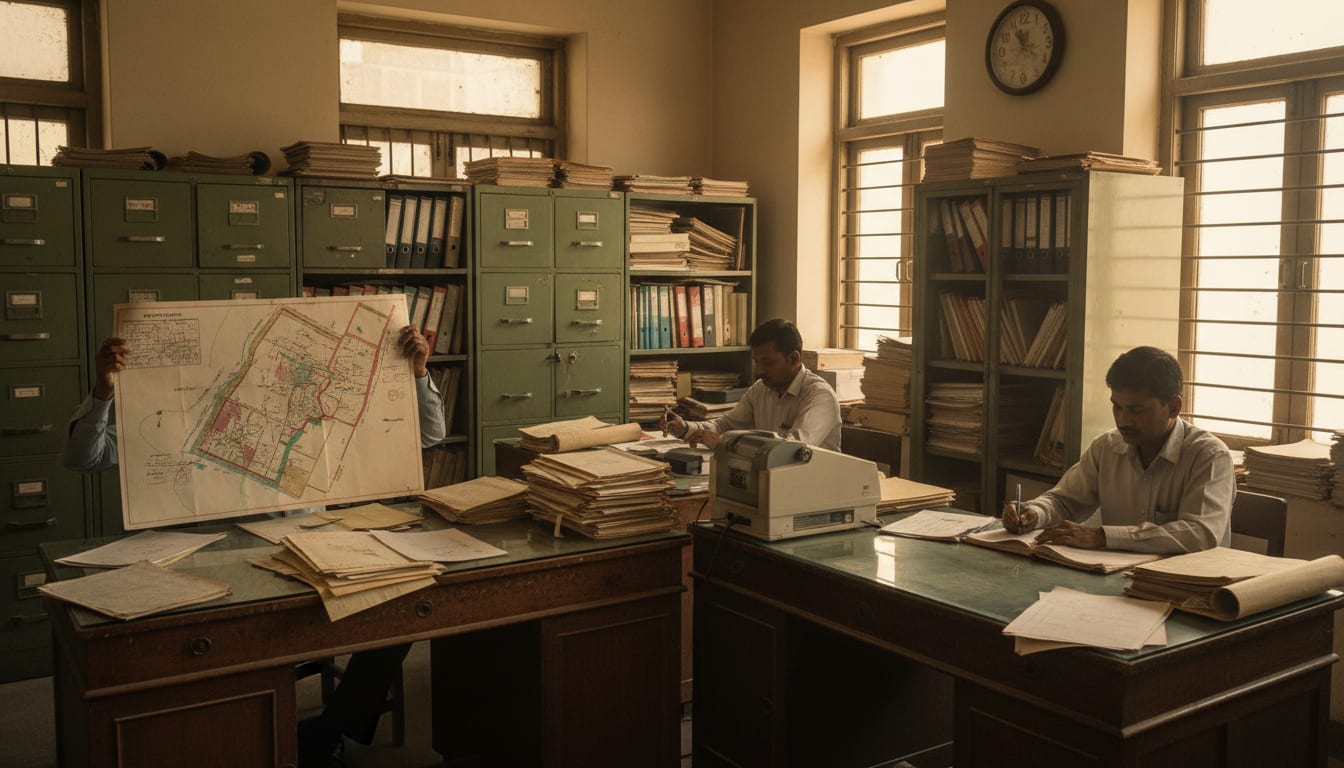
Read this Khatiyan and tell me which plot the seller actually owns. Most readers get it wrong.
Picture this: 3 AM in Sasaram. A knock on the door wakes a retired school teacher. The police are outside. The plot he bought for his daughter's wedding is the subject of a massive civil dispute. He holds a pristine copy of the Revisional Survey Khatian showing his seller's grandfather as the absolute owner. The paperwork looked clean. Too clean.
The weapon of choice was not a forged signature or a fake stamp paper. It was the truth, weaponised. The scammers used genuine, government-issued Khatians to sell land they no longer owned.
Here is what they do not want you to know. A Khatian is a historical snapshot. It is not a modern title deed. When you buy a plot in Bihar based solely on a Khatian, you are walking straight into a financial slaughterhouse. The Sasaram example shows exactly why you must dig deeper.
What is a Khatian in Bihar?
The Khatian, often called the Apna Khata in Bihar, is the foundational land record prepared during the state's settlement surveys. It details the Raiyat (cultivator or owner), the Khata (account) number, the Khesra (plot) number, the Mauja (village), and the nature of the land under the Bihar Tenancy Act, 1885.
Bihar relies on two primary surveys. The Cadastral Survey (CS Khatian) was conducted between 1888 and 1920. The Revisional Survey (RS Khatian) updated these records between 1950 and 1980.
When a seller hands you an RS Khatian, they are showing you who owned the land fifty years ago. They are not showing you who owns it today. The trail often goes cold right after the survey ink dried. Until you check the subsequent transactions, you are buying a ghost.
The Sasaram Title Verification Mistake
Let us break down the exact mechanism of the Sasaram fraud. The seller approached the retired teacher with a verified RS Khatian. The document clearly listed the seller's grandfather as the sole owner of a prime residential plot.
The buyer did what most people consider due diligence. He logged into the Bihar Bhumi portal. He pulled the Apna Khata record. The online database perfectly matched the physical paper. The grandfather was listed. The seller produced a valid death certificate for the grandfather and a family tree showing he was the sole legal heir.
The teacher paid in a mix of bank transfers and cash. He registered the deed.
Three weeks later, construction began. Two days after that, a local businessman arrived with a police escort and a court injunction. The businessman did not have a Khatian. He had something much more powerful. He had a Kewala.
The risk is real. Verify before you sign.
The grandfather had indeed owned the land during the Revisional Survey. But the grandfather had sold the land to the businessman's father years earlier. The Khatian never updated. It never does.
Why Khatian Does Not Equal Title
This is the most dangerous misconception in Bihar property law. A Khatian is a record of possession and revenue assessment. It is not a document of title.
Section 54 of the Transfer of Property Act, 1882 clearly defines a sale. It requires a registered instrument for any immovable property valued over ₹100. Ownership transfers through the registered deed, not through the revenue survey.
The Supreme Court of India and the Patna High Court have repeatedly ruled that revenue records do not confer title. They only reflect who is liable to pay the Lagaan (land revenue). If a seller claims absolute ownership based strictly on a Khatian, they are either deeply ignorant or actively scamming you.
When the grandfather sold the plot, the title legally passed to the buyer. The fact that the Revisional Survey Khatian remained unchanged did not invalidate the sale. It simply created a trap for the next unsuspecting buyer.
The Jamabandi Panji Disconnect
If the Khatian does not update, how do you track ownership? You track it through the Jamabandi Panji, also known as Register-II.
When a legal sale occurs, the buyer must apply for Dakhil Kharij (mutation). This process removes the seller's name from the revenue records and adds the buyer's name. But here is the critical detail: mutation updates the Jamabandi, not the original Khatian.
In the Sasaram example, the earlier buyer successfully completed their mutation. Their name was entered into Register-II. They had been paying the Lagaan and collecting the Rasid (receipt) for years.
The retired teacher never checked the Jamabandi. He stopped his investigation at the Khatian. He looked at the historical snapshot and ignored the live revenue ledger. That single omission cost him his life savings.
Want to see what investigators see? Look here.
Checking the Jamabandi is non-negotiable. You must match the Khata and Khesra numbers from the Khatian against the current Jamabandi Panji on the Bihar Bhumi portal. If the names do not match, the chain of title is broken.
How the Kewala Erases the Khatian
The ultimate authority in land ownership is the registered sale deed, locally known as the Kewala. Section 17 of the Registration Act, 1908 makes the registration of sale deeds mandatory.
A valid Kewala entirely supersedes an older Khatian. Even if the Khatian lists a specific family, a subsequent Kewala executed by that family transfers the rights completely.
Scammers exploit this hierarchy. They know that rural buyers and first-time investors place immense emotional weight on the Khatian. They present the yellowed survey document as undeniable proof of heritage. Meanwhile, they hide the Kewala that stripped them of those rights decades ago.
The only way to defeat this tactic is to search the registration archives. You must trace the Kewala history at the Sub-Registrar's office. You cannot rely on the seller to volunteer this information.
Three Steps to Verify Ownership Beyond Khatian
Do not become the next Sasaram statistic. A verified Khatian is only step one. To establish true ownership in Bihar in 2026, you must execute a strict three-point verification framework.
- Cross-Reference the Jamabandi Panji
Take the Khesra number from the Khatian and search the Jamabandi Panji on the Bihar Bhumi portal. The current Jamabandi holder is the legally recognised possessor. If the seller's name is not in Register-II, walk away immediately.
- Pull a 12-Year Encumbrance Certificate
An encumbrance certificate (EC) issued under Form 25 proves whether the property has been sold, mortgaged, or gifted. Apply through the Bhumijankari portal. Always pull at least 12 years of history. If the land value is high, push the search back to 30 years.
- Verify the Kewala Chain
Demand the original registered deeds from the seller. Every link in the chain from the Khatian to the present day must be documented. If the property was inherited, demand the registered partition deed. Check the deed numbers against the Sub-Registrar's records on Bhumijankari.
The Land Possession Certificate Loophole
Many buyers think a Land Possession Certificate (LPC) solves the Khatian problem. It does not.
The LPC is issued by the Circle Officer (CO) to certify that a person is in physical possession of the land and is paying revenue. It is primarily used for securing agricultural loans or bail bonds.
While an LPC is a strong indicator of possession, it is still a revenue document, not a title deed. A corrupt Karamchari can issue an LPC based on a forged Khatian, bypassing the Jamabandi entirely. A buyer who trusts the CO's seal loses the money when the true owner produces the registered Kewala.
Never accept an LPC as absolute proof of ownership. It is merely a supporting document. It must align perfectly with the Jamabandi, the EC, and the registered Kewala.
The Financial Cost of Khatian-Only Verification
The math is brutal. Skipping the deep verification process saves you a few hundred rupees but exposes you to total financial ruin.
| Verification Step | Financial Risk if Skipped |
|---|---|
| 12-Year Encumbrance Certificate | 100% loss of property value |
| Certified Copy of Kewala | Title dispute litigation costs |
| Jamabandi Online Check | Rejection of mutation application |
| Bhu-Naksha Boundary Verification | Boundary encroachment lawsuits |
The retired teacher in Sasaram saved a few hundred rupees by not pulling the EC and the Kewala. He lost his life savings.
Securing Your Bihar Plot Before 2026 Ends
The Bihar government is actively digitising records. The Parimarjan portal is attempting to clean up discrepancies between the Khatian and the Jamabandi. But the system is still riddled with historical gaps.
A Khatian is the beginning of your investigation, never the end. It tells you who owned the land during the survey. It is your job to find out who owns it today.
The documents tell a story. You just have to know which ones to read. Do not trust the paper they hand you. Trust the registry.
The next victim could be you. Or not. Your choice.
Authoritative sources: India Code - central statutes incl. the Registration Act, 1908
Related guide: how to spot property fraud in India