


Picture this: 3 AM. A knock on the door. A retired buyer opened his gate to find the local police. He had just spent his savings on a retirement plot. The documents told a different story. The man who sold him the land did not own it. The real owner was standing right behind the police officers. He watched his entire life savings vanish in an instant. The paperwork looked clean. Too clean. If you are buying land in Bihar in 2026, you are walking into a minefield. You need to know exactly how to check property ownership records online in Bihar. A single missed step will cost you everything. Before you hand over a single rupee, you must follow a strict title verification checklist.
What Went Wrong
The buyer did what most buyers do. He asked for the land documents. The seller handed over a pristine Jamabandi Panji printout. He went online to the Bihar Bhumi portal. He entered the Khata number and the Khesra number. The portal showed the exact same details. The seller's name was right there on the screen. The Lagaan receipt was paid up. He thought he was perfectly safe. He wrote the cheque.
But who was really behind this? The seller was merely a tenant who had manipulated the local revenue office. Under Section 21 of the Bihar Tenancy Act, 1885, occupancy raiyats hold certain rights. They pay the tax. Their names appear in the revenue records. But they do not hold the absolute title to sell the land. The real owner held the original Kewala. The buyer only checked the revenue record. He never checked the registry record. He walked right into a trap.
What is the Apna Khata?
The Apna Khata or Khatian is the primary land record document in Bihar detailing the rights of a landholder. Maintained on the Bihar Bhumi portal, it lists the Khata account number, the Khesra plot number, the Mauja village code, and the specific area of land owned by a Raiyat.
This document is your starting point. It is never your finish line. Relying solely on the Apna Khata is a serious mistake property buyers make in Bihar today. The revenue department updates these records during surveys, like the Cadastral Survey or Revisional Survey. But a lot happens between surveys. Properties are sold. Families divide land. The Apna Khata often lags behind reality by decades.
The Fatal Flaw in Revenue Records
Here is what they do not want you to know. A Jamabandi entry does not prove ownership. The Supreme Court of India has ruled repeatedly that revenue records are only for tax collection purposes. They do not confer title.
In 2026, fraudsters are actively exploiting this gap. They bribe local clerks to mutate the land in their name. Once their name appears on the Bihar Bhumi portal, they quickly sell the land to an unsuspecting buyer. The buyer checks the portal, sees the name, and assumes the title is clear. This is a fatal assumption. You must look past the portal. You must look at the legal chain of custody.
Section 17 and the Kewala Chain
The Sub-Registrar records are where the truth lives. According to Section 17 of the Registration Act, 1908, any sale of immovable property worth more than ₹100 must be registered. If a sale deed is not registered, it has no legal value.
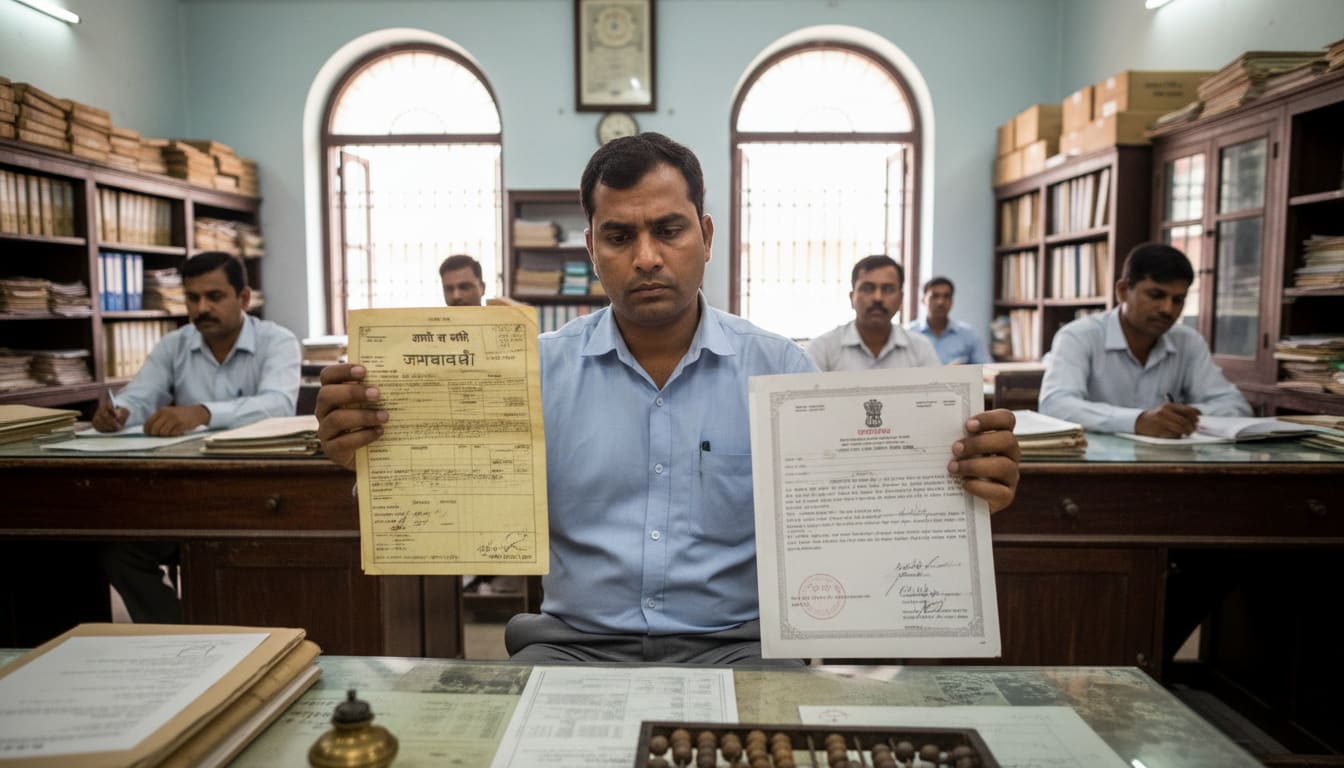
In Bihar, the registered sale deed is called the Kewala. To verify true ownership, you must trace the Kewala chain. You must visit the Bhumijankari portal. This is the official portal of the Registration Department of Bihar. You need to search for the property using the party name or the exact property details. You are looking for the encumbrance certificate meaning and the history of transactions. If the person selling you the land cannot show a registered Kewala in their name, or a clear registered chain of inheritance, walk away.
Decoding the 'Data Nahi Hai' Message
Many buyers try to do the right thing. They log into the Bihar Bhumi portal. They select their district, their Anchal, and their Mauja. They enter the 14-digit Jamabandi number. Then a red error message flashes across the screen. Data Nahi Hai. No record found.
This Bihar Bhumi server error is not always a glitch. Sometimes, it is a deliberate obfuscation. When records were digitized, many entries were corrupted or left incomplete. Fraudsters target these exact plots. They know buyers cannot verify the history online. If you see this error, you cannot proceed with the purchase. You must demand that the seller use the new Parimarjan Plus portal to correct the digitized Jamabandi before you sign any agreement.
2026 Bihar Land Verification Table
Do not skip these steps. You need a structured approach to survive the current market.
| Verification Step | Portal / Office |
|---|---|
| Apna Khata Check | Bihar Bhumi Portal |
| Encumbrance Search | Bhumijankari Portal |
| Certified EC Copy | Sub-Registrar Office |
| Physical Mutation | Circle Officer |
This table represents your baseline defense. Every single step must align. If the Apna Khata says one name, but the Encumbrance Certificate shows a different recent transaction, the deal is dead.
Section 54 and the Absolute Title
Three families. One plot. Zero survivors of the financial ruin. This happens when buyers ignore the fundamental law of property transfer. Section 54 of the Transfer of Property Act, 1882, defines a sale as a transfer of ownership in exchange for a price paid.
This transfer only becomes absolute upon registration. An unregistered agreement to sell is just a piece of paper. A Land Possession Certificate is just a snapshot of physical control. Neither gives you the legal right to the land. You must verify that the seller holds the absolute title under Section 54. You must read the fake property documents warning signs. Look at the stamp duty paid. In 2026, the registration fee in Bihar remains strict. If the previous deed shows anomalies in stamp duty valuation, the title is defective.
The Final Defense Line
You cannot trust a photocopy. You cannot trust a portal screenshot. You cannot trust a local broker who promises that the mutation will be handled later. Under the Bihar Land Mutation Act, 2011, a mutation application must be processed within a strict deadline. If a seller has owned the land for years but cannot produce a mutation order, they are hiding something.
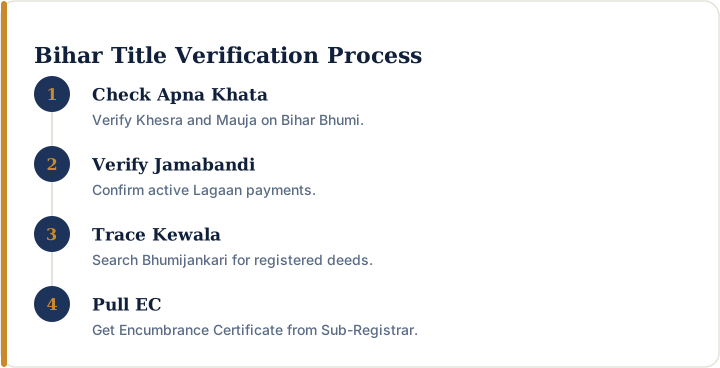
Verify the Khatian. Cross-check the Jamabandi. Pull the Encumbrance Certificate from the Sub-Registrar. Trace the Kewala back at least thirty years. This is the only way to check property ownership records online in Bihar safely. Anything less is a gamble with your life savings.
Authoritative sources: India Code - central statutes incl. the Registration Act, 1908
Related guide: online land title verification in India
Scheduled Area Restrictions: Section 22
A major blind spot for buyers in Eastern India is the strict regulation surrounding tribal land. Buyers evaluating properties in Odisha must strictly navigate Section 22 of the Odisha Land Reforms (OLR) Act, 1960. If a broker tries to sell you land in a Scheduled Area without explicitly detailing these restrictions, walk away immediately. In heavily regulated districts like Mayurbhanj, Sundargarh, and Koraput, any transfer of land from a person belonging to a Scheduled Tribe to a non-tribal person is entirely void without prior written permission from the Revenue Officer.
If you are evaluating a property with a tribal ownership history, you must demand the following documentation:
- Official Permission Order: A certified copy of the Revenue Officer’s explicit approval for the transfer under Section 22 of the OLR Act.
- Caste Certificate of the Seller: To verify their exact demographic classification against the historical land records.
- Gram Sabha Resolution: In certain scheduled areas, local village council approval is a mandatory prerequisite for land alienation.
- Historical Title Deeds: Proof that the land was not illegally alienated from a tribal owner at any point in the past thirty years.
Brokers often claim that a "General Power of Attorney" (GPA) can bypass these tribal land restrictions. This is legally false.
Concrete Takeaway: Never execute a sale agreement for land in a Scheduled Area without first independently verifying the Revenue Officer's written alienation permission.