

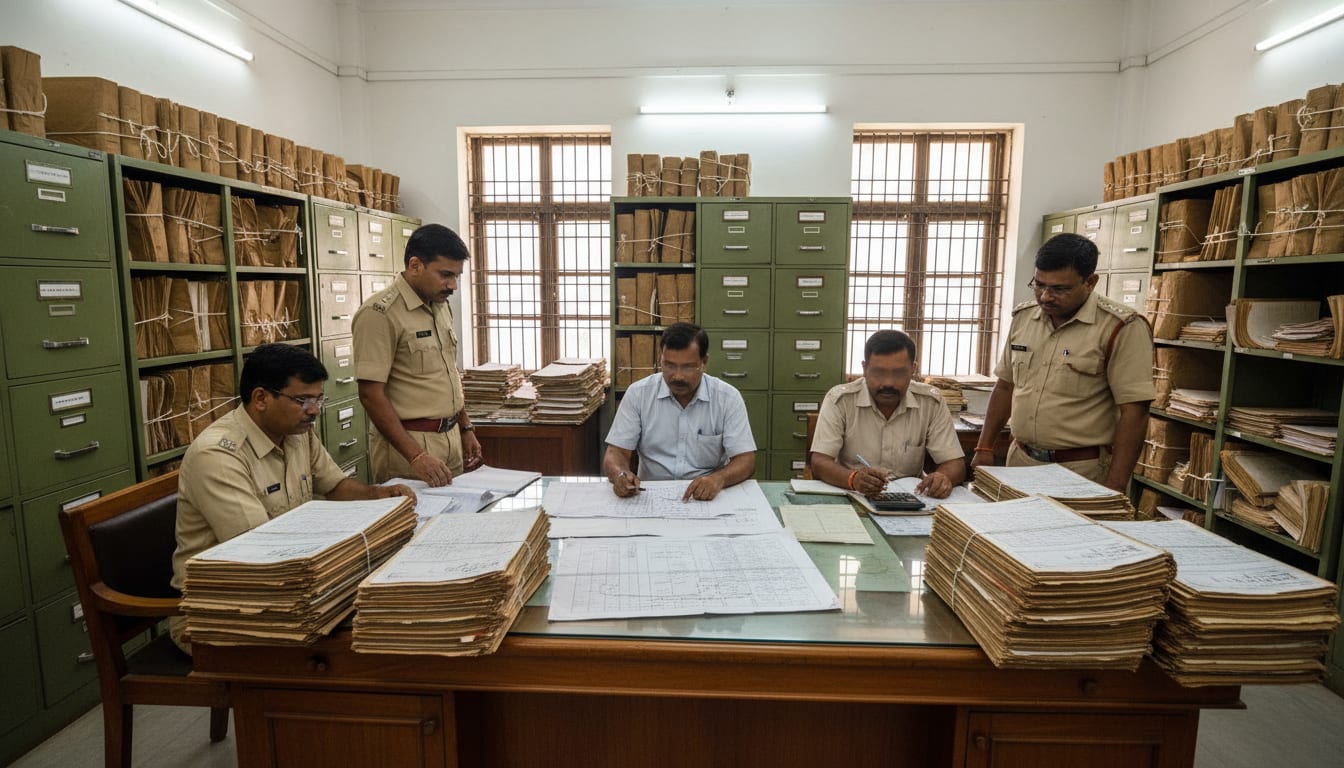
Picture this: 3 AM. A knock on the door. A family in Patna wakes up to find local police and a bank recovery agent standing on their porch. They are handed an eviction notice for a property they bought just six months ago. The paperwork looked clean. Too clean. They had checked the online portals. They had downloaded the receipts. They thought they could save a few thousand rupees by skipping a formal legal review.
Buyers assume digitization means safety. They assume a green checkmark on a government website equals a clear title.
Here is what they do not want you to know. The gap between an online digital record and a legally defensible title is massive. That gap is where the fraudsters operate. That gap is exactly why you cannot afford to skip professional document verification.
The Patna Mutation Case
Let us break down exactly how the family lost their money. The buyer found a prime residential plot. The seller handed over a thick file of documents. The buyer did what most educated people do today. They went online.
They logged into the Bihar Bhumi portal. They entered the Khata (account number) and the Khesra (plot number) for the specific Mauja (village). The portal returned a hit. The Jamabandi Panji (Register II) showed the seller's name. The Lagaan (rent receipt) was paid up to date. Everything matched.
So, the buyer paid the advance. They registered the deed. They applied for Dakhil Kharij (mutation). Then the bank showed up.
The seller had taken a commercial loan against that exact Khesra years earlier. How did the online portal miss this? Because mortgages are not always updated in the revenue records immediately. The Jamabandi Panji only tracks who pays the land tax. It does not track who holds a lien against the property. The buyer bought the land, and legally, they inherited the debt.
This is the reality of the modern real estate market. The digital tools are excellent for basic checks. They are completely inadequate for legal defense.
Why Bihar Bhumi Printouts Are Not Clear Title
What is the Khatian?
The Khatian (also known as Apna Khata) is the primary record of rights in Bihar. It details the Raiyat (tenant/owner), the Khata number, the Khesra number, and the area of the land. However, it is a revenue document used for tax collection, not a definitive proof of ownership under civil law.
Many buyers download their CS Khatian (Cadastral Survey from the early 1900s) or the RS Khatian (Revisional Survey from the 1970s) and assume they hold an ironclad title. They do not. The Supreme Court has repeatedly ruled that revenue records do not confer title.
If you are reading the NRI Land Investment Handbook, you will know that title flows from registered deeds, not just tax receipts. A lawyer knows how to trace the history of the land from the CS Khatian, through the RS Khatian, down to the current Jamabandi. If there is a break in that chain, or if the area in the RS Khatian is smaller than the CS Khatian, a lawyer flags it. A layman just sees a name on a screen and signs the cheque.
A careful review of these records looks for the invisible fractures. A missing inheritance partition. An unregistered family settlement. These do not show up on a simple portal search.

The Hidden Mortgage Loophole in Patna
The most dangerous document in Bihar real estate is the one you do not ask for. In this case, the buyer failed to pull an Encumbrance Certificate (EC) from the Sub-Registrar's office.
An EC is a record of all registered transactions on a property over a specific period. If the seller mortgaged the land, the bank registers that mortgage with the Sub-Registrar. This creates an encumbrance entry.
The official fee for an EC is small, and paying it could have spared the buyer the loss. But they did not know where to look. They thought the Lagaan receipt was enough.
A property lawyer does not make this mistake. Before they ever advise you to sign an agreement, they pull a 30-year EC via Bhumijankari. They cross-reference the EC against the Jamabandi Panji. If the EC shows a transaction that the Jamabandi does not, the deal stops. This is the core of Bihar title verification.
What Property Lawyers Actually Verify in Bihar
You are not paying a lawyer just to read documents. You are paying them for their paranoia. You are paying them to assume everyone is lying until the paperwork proves otherwise.
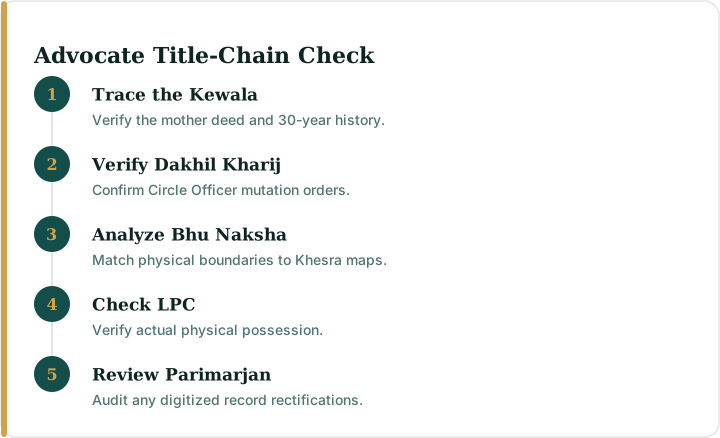
Here is the 5-point title-chain check a competent Patna advocate performs:
- Tracing the Kewala (Sale Deed): They do not just look at the current deed. They demand the mother deed. They trace the ownership back at least 30 years to ensure every transfer was legal.
- Verifying the Dakhil Kharij: They check the Dakhil Kharij online status and verify that the mutation order was actually passed by the Circle Officer (CO), not just applied for.
- Analyzing the Bhu Naksha: They pull the cadastral map. They ensure the physical boundaries on the ground match the Khesra boundaries on the government map. Fraudsters often sell plot A while showing the buyer plot B.
- Checking the LPC (Land Possession Certificate): They verify that the seller is in actual physical possession of the land, which is crucial for preventing subsequent disputes.
- Cross-checking the Parimarjan Portal: If there were errors in the digitized Jamabandi, they check if a rectification was legally processed through the Parimarjan system, or if it was manipulated.
This level of scrutiny is impossible for an untrained buyer. The terminology alone is a minefield. Understanding Khatian vs Jamabandi takes years of practice.
Section 17 Registration Act 1908 Explained
Let us talk about the law.
Section 17 of the Registration Act, 1908, mandates that any document transferring an interest in immovable property worth more than ₹100 must be registered. This is non-negotiable.
Fraudsters in rural Patna often rely on unregistered agreements on ₹1000 stamp paper. They call it a "Bainama" or an agreement to sell, and they convince the buyer that this is enough to take possession. It is not. Under Section 54 of the Transfer of Property Act, 1882, a contract for the sale of immovable property does not, of itself, create any interest in or charge on such property.
If you hand over cash based on an unregistered document, you have bought nothing. A lawyer will immediately reject an unregistered chain of title. They will force the seller to execute a proper, registered Kewala at the Sub-Registrar office.
Furthermore, lawyers understand the nuances of the Bihar Tenancy Act, 1885. They know how Section 21 protects occupancy Raiyats and how agricultural land cannot be arbitrarily converted for commercial use without the proper permissions from the District Magistrate.
The paperwork can look incredibly convincing. Fake stamps, forged signatures, cloned portal printouts. The truth is always buried in the registry.
The Real Cost of Skipping Legal Verification
Buyers often balk at the fee a senior property advocate charges for a comprehensive title search and drafting.
Compare that to the risk.
| Verification Method | Hidden Risks | Potential Financial Loss |
|---|---|---|
| DIY Portal Search | Missed mortgages, fake deeds, boundary disputes | 100% of property value |
| Unverified Broker | Conflict of interest, zero legal liability | 100% of property value |
| Verified Advocate | Minimal. Backed by legal liability and thorough SRO checks | ₹0 (Disaster averted) |
If you are buying a ₹50 Lakh plot, a ₹25,000 legal fee is exactly 0.5% of your investment. It is the cheapest insurance policy you will ever buy. When a Biharbhumi server error hides a critical record, the lawyer knows how to manually pull the Register II from the Circle Office. You do not.
How to Vet a Patna Property Advocate
Not all lawyers are created equal. You need a specialist. A criminal defense lawyer cannot verify a complex civil title chain.
When you sit down with an advocate in Patna, ask them these three questions:
First, ask them how they verify the RS Khatian against the current Jamabandi. If they say they just check the online portal, walk away. They must mention pulling the physical Volume and Page number from the registry.
Second, ask them about their process for securing an Encumbrance Certificate. They should insist on a minimum 15-year search, preferably 30 years, directly from the Sub-Registrar.
Third, ask them if they draft a custom indemnity clause in the Sale Deed. A standard template is dangerous. The deed must specifically state that the seller will indemnify the buyer against any future claims arising from undisclosed heirs or hidden mortgages.
The 2026 Patna Property Buyer Survival Guide
The real estate landscape in Bihar is evolving. The government is pushing for total digitization, but the transition is messy. Old records conflict with new records. Sabak (old) plots do not align with Hal (new) plots.
Do not become another statistic. Follow this survival guide:
- Never pay an advance without a 30-year EC.
- Never accept a portal printout as proof of ownership.
- Always hire an independent property advocate.
- Ensure your advocate checks the physical Bhu Naksha.
- Register every single agreement, no matter how small.
The trail often goes cold when buyers try to cut corners. The fraudsters count on your impatience. They count on your desire to save a few rupees on legal fees.
Do not give them the satisfaction. Verify everything. Trust no one. Secure your title with the full force of the law behind you.
The choice is yours. A small fee today, or a massive legal battle tomorrow. Make the right call.
Authoritative sources: India Code - central statutes incl. the Registration Act, 1908
Related guide: AI title verification vs an advocate search
Section 22: Scheduled Area Restrictions
Another critical layer of verification involves statutory restrictions on land transfers, specifically under the Odisha Land Reforms (OLR) Act, 1960. Buyers looking at cheaper land parcels in districts like Mayurbhanj, Sundargarh, or even rural pockets of Khordha often fall into the trap of purchasing restricted property without realizing the deed is legally void from day one.
Under Section 22 of the OLR Act, any transfer of immovable property by a person belonging to a Scheduled Tribe (ST) to a person not belonging to a Scheduled Tribe is strictly prohibited unless explicit, prior written permission is granted by the Revenue Officer (typically the Sub-Collector). Fraudsters will often use a General Power of Attorney (GPA) to bypass this restriction, which holds zero legal validity in a court of law.
If you are considering a plot where the original recorded tenant belongs to a restricted category, you must follow this exact protocol:
- Verify Tenant Status: Examine the caste column in the original Record of Rights (RoR) at the Tahasil office.
- File Form VIII: If the seller is ST and you are non-ST, the seller must submit Form VIII under the OLR Rules to the Sub-Collector.
- Clear the Objection Window: Wait out the mandatory 30-day public notice and objection period before any advance money changes hands.
Takeaway: A registered sale deed does not override the OLR Act. If you purchase Section 22 restricted land without the Sub-Collector’s formal written order, the state can confiscate the property and you will forfeit your entire investment.