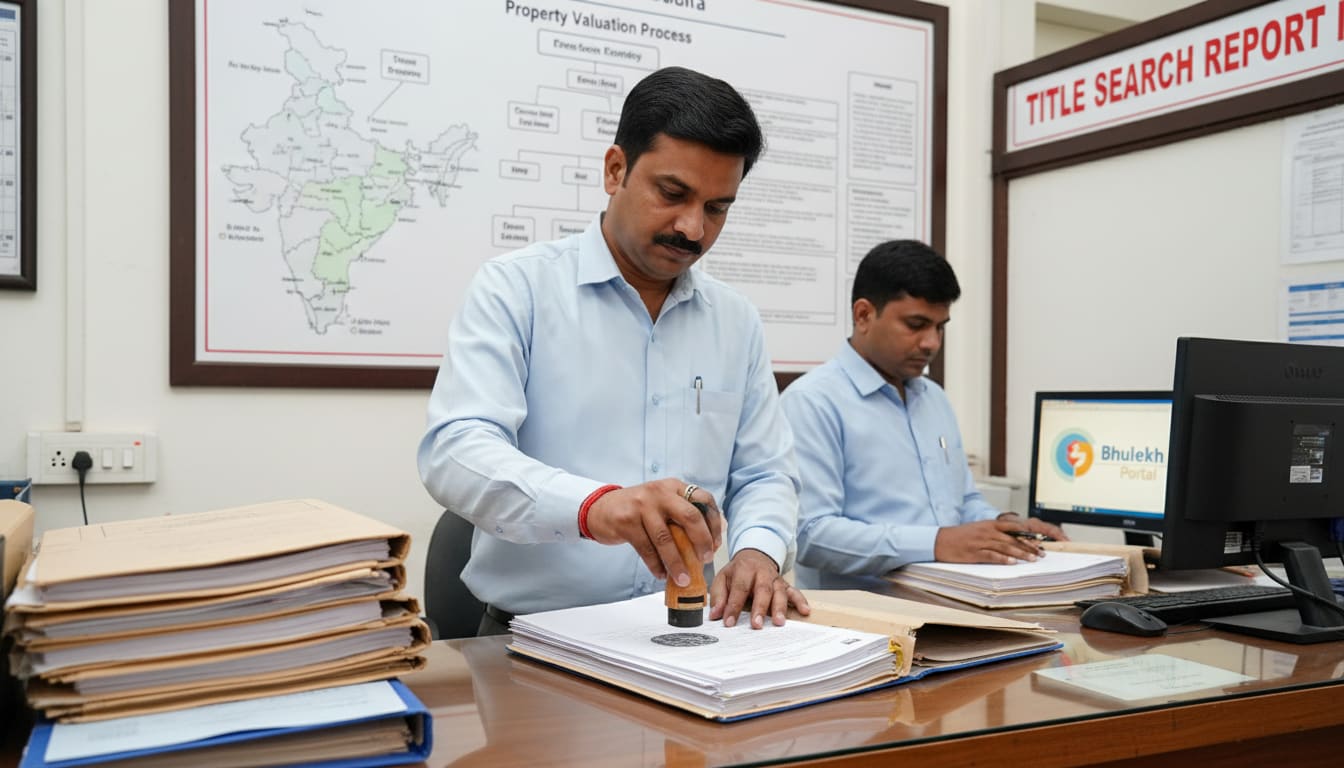
Picture this. 3 AM. A knock on the door. You open it to find a court bailiff holding a stay order. The ₹50 lakh plot you bought last year is now locked in a civil dispute. It never belonged to the seller. The papers looked clean. Too clean. I have seen this pattern before. When I dug into the records, the truth was worse. Three families claimed the same plot. Zero survivors financially.
Here is what they do not want you to know about buying property in India. You think the government guarantees your ownership. They do not. India operates on a system of presumptive title. Your registered sale deed is merely a record of a transaction. It is not absolute proof of ownership. To bridge that gap, you need a document that pieces together the fractured history of the land. You need a comprehensive investigation.
What is a Title Search Report?
A Title Search Report is a formal legal document prepared by an advocate that traces the historical ownership chain of a property. It verifies that the current seller holds absolute, marketable title and that the land is free from mortgages, disputes, or unrecorded encumbrances.
This report is your only shield against a broken system. When you commission a title search, an advocate examines decades of revenue records, registration logs, and municipal data. They do not just look at the latest deed. They look at every hand that touched the property over the last 30 years.
Without this report, you are flying blind. You might be paying for a property that the seller has already mortgaged to a bank. You might be buying agricultural land that was never legally converted for residential use. A proper title verification checklist forms the backbone of this report. It systematically uncovers the hidden liabilities that sellers try to bury.
The Presumptive Title Trap
The trap starts with a fundamental misunderstanding of Indian law. Most buyers believe that registering a document at the Sub-Registrar office makes them the undisputed owner. The law says otherwise.
Under Section 17 of the Registration Act 1908 text, registration is mandatory for property transactions. However, the Sub-Registrar only verifies that the stamp duty is paid and the parties are present. They do not verify if the seller actually owns the land. The registrar is a record keeper, not a title guarantor.
If a fraudster registers a sale deed for the Taj Mahal, the registration process will not stop them as long as the fees are paid. Section 54 of the Transfer of Property Act, 1882 requires a registered instrument for sales exceeding ₹100, but it assumes the seller has the right to sell. This legal vacuum is where buyers lose their life savings.
This is why a Title Search Report is non-negotiable. It does the job the government does not do. It proves the seller has the legal authority to execute that transfer.
Anatomy of the Title Report
A professional search report is not just a summary. It is a forensic breakdown of the property history. I always look for specific components when reviewing these files. If a report lacks any of these sections, it is incomplete.
| Component | What It Proves | Source Document |
|---|---|---|
| Ownership Flow | How the property moved from owner to owner | Sale Deeds, Gift Deeds, Wills |
| Revenue Status | Who the government recognizes for tax purposes | Record of Rights, Mutation, Khata |
| Liabilities | Existing loans, leases, or court attachments | Encumbrance Certificate |
| Land Use | Legal permission to build on the plot | Conversion Order, Approved Plan |
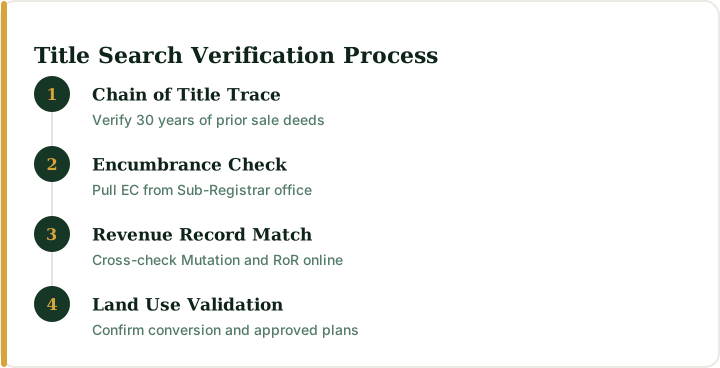
The investigator must trace the Chain of Title back to a root document. This is usually a government grant, a partition deed, or a sale deed that is at least 30 years old. Any break in this chain is a massive red flag.
Case Study: The Missing Link
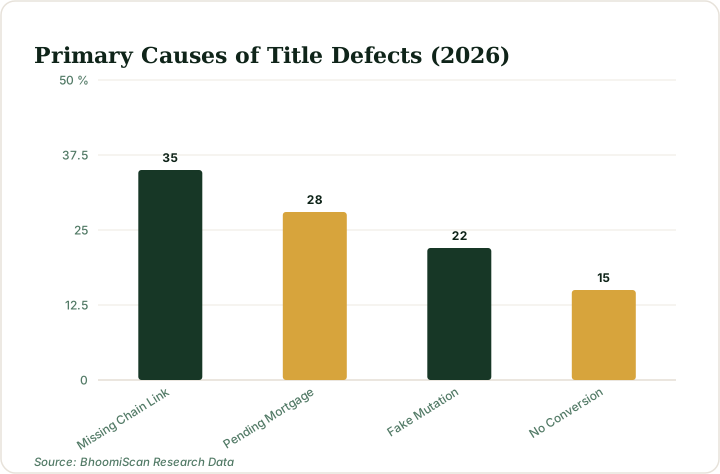
Let me tell you about a 2025 case I investigated. A buyer purchased a residential plot for ₹50 lakh. The seller provided a registered sale deed from 2022 and a clean Encumbrance Certificate for the last three years. The buyer thought they were safe.
The trail went cold. Until I pulled the records from 2010.
The seller in 2022 had bought the land from a man who claimed to have inherited it. But there was no legal heir certificate. There was no mutation record showing the inheritance. There was a 12-year gap in the ownership chain. The actual legal heirs of the original owner filed a civil suit in 2025. The court froze the property.
The buyer lost their ₹50 lakh advance. They are now stuck in a legal battle that could take two decades to resolve. A standard search report would have caught this missing link immediately. It would have flagged the absence of the mutation record and the missing inheritance proof.
How State Portals Hide Truth
Many buyers try to play lawyer. They log into their state land record portal, see the seller's name, and transfer the money. This is a fatal mistake.
India's land records are fragmented. While the DILRMP, Digital India Land Records Modernization Programme has digitized millions of records, the systems are not fully integrated. A name on a portal does not equal a clean title.
Take Karnataka's Bhoomi system and the RTC extract. Or Maharashtra's 7/12 extract. Or Odisha's Bhulekh portal. These are revenue records. They are maintained for collecting property taxes. They are not conclusive proof of ownership. If you want to understand how these maps and records interact, you need to know What is Bhu Naksha Odisha? Cadastral Map Guide for 2026 and similar state-specific mapping tools.
A fraudster can bribe a local official to alter the online mutation record. If you only check the online portal, you will walk right into the trap. The Title Search Report cross-references the online revenue record with the physical registration logs at the Sub-Registrar office.
The Encumbrance Verification Rule
One of the most critical parts of the report is the encumbrance check. An Encumbrance Certificate shows registered transactions and liabilities on the property.
Standard practice dictates a minimum 12-year search. This aligns with the Limitation Act, 1963, which gives a person 12 years to claim adverse possession. However, a meticulous investigator will always push for a 30-year search.
The forms differ by state. In many states, Form 25 is issued when encumbrances exist, and Form 26 is a nil encumbrance certificate. In others, it might be Form 15 or 16. The report decodes these forms. It ensures that an old mortgage from 1998 was actually released with a registered reconveyance deed.
Banks are obsessed with this step. If you want to know What Banks Check Before Land Loan in Odisha: 2026 Guide, the 30-year encumbrance history is at the top of their list. They will not risk their capital on a defective title.
Financial Stakes and Stamp Duty
When you buy a property, you are not just paying the seller. You are paying the state. The financial stakes of getting the title wrong are astronomical because transaction costs are sunk costs.
Consider the current rates. In many jurisdictions, stamp duty is a massive expense. For example, standard rates might be 5% for male buyers and 4% for female buyers, plus a 2% registration charge. On a ₹50 lakh property, a male buyer pays ₹2.5 lakh in stamp duty and ₹1.0 lakh in registration fees.
If the title is defective and you lose the property, the government does not refund your stamp duty. You lose the ₹50 lakh purchase price and the ₹3.5 lakh in taxes. Understanding local market dynamics, like Land Price Appreciation in Khordha: What Investors Must Know, is useless if you lose the asset entirely due to a title defect.
What to Do Next
You cannot afford to skip this process. The paperwork is designed to confuse you. The system is designed to protect the state, not the buyer.
Follow these four steps before you pay a single rupee in advance:
- Demand the complete chain of title documents from the seller going back at least 30 years.
- Request the latest Encumbrance Certificate and the updated Record of Rights from the relevant state portal.
- Verify the approved building plan and land conversion status if the property is residential.
- Commission a formal Title Search Report from a verified advocate who understands the local revenue laws.
Do not trust photocopies. Do not trust verbal assurances. The documents tell the real story. You just need someone who knows how to read them.
Related guide: AI property title verification
Hidden Traps in Odisha's Land Revenue Laws
A standard title search might verify the chain of registered deeds, but it often misses state-specific statutory restrictions that can render a sale completely void. In Odisha, possessing a registered sale deed does not guarantee absolute ownership if the original land classification prohibits private transfer. Buyers in rapidly expanding districts like Puri and Sundargarh frequently fall into these legal traps.
When reviewing the Record of Rights (RoR), your advocate must screen for three specific Odisha-centric defects:
- Tribal Land Restrictions: Under Section 22 of the Odisha Land Reforms (OLR) Act, 1960, any transfer of land from a Scheduled Tribe (ST) person to a non-ST person is legally void unless prior written permission is obtained from the Sub-Collector. If this permission is missing from a 1990s transaction in the chain, your current title is entirely invalid.
- Temple and Endowment Lands: Properties marked as "Amrut Manohi" or belonging to the deity under the Shri Jagannath Temple Act, 1955, cannot be legally sold by private individuals. Hundreds of buyers in the Cuttack-Bhubaneswar twin city area have lost their life savings buying illegally plotted temple lands.
- Consolidation Holdings: If the land is classified as "Chaka" under the Odisha Consolidation of Holdings and Prevention of Fragmentation of Land Act, 1972, transferring a fragment of it without special permission from the Consolidation Officer is strictly prohibited.
Concrete Takeaway: Never rely solely on a registered sale deed; mandate your advocate to cross-reference the property’s Khata classification against local endowment registers and OLR clearance certificates to ensure the land is legally alienable.
Real Costs and Timelines for Odisha Title Searches
Buyers often underestimate the logistical friction of extracting historical property records. While the Bhulekh Odisha portal provides instant digitized land records, a legally binding Title Search Report requires certified physical copies from the Sub-Registrar's Office (SRO) and the local Tahasil.
Understanding the official fees and statutory timelines will prevent sellers from rushing you into a blind transaction. Here is what you must factor into your due diligence phase in districts like Khordha:
- Encumbrance Certificates (EC): While you can view recent encumbrances online via IGRS Odisha, a formal 30-year manual EC is mandatory for a thorough search. The official government fee is a ₹100 base charge plus ₹50 for every subsequent year searched. Expect this application to take 3 to 7 days to process at the SRO.
- Certified Copies of Deeds: If the seller cannot produce original documents, you must apply for certified copies. The state charges a nominal fee of ₹20 per page, but retrieving a 25-year-old deed from the physical archives typically requires a 10 to 15-day waiting period.
- Mutation Orders: Procuring the historical mutation extract-the official order from the Tahasildar that legally transferred the revenue-paying liability-can take up to 30 days if the physical files are buried in the district record room.
Concrete Takeaway: Budget an additional ₹15,000 to ₹25,000 for advocate fees and official document extraction, and build a strict 21-day due diligence window into your agreement to sell before handing over any earnest money.