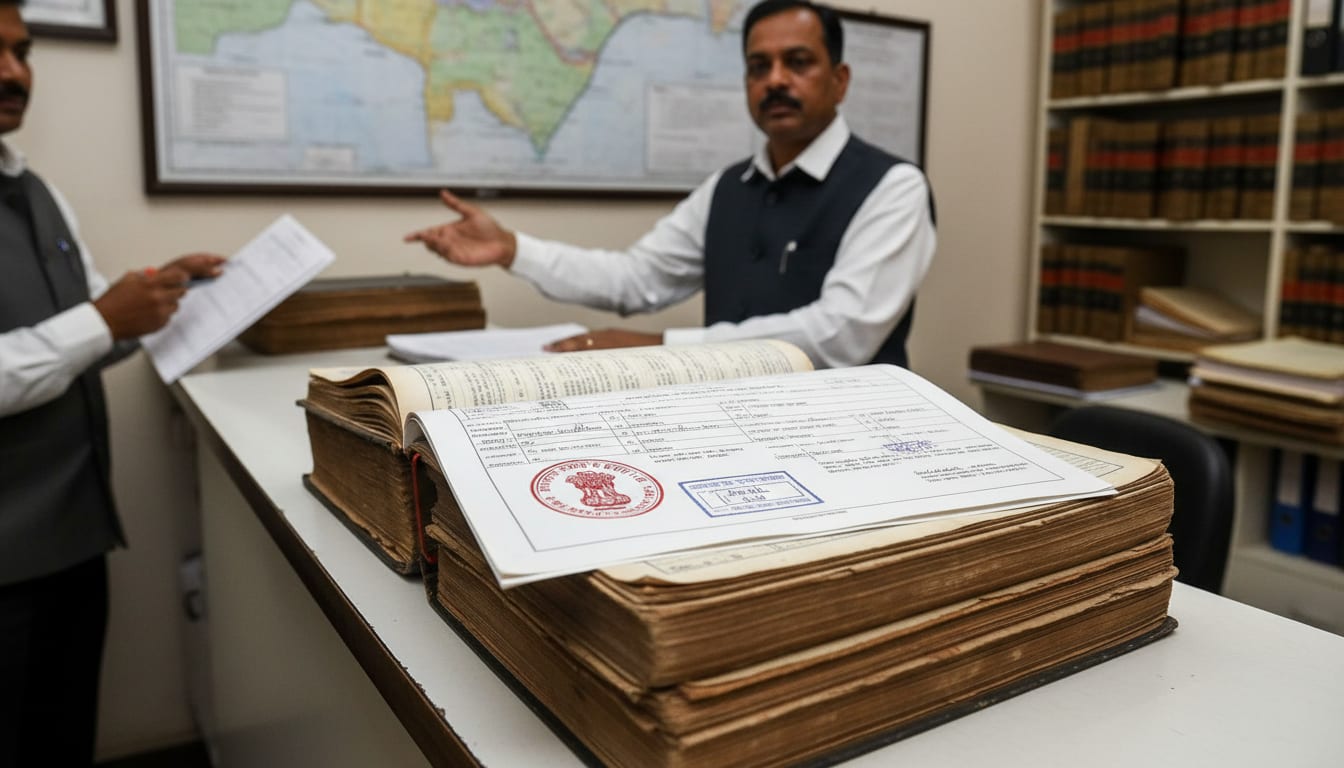
Picture this: 3 AM. A knock on the door. You open it to find local police standing alongside a stranger holding a stack of stamped papers. The stranger claims he owns the house you just bought. You panic. You pull out your property title search report. The advocate's signature is right there at the bottom, declaring the title clear and marketable. But the paperwork lied.
I have seen this pattern before. In early 2026, a family in Pune lost ₹1.2Cr because their legal counsel trusted a digital portal over archival dust. The property title search report is the single most critical document in any Indian real estate transaction. Yet, most buyers have no idea how it is actually constructed, what databases it pulls from, or where the fatal blind spots lie.
Here is what they do not want you to know. India runs no national title guarantee. A buyer in any state must verify the Chain of Title document-by-document. If you rely on a surface-level digital check, you are walking into a trap.
What Is a Property Title Search Report?
A Property Title Search Report is a formal legal document prepared by an advocate that traces the historical ownership of a specific parcel of land, usually over a 30-year period. It details all past transactions, existing mortgages, legal disputes, and encumbrances to determine if the current seller has the absolute legal right to transfer the property.
The report is not a government certificate. It is an independent legal opinion based on a manual and digital reconstruction of history. When an advocate drafts this report, they are essentially playing detective across multiple fragmented government departments.
They must reconcile the registration records at the Sub-Registrar office with the revenue records maintained by the Tahsildar. If those two systems disagree, the title is defective. And in India, they disagree constantly.
The Presumptive Title Trap
The root of the problem lies in central law. Under Section 17 of the Registration Act, 1908, the registration of a sale deed is mandatory for immovable property valued over ₹100. However, this registration only records the transaction. It does not guarantee that the seller actually owned the land.
When you register a deed, the Sub-Registrar does not verify ownership. They only verify that the stamp duty is paid and the parties are present. The burden of proving ownership falls entirely on the buyer.
Furthermore, Section 54 of the Transfer of Property Act, 1882 defines a sale as a transfer of ownership in exchange for a price paid. But if the seller's original title was defective, the transfer is void. This is the presumptive title trap. The government presumes the title is good until someone challenges it in court. A title search report is your only shield against this presumption.
Anatomy of a 30-Year Chain
A bulletproof report does not just look at the current owner. It digs three decades deep. Why 30 years? Because under the Limitation Act, 1963, the maximum period to file a suit for recovery of possession by the government is 30 years.
Here is what the investigator is actually looking for.
| Document Type | Issuing Authority | What It Proves | Risk of Forgery |
|---|---|---|---|
| Sale Deeds | Sub-Registrar | Historical transfer of rights | High |
| Encumbrance Certificate | Sub-Registrar | Registered mortgages and liens | Medium |
| Record of Rights (RoR) | Revenue Department | Current possession and mutation | Extreme |
| Death Certificates | Municipal Corporation | Legal heirship in inheritance cases | High |
| Master Plan Extract | Town Planning Authority | Approved land use zoning | Low |
If even one document in this 30-year chain is missing, the chain is broken. Advocates call this a missing link. Fraudsters call it an opportunity.
State Portals vs Archival Reality
The government has spent millions on the DILRMP, Digital India Land Records Modernization Programme to digitise these records. The progress is impressive on paper. But on the ground, it is a fragmented mess.
Every state uses a different system. Karnataka has Bhoomi. Maharashtra uses Mahabhumi for 7/12 extracts. Telangana operates Dharani. If you are reading a Title verification checklist (Odisha), you will be dealing with Bhulekh and the Inspector General of Registration (IGR).
The digital gap is where the fraud happens. Most state portals only digitized records from the early 2000s onward. If a property was mortgaged in 1995, that encumbrance might only exist in a physical ledger rotting in a district archive.
When you read about the Verify Property Ownership India 2026 Encumbrance Certificatexactly what it means. A lazy advocate will check the digital portal, see a clean record from 2005 to 2026, and declare the title clear. They miss the 1998 mortgage entirely.
Case Study: The ₹1.2Cr Phantom Owner
Let us look at the ₹1.2Cr Pune case from early 2026. The buyer, an IT professional, wanted to purchase a resale villa. The seller provided a pristine chain of documents.
The buyer hired an advocate who pulled the digital 7/12 extract and a 15-year digital Encumbrance Certificate. Everything matched. The title search report was issued with a green light. The buyer paid the ₹1.2Cr and registered the deed.
Three months later, a bank issued an auction notice on the villa.
What happened next shocked even me. The seller had mortgaged the property in 2003. The advocate only searched back 15 years because the state's digital portal only went back to 2008. The physical records at the Sub-Registrar office held the truth, but nobody bothered to pay the ₹500 physical search fee to look at them. The buyer lost the money and the house.
We'll tell you exactly what to check, free, on WhatsApp.
This is why relying on a superficial report is financial suicide.
The 5-Point Title Verification Check
When I dig into property records, I do not trust summaries. I verify the raw data. If your advocate is not following this exact 5-point sequence, fire them.
- Reconcile the Khata with the Deed. The name on the registered Sale Deed must perfectly match the name on the revenue record (Khata, Patta, or RoR). A mismatch means the mutation was never completed.
- Pull a 30-Year Physical EC. Do not accept a 13-year digital Encumbrance Certificate. Demand a manual search of the Sub-Registrar's physical Index II registers going back 30 years.
- Verify the Origin Story. How did the first owner in the 30-year chain acquire the land? Was it a government grant? A partition deed? You must trace it back to a sovereign source or an undisputed partition.
- Check the CERSAI Database. The Central Registry of Securitisation Asset Reconstruction and Security Interest of India tracks equitable mortgages. Many loans are not registered at the Sub-Registrar office but are flagged in CERSAI.
- Cross-Examine Legal Heirs. If the property passed through inheritance, verify the death certificate and the surviving member certificate. Unregistered wills are the number one cause of post-sale litigation.
The Mutation Disconnect
One of the most misunderstood concepts in Indian property law is mutation. Mutation is the process of updating the revenue records after a sale.
Buyers often assume that registering the sale deed automatically updates the revenue records. It does not. Registration happens under the Registration Act 1908 text, managed by the state's Inspector General of Registration. Mutation happens under the state's specific Land Revenue Code, managed by the Tahsildar.
These two departments rarely talk to each other. I recently reviewed a Bengaluru Property Verification 2026 case where the buyer registered the deed but forgot to apply for the Khata transfer. Five years later, the original seller used the old Khata to sell the exact same property to a second buyer.
A proper title search report must confirm that every single historical sale in the chain was followed by a corresponding historical mutation.
The CERSAI Blind Spot
Even if the Sub-Registrar records are clean, the property might still be heavily in debt.
Banks often issue loans by taking physical possession of the original title deeds. This is called an equitable mortgage. Because no formal mortgage deed is registered at the SRO, the Encumbrance Certificate will show zero loans.
To catch this, the investigator must search the CERSAI portal. CERSAI was created to prevent the exact scenario where a fraudster takes loans from three different banks using forged copies of the same title deed. A modern title search report is completely invalid if it does not include a CERSAI clearance certificate.
Commissioning a Bulletproof Report
You cannot afford to cut corners here. A standard 30-year title search report in 2026 will cost between ₹10,000 and ₹25,000 depending on the complexity of the chain and the state.
When you hire an advocate, give them specific instructions. Do not just ask for a title report. Ask for a 30-year physical Index II search. Ask for the CERSAI check. Ask them to verify the mutation history at the Tahsildar office.
If you are dealing with complex inheritance or partition, as seen in many Hyderabad Property Lawyers 2026 cases, demand that they cross-reference the family tree with the local municipality records.
The documents will always tell a story. You just need an investigator who knows how to read the language of the archives, not just the pixels on a screen.