

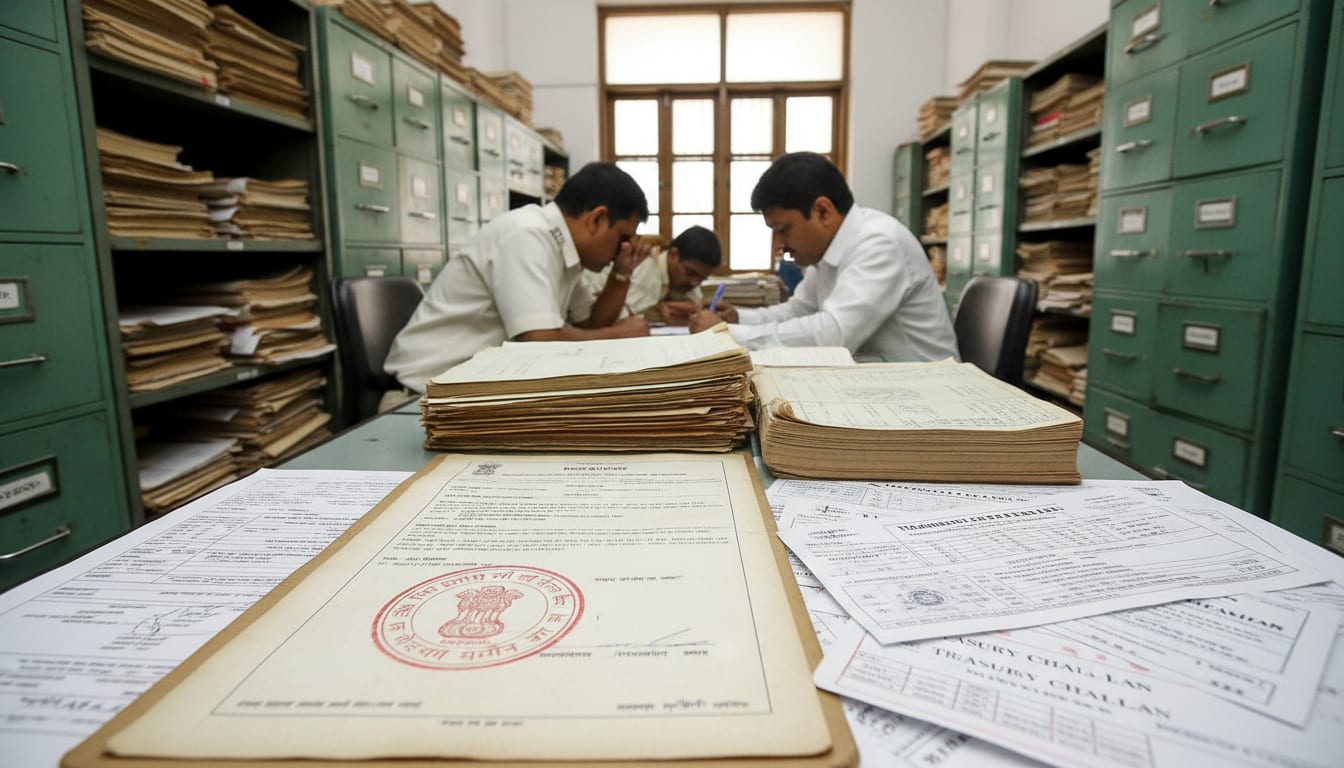
Picture the file in front of you. You have a Sale Deed, a Khatiyan, and an Encumbrance Certificate. Three documents, three names, three plot numbers. Now reconcile them. Consider a buyer who pulls a 30-year Encumbrance Certificate from the state portal. It looks clean. Too clean. They go ahead and pay for the commercial plot. Then a court injunction arrives: the property is tied up in a family partition suit. The buyer loses everything.
Buyers across India confuse a basic registry receipt with an absolute guarantee of ownership. Here is what they do not want you to know. India operates on presumptive title. Registration does not prove you own the land. It only proves a transaction took place. Relying solely on an Encumbrance Certificate is like reading the first chapter of a mystery novel and assuming you know the killer. The documents told a different story.
What is the Encumbrance Certificate?
The Encumbrance Certificate (EC) is a legal document issued by the Sub-Registrar's office under Form 25 or its state equivalent. It lists all registered transactions, such as sales, mortgages, and leases, recorded against a specific property over a requested period.
This document is a snapshot. It reflects the ledger at the local registration office. Section 17 of the Registration Act, 1908 mandates the registration of certain documents. If a document is registered, it appears on the EC. If it is not registered, the EC remains blank. This is the first critical failure point for buyers. They assume a blank EC means a clear title. It does not. It only means no one has officially registered a claim.
Across states, the limitations are glaring. An EC will not show an unregistered will. It will not show an oral family partition. It will not show a pending civil court dispute. It will not show if the government has acquired the land for a highway project. It only shows what the Sub-Registrar knows. And the Sub-Registrar only knows what citizens choose to tell them through formal registration.
The Anatomy of a Title Search
A Title Search Report is entirely different. It is a comprehensive legal investigation into the true ownership of a property. It does not stop at the Sub-Registrar's office. It starts there.
A proper title search reconstructs the Chain of Title from the ground up. The investigator pulls the EC. But then they move to the revenue department. They pull the Record of Rights. They check the mutation register. They verify the original land grant. They search the civil court databases for pending litigation. They check the local planning authority for zoning violations.
This is not a simple portal download. It is a forensic reconstruction. The Property Title Search Report: How It Works in India highlights why this manual cross-referencing is non-negotiable. India has no unified national title guarantee system. The burden of proof falls entirely on the buyer. You must verify the chain document-by-document.
The Unregistered Will Problem
This is a massive vulnerability. Section 54 of the Transfer of Property Act, 1882 requires registration for any property sale exceeding ₹100. But the law treats inheritance differently.
In many parts of India, a will does not need to be registered to be legally valid. A property owner dies. The family discovers a handwritten will. They do not register it. They do not mutate the revenue records immediately. Years later, one sibling tries to sell the property. The buyer pulls an EC. The EC shows the deceased parent as the last registered owner. The sibling produces the unregistered will. The buyer accepts it.
Then another sibling surfaces with a later, conflicting will. They file a civil suit. The buyer is now trapped in a decade-long legal battle. The EC offered zero protection because the conflicting claims were never registered.
We'll tell you exactly what to check, free, on WhatsApp.
Why State Portals Keep You Guessing
The digital divide makes this harder. The central government launched the DILRMP, Digital India Land Records Modernization Programme to digitise records. But land is a state subject. Every state built its own isolated system.
In Maharashtra, you check the 7/12 extract on Bhumi Abhilekh. In Karnataka, you pull the RTC on the Bhoomi portal. In Telangana, you use Dharani. In Odisha, you use Bhulekh for the Record of Rights and IGR Odisha for the Form 25 Encumbrance Certificate.
These systems rarely talk to each other. A sale deed registered on the IGR portal does not automatically update the revenue portal. This creates a dangerous lag. A fraudster sells a plot on Monday. The EC updates on Tuesday. But the mutation in the revenue record might take weeks. On Wednesday, the fraudster uses the outdated revenue record to secure an illegal loan. The buyer who only checked the EC is now fighting a bank for their own land.
The Mortgage Without Release Pattern
One persistent pattern involves phantom mortgages.
A property owner takes a loan from a bank. The bank registers the mortgage. Years later, the owner pays off the loan. The bank issues a NOC (No Objection Certificate). The owner puts the NOC in a drawer and forgets about it. They never register the release deed at the Sub-Registrar's office.
When the owner tries to sell the property, the buyer pulls the EC. The EC still shows an active mortgage. The deal collapses. Alternatively, the owner takes a loan via an equitable mortgage by simply depositing the title deeds. In some states, this does not require registration. The EC shows no loan. The buyer purchases the property. The bank arrives a year later to auction the land. A title search catches this by demanding the original mother deed. An EC check misses it entirely.
Want to see what investigators see? Look here.
The Key Differences
The difference between these two checks is stark. One is a clerical receipt. The other is a legal shield.
| Feature | Encumbrance Certificate | Title Search Report |
|---|---|---|
| Scope of Search | Registered transactions only | Revenue, courts, registry, and zoning |
| Legal Liability | None (government disclaimer) | Advocate's professional liability |
| Unregistered Claims | Blind to them | Actively investigates them |
| Court Disputes | Not checked | Verified via e-Courts |
Buyers often balk at the fee for a proper title search. They prefer the portal download. Risking the whole purchase to save that fee is a catastrophic miscalculation.
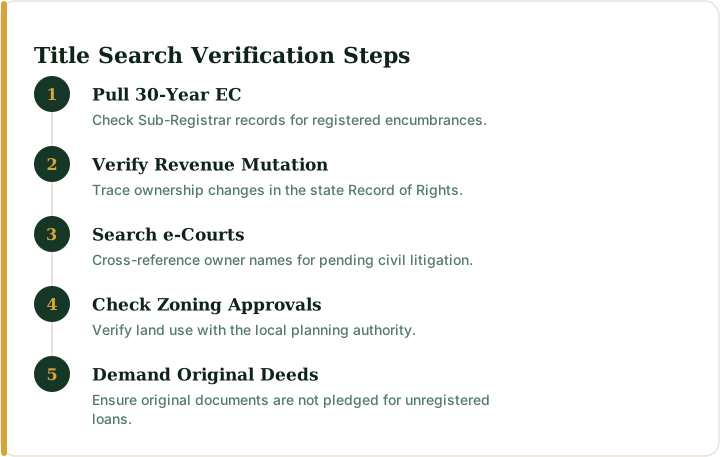
The 5-Point Title Chain Framework
To survive the Indian real estate market, you need a system. Use this strict 5-point framework for every purchase. Do not skip a single step.
First, pull the 30-year Encumbrance Certificate. Do not accept a 12-year check. Fraudsters know the 12-year limitation period for adverse possession. They will hide older defects. Go back 30 years.
Second, verify the mutation history. Pull the Record of Rights from the state revenue portal. Trace every change in ownership. If a name changed due to inheritance, demand the death certificate and the legal heir certificate.
Third, cross-reference the civil courts. Use the e-Courts portal. Search the names of all previous owners in the chain of title. Search the specific plot number. Look for injunctions, partition suits, or specific performance claims.
Fourth, check the zoning. Visit the local planning authority. Verify that the land use matches the deed. Agricultural land sold as residential plots without a formal conversion order is a common trap. The government will demolish your house, and the EC will not warn you.
Fifth, demand the original documents. Never accept photocopies. Fraudsters use high-quality colour photocopies to sell the same plot to five different buyers. If the seller claims the original is lost, halt the transaction. A lost original often means it is sitting in a bank vault as collateral for an unregistered loan.
The Presumptive Title Reality
You must understand the legal reality of the Registration Act 1908 text. The Indian state does not guarantee your title.
In countries with Torrens title systems, the government maintains a definitive register of landholdings. If your name is on the register, you own the land. If the government makes a mistake, they compensate you. India does not use this system.
Registration in India is merely a record of a transaction. The Sub-Registrar does not verify if the seller actually owns the land. They only verify that the seller signed the document and paid the stamp duty. If I register a sale deed selling the Taj Mahal to you, the Sub-Registrar will process it as long as we pay the fees. The EC will show you as the owner of the Taj Mahal. But you do not own it.
This is why an Encumbrance Certificate is structurally insufficient. It records the claim, but it does not validate the truth of the claim. Only a comprehensive title search validates the truth.
Your Final Defense Strategy
The paperwork looked clean. Too clean. That is the trap.
Do not rely on verbal assurances. Do not rely on a broker's promise. Do not rely on a single document downloaded from a government portal. The fragmented nature of Indian land records requires extreme paranoia.
Gather the Sale Deed. Gather the Encumbrance Certificate. Gather the Record of Rights. Trace the timeline. Look for the gaps. Every gap is a potential lawsuit. Every missing link is a potential total loss of capital.
The next victim could be you. Or not. Your choice.
The Hidden Liabilities Your Encumbrance Certificate Will Never Show
An Encumbrance Certificate (issued in Form No. 15 or 16) only reflects transactions recorded in "Book I" at the Sub-Registrar's office under the Registration Act, 1908. If a transaction does not legally require registration, or if it bypasses the Sub-Registrar entirely, your EC will remain dangerously blank. Relying solely on this document leaves you exposed to invisible financial landmines.
In Odisha, several critical liabilities routinely bypass the EC system. If you are buying a commercial plot in Khordha or agricultural land in Ganjam, a clean EC might be hiding massive third-party claims. A comprehensive title search actively hunts for these unregistered encumbrances:
- Equitable Mortgages: Under Section 58(f) of the Transfer of Property Act, a property owner can secure a bank loan simply by depositing their original title deeds with the lender. Because no formal mortgage deed is registered at the Sub-Registrar's office, this multi-crore debt will never appear on an EC.
- **Pending Litigation (Lis Pendens):** If two brothers are fighting over inherited land in the Cuttack Civil Court, the EC will not show the active lawsuit. Section 52 of the Transfer of Property Act dictates that whoever buys this land is bound by the court's final verdict, even if they bought it in good faith.
- Statutory Dues: Unpaid property taxes to the Bhubaneswar Municipal Corporation or pending land revenue arrears at the local Tahasil do not register as encumbrances on an EC, yet the government can auction the property to recover them.
Concrete Takeaway: Never treat a "Nil Encumbrance" certificate as proof of clear title; it is merely proof that no registered deeds were executed, leaving you entirely blind to equitable mortgages and pending court disputes.
Executing a 30-Year Title Search in Odisha
A true title search is an aggressive, multi-departmental investigation that bridges the gap between the Registration Department (which handles deeds) and the Revenue Department (which handles actual land records). You cannot complete this from your smartphone. It requires physical verification, specific statutory applications, and cross-referencing historical data.
In Odisha, land records are categorized into Sabik (old) and Hal (current) records under the Odisha Survey and Settlement Act, 1958. A proper title search must trace the property's lineage through both eras, typically covering a minimum of 30 years to satisfy banking norms and establish an unbroken chain of ownership.
To execute a flawless title search, your legal counsel must follow this exact sequence:
- Extract the 30-Year EC: Apply via the IGRS Odisha portal or offline.
- Verify the RoR (Patta): Cross-match the seller's details on the Bhulekh Odisha portal. However, online records are not legally binding. You must apply for a certified copy of the Record of Rights from the local Tahasildar (e.g., Jatni or Sundargarh Tahasil).
- Inspect the Mutation Register: Physically visit the Tahasil office to verify the Mutation Register (Register No. 3). This confirms exactly how the current seller obtained the revenue rights-whether by inheritance, partition, or a previous sale.
Concrete Takeaway: Budget time and legal and statutory fees to conduct a rigorous, 30-year title search across both IGRS and local Tahasil offices before transferring any advance payment.