Look at the sale deed your seller just handed you and point to the line where the government guarantees they own the land. Most buyers scan the pages for minutes before realizing the terrifying truth. That line does not exist. In India, registering a property does not guarantee ownership. A family in Pune recently lost ₹45 lakhs because they assumed a registered deed meant a clean title. By 2026, as land values surge across tier-two cities, relying on a single document is financial suicide. We need to build a 30-year history from scratch. Here is what I tell every client who walks into my office: you are not buying land, you are buying a paper trail. If that paper trail has a single broken link, your life savings are at risk. The good news is that conducting a thorough title search is entirely within your control if you follow a strict framework. For readers managing assets in the east, our Title verification checklist (Odisha) provides a localized breakdown, but the core principles remain identical across the country.
The Presumptive Title Trap in India
India runs on a presumptive property title system. This means the government does not certify that the seller is the true owner. When you visit the Sub-Registrar office, the officials are only there to record the transaction and collect stamp duty. They do not verify if the seller actually has the legal right to sell the plot.
This legal reality is anchored in two central statutes. First, Section 17 of the Registration Act, 1908 mandates that any sale of immovable property above ₹100 must be registered. However, registration merely places the document on the public record. Second, Section 54 of the Transfer of Property Act, 1882 defines a sale as a transfer of ownership in exchange for a price paid. If the seller does not possess absolute ownership, they cannot legally transfer it to you, regardless of what the registered deed says.
I have helped hundreds of families navigate this exact confusion. A buyer will bring me a beautifully stamped document and ask why a bank rejected their home loan. The answer is always the same: the bank looked past the current deed and found a flaw in the historical ownership chain. You must act like a bank before you hand over your advance payment.
What is a Property Title Search?
A property title search is the legal process of retrieving and examining public records to confirm a property's legal ownership, verify the continuous chain of transfers over the past 30 years, and uncover any hidden encumbrances, mortgages, or court disputes attached to the land.
Why 30 years? The Limitation Act sets a 12-year period for adverse possession claims and certain property disputes. Banks and legal experts double this period and add a buffer, establishing the 30-year standard to ensure no dormant claims can suddenly surface to challenge your ownership. Building this history requires patience, as records are split between the Registration Department, which handles deeds, and the Revenue Department, which handles land taxes and agricultural records.
The 5-Point Title-Chain Check
The solution to this fragmented system is a structured methodology. I call it the 5-Point Title-Chain Check. Follow these exact steps to uncover the truth about any plot of land in India.
- Trace the Mother Deed: Identify the earliest recorded document that establishes how the property originally came into existence. This could be a government allotment, a partition deed, or a very old sale deed. Every subsequent transfer must flow logically from this root document.
- Verify the Encumbrance Certificate: Apply for an Encumbrance Certificate from the Sub-Registrar for the past 30 years. This document lists all registered transactions, mortgages, and leases. If the EC shows a mortgage, demand the registered release deed.
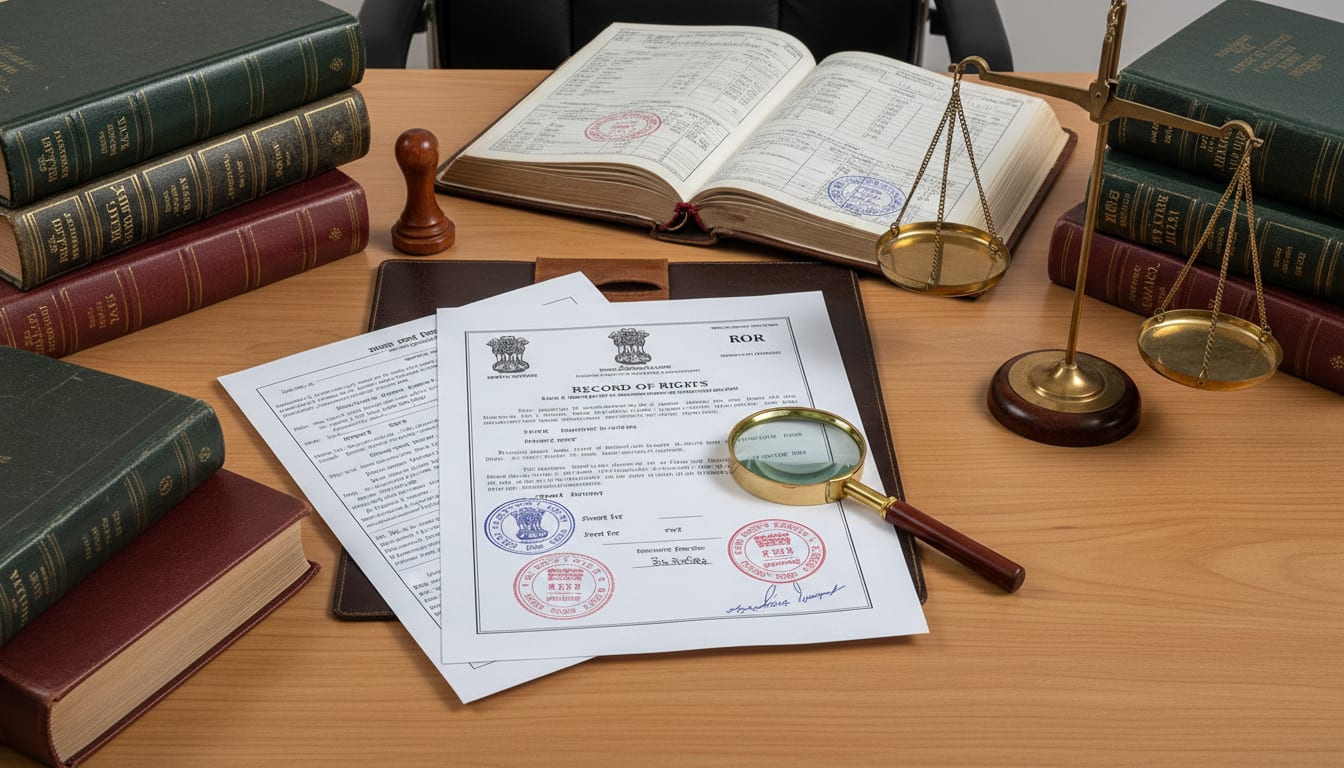
- Match the Record of Rights: Pull the current revenue record from your state portal. Ensure the seller's name exactly matches the name on the registered sale deed. Discrepancies here are the number one cause of land disputes.
- Check Mutation Entries: Verify the historical mutation register. Mutation is the process of updating the revenue records after a sale. A missing mutation entry means the government still considers the previous seller as the taxpayer.
- Confirm Physical Possession: Visit the land. Talk to the neighbors. Check for physical boundary markers. A paper title is useless if someone else has been farming the land for the last 15 years.
To understand how these documents connect, review our guide on the Chain of Title.
Navigating State Portals in 2026
Historically, verifying these five points meant spending weeks bribing clerks in dusty archive rooms. Today, the landscape has transformed significantly. The DILRMP, Digital India Land Records Modernization Programme has pushed states to digitize their revenue and registration records. However, India does not have a single national portal. You must know exactly where to look based on your geography.
In Karnataka, you will search the Bhoomi portal for the RTC, which stands for Record of Rights, Tenancy and Crops. In Maharashtra, you will access Mahabhulekh to download the 7/12 extract. In Telangana, the Dharani portal integrates both registration and revenue data. In eastern states, you will look for the RoR or Khatiyan on portals like Bhulekh.
While the names change, the data structure is identical. You are always looking for the Khata number, which identifies the owner, and the Survey number, which identifies the physical plot. Never trust a seller who provides a printout of these records. Always log into the state portal yourself, enter the survey number, and verify the live data. If you are unsure how to interpret the data, our breakdown on how to read an India encumbrance certificate 2026 is a critical next step.
The Rs 3.2 Crore Double Mortgage Case
Let me share a specific case pattern that devastated 15 families in 2025. This is known as the cooperative bank mortgage trap. A developer in a tier-two city acquired a large parcel of land. He mortgaged the original Mother Deed with a local cooperative bank to secure a ₹3.2 Crore construction loan.
Because cooperative banks sometimes delay updating their liens with the central Central Registry of Securitisation Asset Reconstruction and Security Interest, the encumbrance did not immediately reflect on the standard online portal. The developer then subdivided the land and sold the plots to 15 different buyers. He showed them a clean online Encumbrance Certificate. The buyers registered their sale deeds, paid their stamp duty, and thought they were safe.
Six months later, the developer defaulted on the loan. The cooperative bank initiated recovery proceedings and attached all 15 plots. The buyers learned the hard way that a prior registered mortgage supersedes a subsequent sale. They lost their money, their land, and spent 42 days in court just to get a hearing. This is why cross-referencing physical records with digital portals is non-negotiable.
The risk is real. Verify before you sign.
Timeline and Cost for Title Verification in 2026
Many buyers skip professional verification because they fear the costs. This is a false economy. Spending a fraction of your property value on due diligence is the best insurance policy you can buy. Here is a realistic breakdown of what you should expect to pay and how long the process takes in 2026.
| Verification Step | Average Cost (INR) | Expected Timeline |
|---|---|---|
| 30-Year Encumbrance Certificate | ₹500 to ₹1,500 | 2 to 5 Days |
| Certified Copies of Old Deeds | ₹300 to ₹800 per deed | 3 to 7 Days |
| Revenue Record Extracts | ₹50 to ₹200 | Instant (Online) |
| Independent Legal Title Opinion | ₹15,000 to ₹35,000 | 7 to 14 Days |
Notice that the government fees are minimal. The true cost lies in the legal expertise required to interpret the documents. A lawyer will read through the dense legal language of the Registration Act 1908 and ensure every transfer complies with statutory requirements.
The Gap Between Digital Records and Reality
Even with digitized portals, there is a massive gap between what the computer shows and who actually owns the land. This gap is where fraudsters operate. The most common discrepancy occurs between the Registration Department and the Revenue Department.
When you register a sale deed, the Sub-Registrar does not automatically notify the Tahsildar to update the land tax records. The buyer must manually apply for mutation. If a buyer fails to do this, the revenue records will continue to show the old owner's name. Years later, the old owner's heirs might illegally sell the property again, using the outdated revenue record to convince a new buyer they still own it. We documented a similar tragedy in our analysis of the Double Registration Scam Sambalpur.
Furthermore, state portals often struggle with historical data migration. In many regions, the transition from old manual ledgers to new digital databases introduced transcription errors. A plot measuring 4.5 acres in the physical ledger might accidentally be typed as 45 acres in the digital system. Relying solely on the digital portal without verifying the original physical source document is a recipe for disaster. If you are dealing with older records, understanding How to Read Khatiyan for Title Opinion is essential to spot these migration errors.
Let's check if your land is truly safe. It takes 2 minutes.
Next Steps to Secure Your Investment
Title verification is not a single event; it is a meticulous process of assembling a puzzle. If you are preparing to purchase property anywhere in India, you must take immediate control of the due diligence process.
First, demand the complete chain of documents from your seller. Do not accept excuses about lost deeds. If a deed is lost, the seller must provide a certified copy from the Sub-Registrar, an FIR copy reporting the loss, and a public notice published in two local newspapers.
Second, independently verify the Encumbrance Certificate. Do not rely on the copy the seller provides. Visit the state portal or the local registration office and pull a fresh 30-year EC yourself. Look for any entries under Form 15, which indicates an encumbrance, versus Form 16, which indicates a nil encumbrance.
Third, hire an independent property lawyer who practices in the specific district where the land is located. Local advocates understand the unique revenue terminologies of their district and have established relationships with the local Tahsildar office. They will spot discrepancies that a generic corporate lawyer in another state will miss.
See your actual records here - no lawyer needed.
The property market in India offers incredible opportunities for wealth generation, but it is unforgiving to the uninformed. By understanding the presumptive title system, enforcing the 30-year rule, and cross-referencing registration data with revenue records, you build an impenetrable wall around your investment. Take the time, spend the money on verification, and secure your family's future.
Don't wait for a problem. Let's verify together.
Related guide: how to spot property fraud in India