


India runs no national title guarantee, so a buyer in any state must verify the chain document-by-document because a registered sale deed does not definitively prove ownership. A common mistake is assuming the government verifies ownership before registering a property. This is a fundamental misunderstanding of Indian property law. Registration merely records a transaction. It does not certify that the seller actually owns the land. If you are purchasing a property valued at ₹50 lakh today, relying solely on the seller's documentation without cross-referencing state revenue portals is a statistical gamble. Let me show you the pattern that costs buyers their life savings and how you can systematically dismantle these risks before you pay a single rupee in advance.
The Presumptive Title Reality in India
What is a Presumptive Title? Under Indian law, property registration confers a presumptive title, not a conclusive one. This means the government presumes the registered owner is valid, but this presumption can be challenged in court. The burden of proving continuous, unbroken ownership lies entirely on the buyer during due diligence.
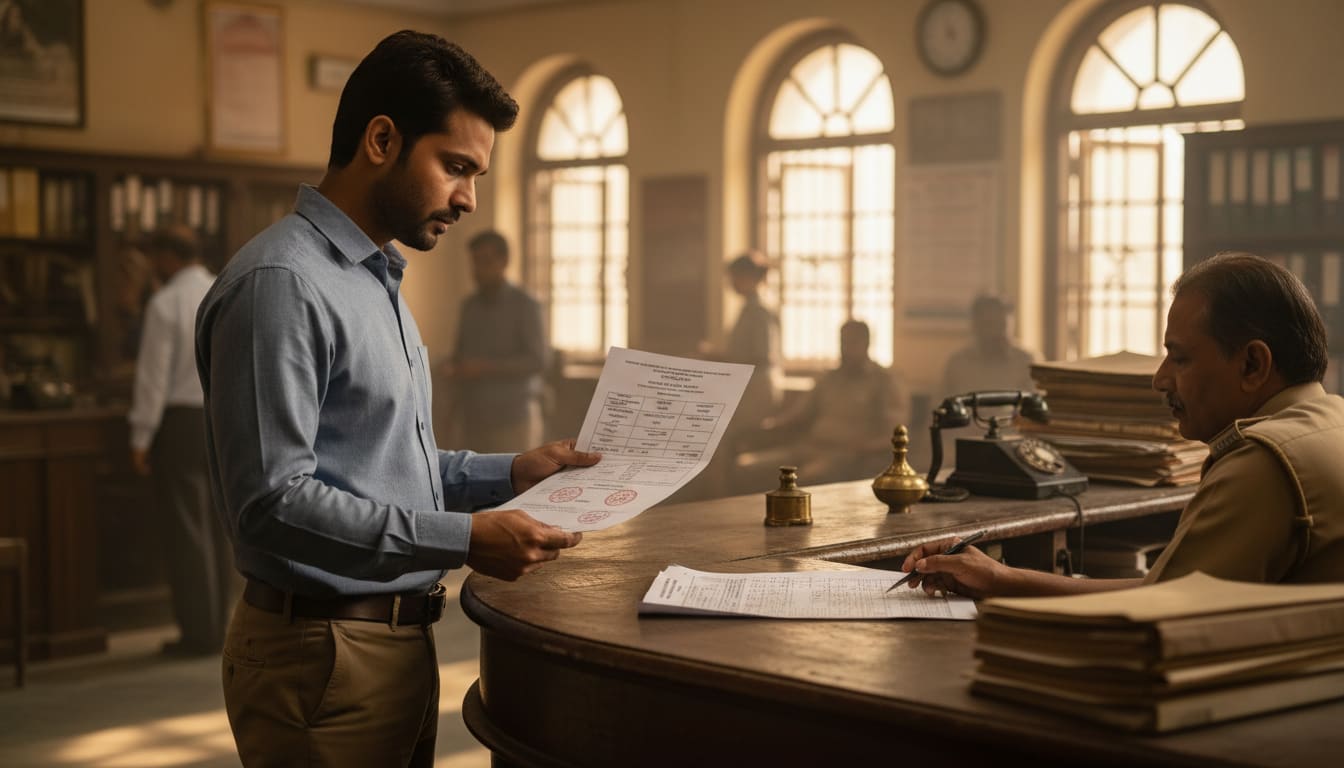
The Registration Act, 1908 governs the recording of documents. Specifically, Section 17 of the Registration Act makes it mandatory to register documents involving the sale of immovable property. However, the Sub-Registrar's office only checks if the stamp duty is paid and the format is correct. They do not verify if the seller has the legal right to sell the plot.
This creates a massive vulnerability for buyers. You might hold a beautifully stamped sale deed, but if the seller's name does not match the Record of Rights maintained by the state revenue department, your deed is legally hollow. This is why Chain of Title verification is not an optional extra. It is the core of Indian property transactions. You must trace the ownership back through previous deeds to ensure an unbroken sequence of legal transfers.
The State Portal Fragmentation in 2026
Because land is a state subject in India, there is no single national database where you can type in an address and see the owner. Instead, you must navigate fragmented state-specific portals. The Union Government coordinates the DILRMP, Digital India Land Records Modernization Programme to digitize these records, but the vocabulary and procedures differ wildly depending on where you are buying.
For example, if you are utilizing the Title verification checklist (Odisha), you will look for the Record of Rights, locally called the RoR or Khata, on the Bhulekh portal. If you cross the border into Maharashtra, you are looking for the 7/12 extract. In Karnataka, it is the Bhoomi RTC. In Telangana, you search the Dharani portal.
Here is a breakdown of how record names shift across jurisdictions.
| State | Revenue Portal | Primary Record Name | Local Terminology |
|---|---|---|---|
| Odisha | Bhulekh | Record of Rights | Khata / Parcha |
| Maharashtra | Mahabhulekh | Extract 7/12 | Saat Bara |
| Karnataka | Bhoomi | Record of Tenancy | RTC / Pahani |
| Telangana | Dharani | Pattadar Passbook | ROR-1B |
Buyers often fail because they apply one state's logic to another. A seller might present a previous sale deed as proof of ownership, but without the corresponding state-specific revenue record confirming the mutation, the title is incomplete. Mutation is the process of updating the revenue records after a sale. If the mutation is pending, the government still recognizes the previous owner for tax and acquisition purposes.
The Financial Title Chain Disconnect
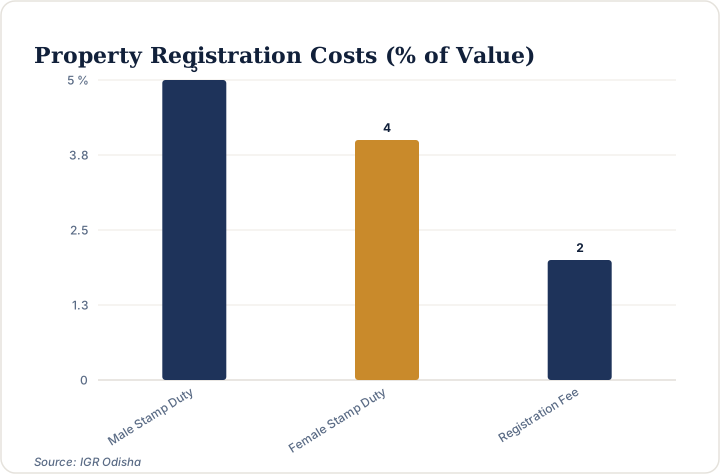
Consider a fraud pattern in Odisha. In a typical transaction for a property valued at ₹50 lakh, the financial exposure is massive before you even consider the purchase price. According to current fee structures, stamp duty is 5% for a male buyer and 4% for a female buyer, plus a 2% registration charge. This means a male buyer pays roughly ₹2.5 lakh in stamp duty and ₹1.0 lakh in registration fees.
In this fraud pattern, buyers were shown a valid-looking sale deed by a seller. The buyers paid the full price plus the government fees. However, the seller had hidden a title-chain gap. They could not produce a continuous chain of earlier deeds. When the buyers attempted to file for mutation, the Tahasildar rejected the application because the seller's name was never updated in the actual Record of Rights. The true owner surfaced months later, resulting in a total capital loss for the buyers. This fake or incomplete land-record matching is one way funds vanish in modern real estate.
The risk is real. Verify before you sign.
This specific mismatch highlights why relying on the seller's paperwork is dangerous. You must pull the documents directly from the government portals yourself. As detailed in our coverage of Property Title Red Flags: Documents a Seller Can't Explain, sellers often claim the original documents are lost or that the mutation is simply delayed. These are critical warning signs.
Encumbrance Certificates and Hidden Mortgages
The next layer of verification involves checking for registered liabilities. An Encumbrance Certificate is a legal document issued by the Sub-Registrar's office that lists all registered transactions against a specific property over a defined period. In Odisha, it is issued as Form 25 (Nil) or Form 26 under the Orissa Registration Rules, 1988; other states' registration rules prescribe their own forms.
Buyers frequently assume that if a property has a loan against it, the seller will disclose it. Properties are routinely sold with pending mortgages that are not obvious from the sale deed alone. Under Section 54 Transfer of Property Act, 1882, a sale is a transfer of ownership in exchange for a price paid. But if the property is mortgaged, the bank holds a charge over it.
If you buy a mortgaged property without the bank's explicit release, the liability transfers to you. A lender makes its own check before it takes land as security: the title report its panel advocate prepares. The Encumbrance Certificate must be pulled for a minimum of 15 to 30 years to ensure no old, unreleased mortgages exist.
Land Conversion and Municipal Approvals
Another severe risk pattern involves the physical nature of the land versus its legal classification. Agricultural land sold as residential-ready land without formal conversion causes immediate registration, loan, and municipal problems.
In states like Odisha, this requires a specific Gharabari conversion certificate. If you purchase agricultural land to build a house, the local municipality will not approve your building plan. Furthermore, if you are buying a built property or an apartment in an under-construction project, you must confirm RERA compliance. The Real Estate Regulatory Authority mandates project transparency, but developers sometimes deviate from the approved building plan.
An unauthorized construction might exist physically, but legally, it is subject to demolition. Verifying the approved plan against the actual structure is a non-negotiable step for built properties. If the seller cannot produce the occupancy or completion-related approval, you are inheriting a legal dispute.
The 5-Point Document Verification Order
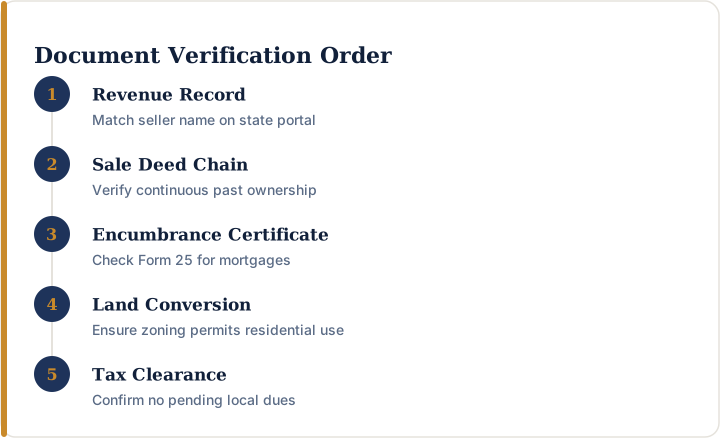
To navigate these risks, you must follow a strict sequence. Checking documents out of order leads to false confidence. Here is the practical verification order you must follow before paying any advance.
- Verify the Revenue Record: Start with the RoR, Khata, 7/12, or RTC directly from the state portal. Confirm the seller's name matches the government database.
- Trace the Sale Deed Chain: Demand the previous sale deeds. Ensure an unbroken sequence of transfers leading up to the current seller.
- Pull the Encumbrance Certificate: Obtain Form 25 or the state equivalent from the Sub-Registrar to check for loans, mortgages, or legal holds.
- Confirm Land Conversion: If buying for residential use, demand the official land conversion certificate proving it is no longer zoned as agricultural.
- Check Tax and Utility Dues: Verify property tax, holding tax, and utility dues. Unpaid local dues can delay your mutation post-purchase.
If any of these five pillars wobble, the transaction is unsafe. Sellers will pressure you to skip steps to close the deal quickly. Do not yield.
Actionable Next Steps for Buyers
Understanding the theory is only half the battle. When you locate a property you want to purchase, you must operationalize this knowledge. As the Hyderabad Property Title Verification: 5-Point Framework explains, moving too fast is a common cause of capital loss.
- Demand photocopies of all title documents from the seller before discussing the advance payment.
- Cross-reference the survey numbers and plot details on your state's digital land record portal.
- Visit the local Sub-Registrar's office to apply for a fresh Encumbrance Certificate yourself, rather than accepting the seller's copy.
- Consult a local legal professional to review the chain of title for any missing links or unregistered agreements.
Taking these steps removes the emotion from the purchase and replaces it with empirical data. In Indian real estate, trust must always be verified.
Navigating the Bhulekh Odisha Digital Landscape
While national guidelines provide a framework, title verification in Odisha requires mastering the state's specific digital infrastructure. The Bhulekh Odisha portal has digitized millions of land records, but relying solely on a web screenshot can lead to disastrous financial consequences under the Odisha Survey and Settlement Act, 1958. Discrepancies between the digital Record of Rights (RoR, locally known as Parcha) and the physical registers at the Tahasil office are common, particularly in rapidly developing districts like Khordha and Cuttack where land values have skyrocketed.
To ensure your title verification is bulletproof in Odisha, you must bridge the gap between digital convenience and legal reality:
- Identify the Identifiers: Extract the exact Khata (account) number, Plot number, and Kisam (land classification) from the seller's documents and input them into the Bhulekh portal to check for immediate red flags.
- Procure Certified Copies: Never rely on the free online PDF. Apply at the local Tahasil office or Mo Seva Kendra for a legally admissible certified copy of the RoR. The official fee is typically ₹30 per page, but it is the only version recognized in a court of law.
- Check for Pending Revisions: Verify if there are any pending settlement revisions. Legacy disputes can freeze a title for years.
Takeaway: Treat the Bhulekh portal as your initial screening tool, not your final legal proof. Always spend the ₹30 to secure a physically certified RoR from the Tahasildar before transferring any earnest money.
OLR Act Section 22: Tribal Land Restrictions
One of the most devastating title traps specific to Odisha involves purchasing land without verifying the seller's caste or tribal status. Under Section 22 and Section 23 of the Odisha Land Reforms (OLR) Act, 1960, the transfer of land from a person belonging to a Scheduled Tribe (ST) or Scheduled Caste (SC) to a non-ST/SC individual is strictly prohibited without explicit prior permission from the Sub-Collector (Revenue Officer).
This restriction is aggressively enforced in Scheduled Area districts such as Mayurbhanj, Sundargarh, and Koraput, but it applies universally across the state. Ignorance of this law does not protect your investment; unauthorized transfers are declared legally void ab initio (from the beginning), and the buyer faces immediate eviction without compensation, alongside potential penalties for illegal possession.
Before finalizing any property transaction in Odisha, execute the following checks:
- Scrutinize the RoR Caste Column: Examine the seller's details in the Record of Rights. The document explicitly lists the caste/tribe category of the landowner. Do not take the seller's verbal assurance.
- Trace the Title History: Ensure no previous owner in the 30-year chain of title was an ST/SC individual who sold the land illegally. A tainted past transaction voids all subsequent sales, even if the current seller is non-ST/SC.
- Factor in Permission Timelines: If purchasing legally from an SC/ST seller, factor in the statutory process. Securing the Sub-Collector's permission involves rigorous background checks and can delay your transaction.
Takeaway: Never bypass OLR Act restrictions. If the title chain reveals ST or SC ownership, immediately halt the transaction until you have verified the existence of a formal, stamped clearance order from the Sub-Collector.