
Three advocates in Khordha last month flagged the exact same document mismatch we are about to explore. A buyer pays an advance, holds a freshly stamped sale deed, and assumes the government has guaranteed their ownership. This is the single biggest misconception in Indian real estate. India operates on a system of presumptive title. When you register a document at the Sub-Registrar office, the government merely records the transaction. They do not guarantee that the seller actually owns the land. If someone sells you a property they do not legally own, your registered deed is worthless, and your money is gone. In 2024 alone, title-chain gaps and fake land records cost buyers thousands of crores nationwide. Here is what I tell every client who walks into my office: you cannot rely on a single piece of paper. You have to build a chain of evidence.
The Presumptive Title Problem in India
Before we look at the documents, we need to understand the legal reality of buying property in India. Under Section 17 of the Registration Act, 1908 text, the registration of a sale deed is compulsory. However, the Sub-Registrar's job is to verify that the stamp duty is paid and that the parties are present. They do not investigate whether the seller has a valid, undisputed right to sell the property.
This means the title you receive is presumptive. It is presumed valid until someone else comes along with a better claim. To protect yourself, you must reconstruct the history of the property across multiple government departments. The national initiative to digitize these records, the DILRMP, Digital India Land Records Modernization Programme, has made this easier, but the systems remain highly fragmented across different states. A buyer in any state must verify the chain document-by-document because a single missing link can void your entire investment. Let us break down the exact five-point verification framework.
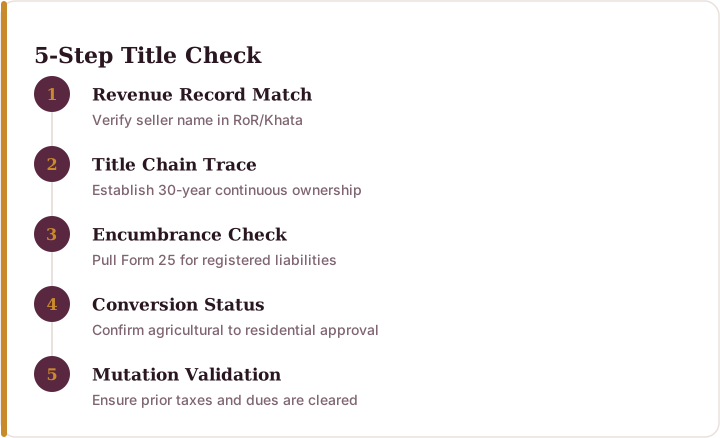
Step 1: Matching the Revenue Record of Rights
The foundation of any land transaction is the revenue record. While the sale deed shows how the property transferred hands, the Record of Rights shows who actually holds the land in the eyes of the government. This document goes by different names depending on your state. It is called the Khatian or RoR in Odisha, the RTC or Pahani in Karnataka, the 7/12 extract in Maharashtra, and the Patta-Chitta in Tamil Nadu.
Your first task is to ensure the seller's name exactly matches the current revenue record. If the seller has a sale deed but their name is not in the Record of Rights, they have not completed their mutation. Buying from them directly is highly risky. In states like Odisha, a common fraud pattern involves a mismatch between the Sabak (old) and Hal (new) settlement records. A seller might show you a clean Sabak record, hiding the fact that the Hal record lists the land as government property. You can learn more about navigating these specific state portals in our guide to Bhulekh verification steps.
Step 2: Tracing the 30-Year Sale Deed Chain
Under Section 54 of the Transfer of Property Act, 1882, a sale is defined as a transfer of ownership in exchange for a price paid. To prove that the current seller has the right to transfer ownership, you must trace the chain of title backward. A standard legal verification requires a continuous, unbroken chain of registered deeds spanning at least 30 years.
You need to see the mother deed, which is the original document establishing the first recorded ownership, followed by every subsequent sale deed, gift deed, or partition deed up to the present day. If property changed hands in 1995, 2005, and 2015, you need all three documents. A missing link in this chain is a massive red flag. Fraudsters often exploit gaps in the chain to sell ancestral property without the consent of all legal heirs. Verifying this chain is particularly crucial when dealing with inherited land, governed by laws like the Odisha Land Reforms Act Encumbrance Certificateimitations on certain types of transfers.

Step 3: Securing the Form 25 Encumbrance Certificate
What is the Encumbrance Certificate?
The Encumbrance Certificate is a legal document issued by the Sub-Registrar's office under Form 25 of the Indian Stamp Rules. It lists all registered transactions, mortgages, and liabilities attached to a specific property over a requested period, typically 15 to 30 years.
The Encumbrance Certificate acts as a mirror reflecting the financial history of the property. If the previous owner took a loan against the land and registered a mortgage, it will appear here. If the property is currently under a court injunction that has been registered, the Encumbrance Certificate will show it. You should apply for an Encumbrance Certificate covering a minimum of 30 years.
However, the solution is simpler than you think but requires diligence. An Encumbrance Certificate only shows registered transactions. It will not show equitable mortgages where the original title deeds were simply deposited with a bank without formal registration. This is why you must always demand to see the original, physical title documents before proceeding. If the seller claims the original documents are lost, walk away. To understand how financial institutions approach this, review our analysis on what banks check before land loan.
We will tell you exactly what to check, free, on WhatsApp.
Step 4: Confirming Land Conversion and Zoning
A frequent issue in Indian property transactions is agricultural land being sold as residential-ready plots without the proper legal conversion. Buying agricultural land for residential use without official conversion is illegal and will block you from getting building plan approvals or bank loans.
In many states, land conversion requires a specific legal order. For example, under Section 8-A of the relevant state land reforms act, an owner must apply to the Tahsildar or Sub-Collector and pay a conversion fee to change the land use from agriculture to homestead or commercial. We recently saw a case where 42 buyers lost roughly ₹32 lakhs each in a suburban layout because the developer never obtained the conversion certificate. The plots existed physically, but legally, they were still farmland. Always demand the official Land Conversion Certificate. For a deeper look at how land ceilings affect these conversions, see our breakdown of the Odisha land ceiling act section 37a.
Step 5: Validating Mutation and Local Dues
Mutation is the process of updating the revenue records after a property transaction. While registration transfers the legal title, mutation transfers the liability to pay property tax. A common mistake buyers make is assuming mutation happens automatically after registration. In most states, it does not. The buyer must apply to the local Tahsildar or revenue office.
Before you buy, verify that the seller has completed their mutation. If they have not, you will have to clear their pending mutation before you can apply for your own. Additionally, you must check for pending property taxes, holding taxes, and utility dues. Unpaid local dues remain attached to the property, meaning the new buyer inherits the debt. A thorough Khatiyan number search fraud prevention check will reveal if the mutation aligns with the registered deed.
The 2026 Cost of Document Verification
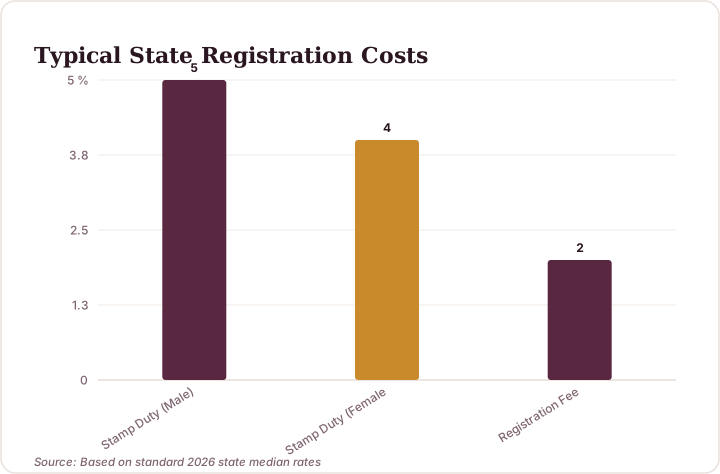
Understanding the financial mechanics of property registration helps you budget correctly and spot anomalies. Stamp duty and registration charges vary significantly by state, but let us look at a standard 2026 example using common state rates to illustrate the costs involved in a ₹50 lakh property transaction.
| Expense Category | Rate for Male Buyer | Rate for Female Buyer | Estimated Cost on ₹50 Lakh |
|---|---|---|---|
| Stamp Duty | 5 percent | 4 percent | ₹2.5 Lakh (Male) / ₹2.0 Lakh (Female) |
| Registration Fee | 2 percent | 2 percent | ₹1.0 Lakh |
| Encumbrance Certificate | Fixed fee per year | Fixed fee per year | ₹500 to ₹1500 (for 30 years) |
| Mutation Application | Nominal fixed fee | Nominal fixed fee | ₹100 to ₹500 |
These figures highlight why thorough verification is essential. You are paying lakhs in government taxes alone. If the title is defective, neither the stamp duty nor the registration fee is refundable. The government keeps the tax, and you lose the land.
What to Do Next Before You Sign
Let me share something that could save you lakhs. Never pay a token advance just to take the property off the market until you have seen the core documents. Fraudsters create false urgency to pressure buyers into skipping due diligence. Follow this exact sequence before signing any agreement to sell.
- Demand photocopies of the seller's registered sale deed and the current Record of Rights.
- Cross-check the names and plot dimensions on both documents against the state land records portal.
- Apply for a 30-year Encumbrance Certificate independently. Do not rely on the copy provided by the seller.
- Verify the physical possession of the property. Visit the site and speak to neighbors to rule out boundary disputes.
- Engage a competent local advocate to draft the agreement and conduct a final review of the title chain.
The verification process requires patience, but it is the only shield you have in a presumptive title system. Take your time, verify every document, and never let anyone rush your investment.
Navigating Tribal Land Restrictions Under the OLR Act
In Odisha, verifying the seller's caste and land classification is just as critical as checking the title chain. Under Section 22 of the Odisha Land Reforms (OLR) Act, 1960, any transfer of land from a Scheduled Tribe (ST) person to a non-ST person is strictly prohibited without prior written permission from the Sub-Collector or competent Revenue Officer. This law heavily impacts real estate transactions in Scheduled Areas like Sundargarh, Mayurbhanj, and Koraput districts.
If you purchase tribal land without this statutory clearance, the transaction is legally void under Section 23 of the OLR Act. The state will restore the land to the original tribal owner, and you will not receive any refund of your purchase money. To avoid this devastating trap, follow these verification steps:
- Examine the RoR (Pattadar) Details: Check the caste status of the recorded tenant on the Bhulekh Odisha portal.
- Request Caste Certificates: If the seller claims to be a non-tribal but has a surname common to ST or SC communities, demand a valid caste certificate issued by the local Tahasildar.
- Verify Sub-Collector Permission: If the seller is an ST individual and you are non-ST, ensure they have obtained the formal Section 22 clearance order. This administrative process typically takes 90 to 120 days to complete.
- Check for Prior Violations: Ensure no previous link in the 30-year title chain violates this rule, as illegal transfers from decades ago can still invalidate current ownership.
Takeaway: Always verify the caste status of the seller and all previous owners in the title chain; if Section 22 applies, never proceed to registration without the Sub-Collector’s stamped permission order.
Verifying Land Classification and Section 8A Conversion
A common pitfall for buyers in rapidly expanding districts like Khordha and Cuttack is purchasing agricultural land with the intent to build a home, only to discover the land type (Kisâm) prohibits construction. In Odisha, building a residential structure on agricultural land (such as Sarada or Taila) without legal conversion violates state revenue laws.
Under Section 8A of the Odisha Land Reforms Act, an owner must apply to the local Tahasildar using OLR Form 8 to convert agricultural land to homestead (Gharabari) status. If a seller claims the land is already converted and demands a premium price, you must rigorously verify the documentation.
Here is what you must check regarding land conversion:
- Check the Kisâm on the RoR: The Record of Rights must explicitly state the land type as Gharabari (homestead) or Patita (buildable), not agricultural.
- Demand the Conversion Order: Ask the seller for the official Section 8A conversion order issued by the Tahasildar.
- Verify Premium Payment Receipts: Ensure the seller has paid the required conversion fees. Depending on the land's location, this fee can range from ₹100 per decimal in rural panchayats to up to 10% of the benchmark valuation in prime municipal areas.
- Confirm the 30-Day Objection Period: The conversion process includes a mandatory 30-day public notice period for objections. Ensure this statutory window was completed legally and no pending litigation exists in the Tahasil office.
Takeaway: Never pay residential plot prices for agricultural land; always demand the finalized Section 8A conversion order and verify the Gharabari classification on the Bhulekh portal before finalizing the sale agreement.