

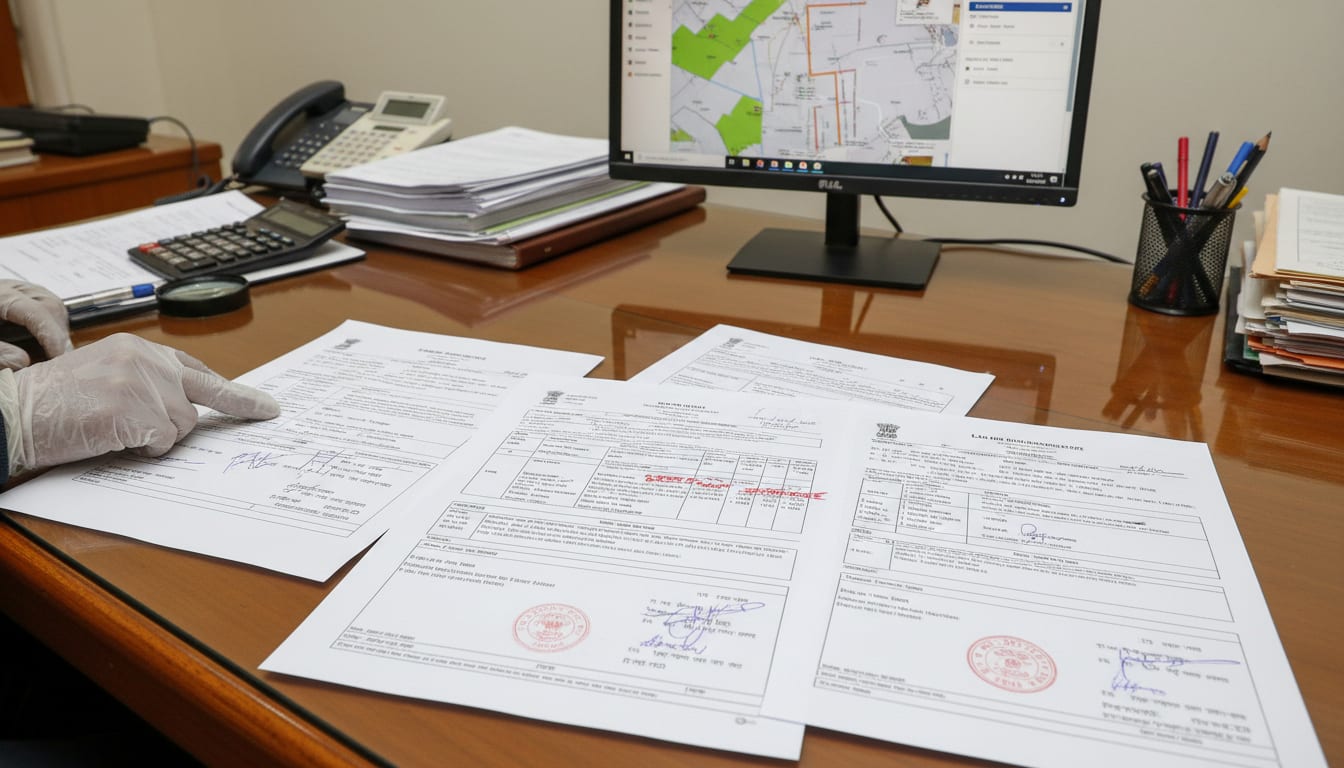
verification the Form 25 Encumbrance Certificate you just downloaded from your local sub-registrar might completely contradict the revenue mutation record? Buyers search for local document verification services, assuming a single government database holds the definitive answer to property ownership. Instead, they walk into a fragmented system where the registered sale deed says one thing, but the local Record of Rights reflects an entirely different reality.
In 2026, the cost of misunderstanding how localized property verification actually works in India is devastating. Buyers often miss the critical step of cross-referencing local registration data with state revenue portals. This oversight leads to catastrophic financial losses, often wiping out decades of savings in a single afternoon. Let me show you the pattern that defines real estate risk today, and exactly how the local verification mechanics operate behind the scenes.
The Local Verification Illusion in India
What is Local Property Document Verification? Local property document verification is the systematic legal process of cross-referencing a seller's claimed ownership documents against decentralized state revenue records and the local Sub-Registrar's registry to establish a continuous, unencumbered chain of title under the Transfer of Property Act.
Most property buyers operate under a dangerous misconception. They believe that if a document is registered at a local government office, the government has verified and guaranteed the seller's ownership. This is a fundamental misunderstanding of Indian property law. India does not operate on a conclusive land titling system like the Torrens system found in some Western countries. Instead, we operate on a presumptive title system. This means that government records merely presume who the owner is based on past registrations and revenue entries, but they do not guarantee it against future legal challenges.
When you initiate a search for property documents verification near your location, you are not asking a single authority for a definitive yes or no. You are actually embarking on an investigative process across multiple, often disconnected, departmental databases. The central government has attempted to bridge these gaps through the Digital India Land Records Modernization Programme, aiming to digitize and integrate registration and revenue records. However, the ground reality in 2026 remains highly localized and fragmented.
A property located in Karnataka requires verification through the Bhoomi portal and the local Kaveri system. A property in Maharashtra demands scrutiny of the 7/12 extract via Mahabhumi. Meanwhile, a property in Odisha requires strict cross-referencing between the IGR Odisha portal and the Bhulekh database. Failing to understand this localized fragmentation is a common reason buyers fall into sophisticated document traps.
Why Sub-Registrar Offices Cannot Guarantee Title
To understand how property document verification works, you must first understand the legal limits of the local Sub-Registrar Office. Section 17 of the Registration Act 1908 mandates the compulsory registration of documents relating to the transfer of immovable property. However, the mandate of the Sub-Registrar is strictly administrative, not judicial.
When a seller and a buyer present a sale deed for registration, the Sub-Registrar verifies the identities of the parties, ensures the correct stamp duty is paid, and records the transaction in Book 1. The Sub-Registrar does not investigate whether the seller actually has a valid, legal right to sell the property. If a fraudster creates a convincing fake chain of title and presents it with a willing accomplice acting as a buyer, the Sub-Registrar will register the document provided the procedural requirements and fee payments are met.
This administrative limitation creates a massive vulnerability for buyers who rely solely on the existence of a registered sale deed. Section 54 of the Transfer of Property Act, 1882, defines a sale as a transfer of ownership in exchange for a price paid or promised. But you cannot transfer ownership you do not legally possess. Therefore, local verification must go far beyond simply checking if a deed was registered. It requires tracing the historical chain of those registrations backward for at least 30 years to ensure every previous transfer was legally sound, properly executed, and free from coercion or dispute.
The 2026 Title Chain Verification Framework
Your odds of avoiding property fraud improve when you follow a structured, multi-department verification sequence. You cannot rely on a single document. Instead, you must build a comprehensive picture by pulling data from at least three different local sources.
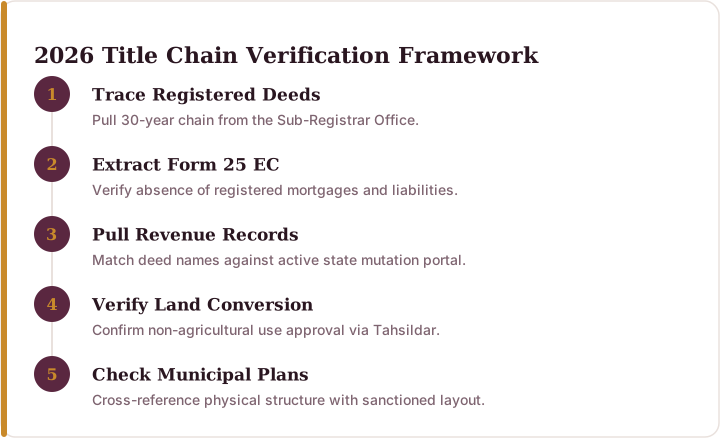
- Trace the Registered Sale Deed Chain: Begin at the local Sub-Registrar Office. Obtain certified copies of all previous sale deeds, gift deeds, or partition deeds spanning the last 15 to 30 years. Verify that the property boundaries, survey numbers, and legal descriptions remain consistent across every transfer.
- Extract the Encumbrance Certificate: Apply for Form 25 at the registration office to uncover any registered liabilities, mortgages, or court attachments recorded against the property over your search period.
- Pull the Revenue Record of Rights: Access the state-specific revenue portal to verify the current mutation status. The name on the latest registered sale deed must perfectly match the name in the active revenue record.
- Verify Land Conversion Status: If the property was historically agricultural, demand the official conversion order from the local Tahasildar or District Collector authorizing non-agricultural use.
- Check Local Municipal Approvals: For constructed properties, cross-reference the physical structure against the building plan sanctioned by the local municipal corporation or development authority.
Forged documents are increasingly sophisticated, often printed on authentic-looking stamp paper with duplicated government seals. Relying on photocopies provided by a seller or a broker is a direct path to financial ruin.
Executing this framework requires patience and a precise understanding of local administrative procedures. Skipping even one step leaves a blind spot that fraudsters actively exploit.
Matching Sale Deeds Against State Revenue Portals
The most critical phase of local verification is reconciling the registration data with the revenue data. This is where many legal defects are discovered. When a property is sold and the deed is registered, the buyer's name does not automatically appear in the local revenue records. The buyer must separately apply for mutation at the local Tahsil or revenue office.
Mutation is the process of updating the Record of Rights to reflect the new ownership for the purpose of land revenue collection. In Odisha, this record is known as the RoR or Khata, accessible via Bhulekh. In Karnataka, it is the RTC or Pahani. In Telangana, it is managed through the Dharani portal.
The verification rule here is absolute: the seller presenting the property to you must hold both a valid registered sale deed AND have their name actively reflected in the current mutation record. If the seller has a registered deed from five years ago but the revenue record still shows the previous owner's name, you have a severe title defect. This gap indicates either administrative negligence by the seller or a pending legal dispute blocking the mutation process. Purchasing a property with an unresolved mutation gap guarantees that you will inherit the legal battle required to fix it.
A Hal Khatiyan Mismatch Example
Let me show you the pattern with an example from Khordha district. A buyer, an IT professional relocating to the area, found a prime residential plot advertised at a slightly below-market rate. The seller provided a registered sale deed clearly showing his name as the absolute owner.
The buyer paid a local agent to conduct a basic search, which confirmed the deed was indeed registered at the local Sub-Registrar Office. Satisfied, the buyer proceeded with the transaction and paid the full consideration.
Six months later, when the buyer applied for his own mutation, the Tahasildar rejected the application. The subsequent investigation revealed a catastrophic oversight. While the seller had a registered deed, he had never successfully mutated the property in the revenue records. The Bhulekh database, specifically the updated Hal Khatiyan (the current record of rights), still listed the original owner.
Capitalizing on this mutation gap, the original owner had fraudulently sold the exact same plot to a different party. Because that buyer immediately completed the mutation process, the revenue records recognized them as the legitimate titleholder. The IT professional was left holding a worthless piece of paper, and lost the whole payment. This example illustrates why following a comprehensive step-by-step title verification checklist is non-negotiable. Reconciling the registration office data with the Tahsil revenue data is the only way to detect a double-sale fraud before the money changes hands.

Uncovering Hidden Mortgages With Form 25
The next layer of local verification involves the Encumbrance Certificate. The EC is a critical document issued by the Sub-Registrar that details all registered transactions, mortgages, and leases associated with a specific property over a requested time period. In Odisha, a nil-encumbrance certificate is Form 25 under the Orissa Registration Rules, 1988; other states' registration rules prescribe their own forms.
When you request an EC for the past 30 years, you are looking for unbroken continuity and the absence of active liabilities. If the previous owner took a loan against the property and registered a mortgage deed, that charge will appear on the EC. The property cannot be legally transferred free and clear until that mortgage is discharged and a release deed is subsequently registered and reflected on a new EC.
However, local verification requires understanding the limitations of the EC. The EC only captures transactions that are formally registered. It will completely miss an equitable mortgage created by the mere deposit of title deeds with a bank, a practice common in many Indian jurisdictions. If a seller deposited the original title documents with a financial institution to secure a loan without registering a formal mortgage deed, the Form 25 EC will show the property as unencumbered.
This is why verifying the physical, original chain of title documents is mandatory. If a seller claims the original deeds are lost and offers only certified copies, the risk of a hidden equitable mortgage rises sharply. A buyer who relies solely on a clean EC can miss original documents sitting in a bank vault, securing an undisclosed loan.
Verifying Land Conversion and Approved Plans
Beyond ownership and encumbrances, local verification must confirm the legal usage rights of the land. India has strict zoning and land-use regulations. Agricultural land cannot be legally used for residential or commercial construction without formal conversion.
If you are purchasing a plot marketed for residential building, you must verify the land conversion order issued by the competent revenue authority. Buying agricultural land with the assumption that you can convert it later is a massive financial risk. Local master plans change, and environmental regulations tighten constantly. If the conversion is denied, the property value plummets, and any unauthorized construction is subject to demolition.
For constructed properties or apartments, verification shifts to the local municipal authority. You must demand the sanctioned building plan and the final occupancy certificate. A common fraud pattern involves developers securing approval for a four-story building but constructing six stories. The top two floors are entirely illegal. The sale deeds for those illegal flats will still be registered by the Sub-Registrar, but the municipal corporation will eventually issue demolition notices. Furthermore, for under-construction projects, verifying the project's active registration on the state's RERA portal is a mandatory layer of modern due diligence.
State Verification Costs and Stamp Duties 2026
Understanding the financial mechanics of property registration is a crucial part of the local verification process. Transaction costs vary significantly across India, dictated by state-specific Stamp Acts and annual circle rate revisions.
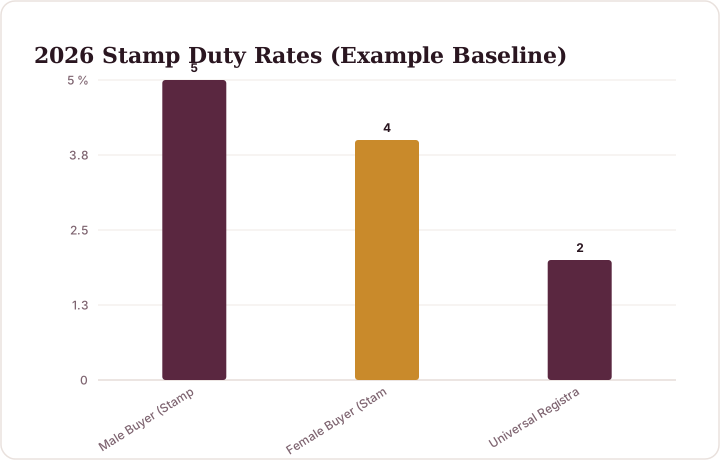
Let us look at the current financial baseline using Odisha as a representative example for 2026. The state government structures stamp duty to encourage female property ownership. Currently, the stamp duty is set at 5 percent of the property's registered value for a male buyer, and 4 percent for a female buyer. In addition to the stamp duty, a flat 2 percent registration fee applies universally.
These percentages translate into substantial upfront capital requirements. The table below illustrates the real cost impact for a standard transaction in 2026.
| Property Valuation | Buyer Gender | Stamp Duty Rate | Registration Fee Rate | Total Government Fees |
|---|---|---|---|---|
| ₹50,000,000 | Male | 5% (₹2,500,000) | 2% (₹1,000,000) | ₹3,500,000 |
| ₹50,000,000 | Female | 4% (₹2,000,000) | 2% (₹1,000,000) | ₹3,000,000 |
| ₹75,000,000 | Male | 5% (₹3,750,000) | 2% (₹1,500,000) | ₹5,250,000 |
| ₹75,000,000 | Female | 4% (₹3,000,000) | 2% (₹1,500,000) | ₹4,500,000 |
Buyers must calculate these costs based on the government-mandated benchmark valuation, commonly known as the circle rate or ready reckoner rate. If the actual transaction price is lower than the circle rate, the stamp duty must still be paid on the higher circle rate value. Failing to accurately assess these local benchmark rates can lead to severe tax penalties. Buyers can be held liable for massive shortfalls when they rely on outdated local valuation charts.
Furthermore, when families handle inherited property across international borders, the verification mechanics become even more complex. Co-owners must navigate strict partition rules and tax implications. Ignoring these localized legal nuances frequently exposes families to severe NRI joint property partition risks and aggressive NRI property tax fraud vulnerabilities orchestrated by local caretakers.
Next Steps for Local Property Due Diligence
The fragmented nature of India's property record system means that safety is entirely your responsibility. The Sub-Registrar will not protect you. The revenue department will not warn you. You must actively bridge the gap between these disconnected local authorities.
Before you transfer any advance payment or sign a preliminary agreement to sell, you must complete the full verification loop. Secure the 30-year chain of registered deeds. Pull the Form 25 Encumbrance Certificate. Demand the latest mutation extract from the state revenue portal. Cross-reference the names, the plot boundaries, and the legal descriptions across all three datasets. If you find a single discrepancy, a missing link in the chain, or a name that does not perfectly align, halt the transaction immediately.
Property document verification near you is not a simple background check you can outsource to a generic web portal. It is a rigorous, highly localized legal investigation that requires comparing physical reality against multiple layers of historical government data. Treat every transaction as a potential risk until the documentation definitively proves otherwise.