


A buyer who pays a token advance before a proper document check can lose the money entirely. When people search for legal help online, they assume handing over a newly printed, registered sale deed is enough to prove the seller owns the land. It is not. India operates on a highly fragmented land record system. A shiny deed does not prove absolute ownership.
The government does not guarantee your property title. If you buy a disputed plot, the financial loss is entirely yours. Families can lose large sums on a single transaction simply because they did not know which documents to demand. The solution is simpler than you think, provided you know exactly what your advocate should be looking for behind the scenes.
The Presumptive Title Problem in India
Let me share something that could save you lakhs. Under Section 17 of the Registration Act, 1908, registering a property document is mandatory. However, the Sub-Registrar's office only verifies that the stamp duty is paid and the parties are present. They do not verify if the seller actually has the legal right to sell that specific piece of land.
This legal reality creates what we call a presumptive title. The registration presumes a transaction took place, but it does not grant conclusive ownership. Section 54 of the Transfer of Property Act, 1882, governs how sales are executed, but the burden of verifying the seller's true ownership falls entirely on the buyer. If a fraudster registers a sale deed for land they do not own, the true owner can challenge it in court, and the buyer will lose both the land and their money.
Because there is no central national database that issues a conclusive certificate of ownership, buyers are forced to rely on state-specific revenue records. The DILRMP, Digital India Land Records Modernization Programme has made great strides in digitising these records, but the underlying legal principle remains unchanged. You must verify the entire historical chain of documents, not just the most recent transaction.
What is the Encumbrance Certificate?
The Encumbrance Certificate (EC) is a legal document issued by the Sub-Registrar's office in the form the state's registration rules prescribe: in Odisha, Form 25 (Nil) or Form 26 under the Orissa Registration Rules, 1988. It lists all registered transactions, mortgages, and legal claims against a specific property over a requested period. Without a clean EC, your property title is legally defective.
Why Local Verification Beats National Portals
A common mistake buyers make is assuming a single national portal will give them a green light to purchase. Land is a state subject in India. This means the vocabulary, the portals, and the procedures change the moment you cross a state border.
If you are verifying land in Karnataka, your lawyer will pull the RTC from the Bhoomi portal. In Maharashtra, they will check the 7/12 extract. If you are buying in the east, a Title verification checklist (Odisha) requires matching the Record of Rights (RoR), locally called the Khata, through the Bhulekh portal alongside the Inspector General of Registration (IGR) records.
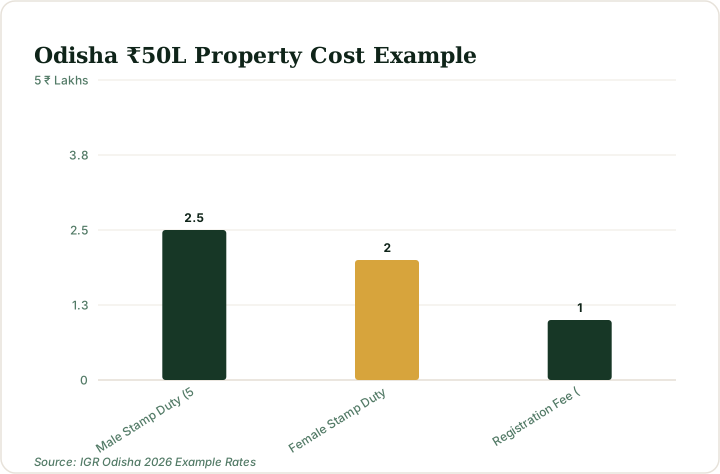
State-specific knowledge is also crucial for calculating costs accurately. Let us look at a real cost example in Odisha for 2026. For a property valued at ₹50 lakh, the state government levies a stamp duty of 5% for men and 4% for women, plus a standard 2% registration fee. This means a male buyer must budget roughly ₹2.5 lakh for stamp duty, while a female buyer pays ₹2.0 lakh, alongside the ₹1.0 lakh registration fee. If your lawyer does not know the local exemptions, circle rates, or recent revenue department circulars, your financial planning will be completely inaccurate.
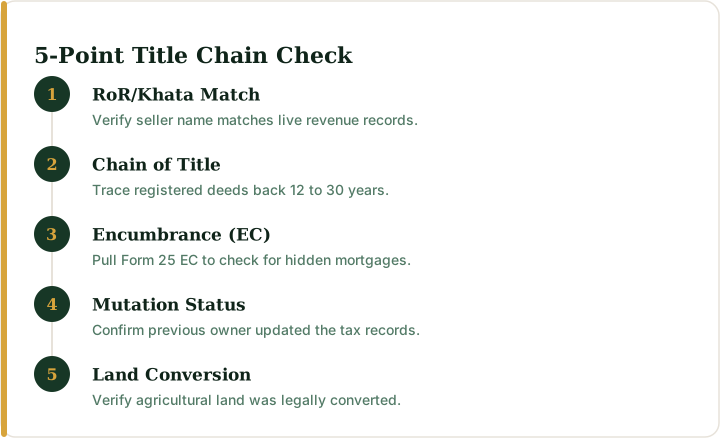
The 5-Point Legal Verification Framework
When you hire a competent professional, they do not just read the sale deed. They execute a strict, multi-layered verification framework. This is the playbook they follow.
First, they verify the Record of Rights (RoR) or Khata. The seller's name and the exact plot details must match the government's revenue records perfectly. If the seller has a sale deed but their name is missing from the RoR, the transaction cannot proceed safely.
Second, they trace the chain of title. They do not just look at the current seller. They look at how the seller got the property, and how the person before them got it. A standard legal search traces this chain back at least 12 to 30 years. Any missing link in this chain is a massive red flag.
Third, they pull the Encumbrance Certificate (EC) for the past 30 years. This reveals if the property has been mortgaged to a bank, pledged as collateral, or has any pending legal disputes registered against it.
Fourth, they check the mutation status. Think of mutation like a billing address update for the government. It updates the revenue records so the new owner pays the property tax. If the previous owner never mutated the property, the current seller cannot legally transfer a clean title.
Fifth, for built properties or converted land, they verify the approved building plan and the land conversion certificate. Agricultural land sold as residential plots without a formal conversion order from the Tahasildar is a trap that will block your future building permits and bank loans.
We will tell you exactly what to check and how to secure these documents before you sign any agreement.
Spotting the Mortgage-Without-Release Pattern
Let us look at a specific fraud pattern that can trap buyers across multiple state portals: the mortgage-without-release trap.
A seller takes a loan against their property ten years ago. They eventually pay off the entire loan to the bank. They have a letter from the bank stating the loan is closed. They show this letter to the buyer, and the buyer assumes the property is clear.
However, the seller never registered the formal Release Deed or Reconveyance Deed at the Sub-Registrar's office. Because the release was never legally registered, the Encumbrance Certificate still shows an active charge against the property. When the new buyer tries to get a home loan to purchase this property, their bank rejects the application immediately. Consider a case similar to the Forged Gift Deed Mutation Scam: Khordha Buyer Checklist pattern, where a buyer paid a non-refundable advance only to discover an uncleared charge on the EC. They lost their advance because they failed to check the Form 25 EC before signing the agreement.
What to Ask Your Lawyer Before Hiring
If you are actively searching for legal representation, you need to know how to interview them. Many general practitioners will offer to review your property documents, but property law requires highly specialized local knowledge.
Do not ask them if the property is safe. Ask them what specific documents they will pull from the state archives.
| Verification Step | What an Average Check Does | What a Specialist Lawyer Does |
|---|---|---|
| Chain of Title | Reads the latest sale deed | Traces registered deeds back 30 years |
| Encumbrance | Checks the last 3 years | Pulls Form 25 EC for 13-30 years |
| Revenue Records | Asks the seller for a copy | Pulls live RoR/Khata from the state portal |
| Local Dues | Ignores them | Checks municipal holding tax and water dues |
You should explicitly ask your advocate if they will verify the land conversion status if the plot is on the outskirts of the city. You should ask if they will cross-reference the physical boundaries with the sanctioned state map. A thorough verification takes time and requires pulling independent records directly from the Registration Act 1908 text mandated authorities, rather than relying on photocopies provided by the seller or the broker.
Let us check if your land is truly safe. It takes just a few minutes to initiate a proper review.
The 2026 Cost of Getting Verification Wrong
The financial stakes in 2026 are higher than ever. Property values have surged, and the complexity of urban land compliance has increased alongside them. If you skip a comprehensive legal verification to save a few thousand rupees on advocate fees, you are risking your entire life savings.
Consider the hidden costs of a defective title. If you buy a property with unpaid holding tax or municipal dues, the local authority will force you, the new owner, to clear those arrears before they process your mutation application. If you buy a flat in an under-construction project without verifying its RERA compliance, you have zero recourse if the builder abandons the project.
The most devastating outcome is discovering a double sale. This happens when a seller registers a sale deed to Person A, and a week later, registers a sale deed for the exact same plot to Person B at a different Sub-Registrar office, exploiting delays in digital record syncing. The only way to catch this is through a real-time, independent verification of the encumbrance and revenue records just hours before you execute your own transaction.
Next Steps for Your Property File
Do not let the complexity of India's land laws paralyze you. The verification process is highly structured, and once you understand the framework, you can take control of your property purchase.
First, demand the complete chain of title documents from your seller. Do not accept excuses about lost deeds. If a deed is lost, there is a specific legal procedure involving police complaints and public notices that must be completed before the sale can proceed.
Second, insist on seeing the latest Encumbrance Certificate and the live Record of Rights. Cross-check the names, the plot numbers, and the total area across all three documents: the sale deed, the EC, and the RoR.
Finally, engage a verified local advocate who understands the specific revenue rules of the district where the property is located. Provide them with the complete file and ask for a written legal opinion on the title's marketability.
Don't wait for a problem to appear years down the line. Let's verify your property file together.
Related guide: AI title verification vs an advocate search
Navigating Scheduled Area Land Restrictions in Odisha
Many buyers from outside the state-and even within-fall into a massive legal trap when purchasing land in Odisha’s tribal-dominated districts. Under the Odisha Scheduled Areas Transfer of Immovable Property (By Scheduled Tribes) Regulation, 1956 (OSATIP), the transfer of land from a tribal person to a non-tribal person is strictly prohibited in designated Scheduled Areas.
If you are looking at properties in districts like Mayurbhanj, Sundargarh, or Koraput, standard document verification is not enough. Section 3 of the OSATIP Regulation makes any unauthorized transfer absolutely null and void. The government can evict the non-tribal buyer, and you will lose your entire investment with zero legal recourse for a refund.
To ensure your property file is safe from OSATIP violations, your lawyer must verify the following:
- Seller’s Caste Verification: Cross-reference the seller's name on the Record of Rights (RoR) with their official caste certificate to confirm they are not classified as a Scheduled Tribe.
- Geographical Zoning: Check if the specific Mouza falls under a notified Scheduled Area, as restrictions apply strictly to these zones.
- Prior Transfer History: Trace the chain of title back at least 30 years to ensure no previous sale violated tribal land transfer laws, as illegal Benami transactions (where land is held by a tribal proxy) can be challenged decades later.
Takeaway: Never skip caste and demographic verification of the seller when buying land in Odisha’s Scheduled Areas, as a single OSATIP violation will instantly void your sale deed.
Verifying Agricultural to Homestead Conversion Status
Another common trap involves purchasing agricultural land for residential construction without verifying its legal conversion status. In high-demand districts like Khordha and Cuttack, unscrupulous developers often plot agricultural land (Sarad or Taila) and sell it to unsuspecting buyers as residential plots.
Under Section 8A of the Odisha Land Reforms (OLR) Act, 1960, agricultural land must be legally converted to homestead (Gharabari) before any construction can occur. If you build on unconverted land, the Tahasildar can halt construction, order demolition, and impose heavy penalties. The legal conversion process has a statutory disposal deadline of 180 days and requires paying a conversion premium based on the land's benchmark valuation, which varies with the plot size and location.
Before finalizing any plot purchase, instruct your property lawyer to demand these specific conversion proofs:
- The OLR 8A Order: A certified copy of the conversion order formally issued and signed by the local Tahasildar.
- Updated Gharabari Patta: The live RoR must reflect the updated land classification as Gharabari (homestead) rather than an agricultural classification.
- Revised Rent Receipts: The latest Khajana (land revenue) receipt must show the higher premium rate applicable to residential land.
Takeaway: Always demand the finalized OLR Section 8A conversion order and the updated Gharabari Patta before purchasing any plotted land for home construction in Odisha.