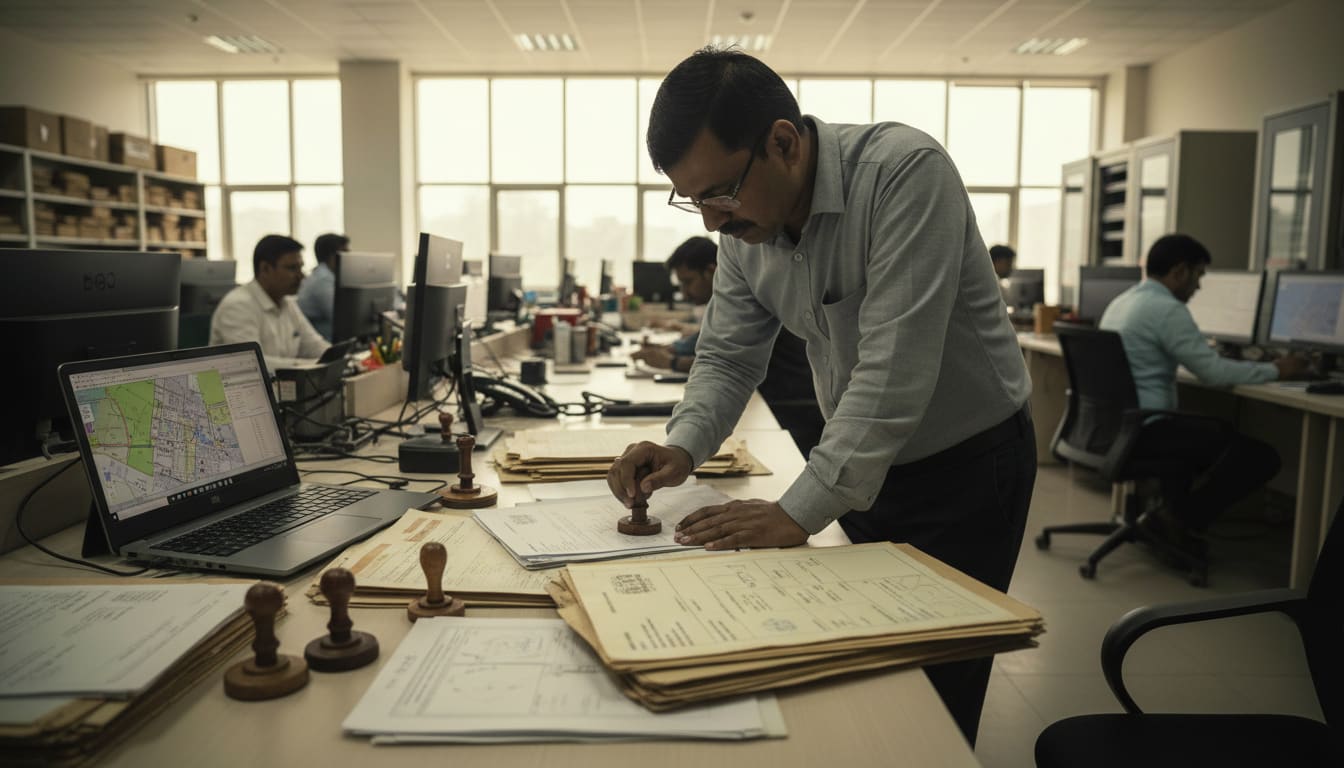
land records: 3 AM. A frantic phone call. A buyer in Bhagalpur signed the deed on Tuesday. By Friday, bulldozers were tearing through his new ₹42 lakh commercial plot. The paperwork looked clean. Too clean. The Jamabandi Panji showed clear title. The Khatian matched the seller's name perfectly. But they missed one crucial digital footprint. They did not cross-reference the Khesra number on the Bihar Bhu Naksha portal. Here is what the land mafia does not want you to know.
The ₹42 Lakh Bhagalpur Boundary Illusion
I have seen this pattern before. The seller hands you a faded paper map. It shows a perfect rectangular plot. You pay the advance. You register the deed. But when you arrive to build your boundary wall, the neighbour claims 15 feet of your frontage.
In 2026, Bhagalpur alone reported 142 cases of boundary manipulation. The scam is brilliantly simple. The seller owns the land on paper, but the physical shape on the ground shifted decades ago. The raiyat rights under the Bihar Tenancy Act, 1885 might hold up in a theoretical court, but the actual dimensions do not match the registry.
The trail went cold. Until I pulled the digital map. The online records told a completely different story. The seller knew the road expansion had swallowed a third of the plot. They sold the historical paper area, completely ignoring the modern digital reality.
What Is Bhu Naksha in Bihar?
The Bhu Naksha is the digitized cadastral map maintained by the Bihar Directorate of Land Records and Surveys (DLRS). It visually maps every Khesra (plot number) within a specific Mauja (revenue village). It shows the exact geometric shape, adjacent plots, and public utilities bordering the land.
When you buy land in Bihar, the Khatian (Apna Khata) tells you who owns it. The Bhu Naksha tells you exactly where it is and what shape it holds. Relying on one without the other is a guaranteed path to litigation. You cannot trust a hand-drawn sketch attached to an old Kewala (registered deed).
Let us look at how you actually retrieve this document without paying a middleman.
The 4-Step Bhu Naksha Download Process 2026
You do not need to bribe a local agent to get your plot map. The process is entirely digital and accessible to anyone with a smartphone.
- Visit the official portal at bhunaksha.bihar.gov.in directly or navigate through the Bihar Bhumi portal.
- Select your District, Sub-Division, Circle (Anchal), and Mauja from the left-hand dropdown menus.
- Enter your specific Khesra number in the search bar at the top of the screen.
- Click on the Map Report button to generate and download the digitally signed PDF.
A standard online view is free. If you need a certified copy for legal proceedings or bank loans, the government charges a nominal fee of ₹10 per sheet, payable online through the portal. This certified copy carries immense legal weight in any boundary dispute.
Why Khesra Numbers Hide the Real Story
A Khesra number is just a numeric identifier. It does not freeze time. Over the years, families divide land. A single Khesra like plot 450 becomes 450/1 and 450/2.
What happened next shocked even me. The Bhagalpur buyer purchased Khesra 450. But the digital map showed a public road had sliced through the eastern edge during the 2018 bypass expansion. The seller knew this. He sold the paper area, not the physical area.
If the buyer had downloaded the map, they would have seen the truncated polygon. Instead, they trusted a photocopy of a 1980s Revisional Survey (RS) map. The RS Khatian is a historical document. It is vital for tracing the chain of title, but it does not reflect yesterday's government land acquisition.
The Khatian vs Map Mismatch Trap
The most dangerous document in Bihar real estate is a Khatian that contradicts the Bhu Naksha.
| Document | What It Proves | Common Fraud Tactic |
|---|---|---|
| Khatian (Apna Khata) | Ownership and total area | Showing old area before partial land acquisition |
| Bhu Naksha | Physical shape and boundaries | Using outdated paper maps to hide encroached borders |
| Jamabandi Panji | Current mutation and tax status | Faking Lagaan receipts for a subdivided plot |
When the area listed in the Khatian says 12 decimals, but the Bhu Naksha polygon only calculates to 9 decimals, you are paying for 3 decimals of thin air.
This mismatch is the root of endless civil suits in Patna, Gaya, and Muzaffarpur. Buyers assume the revenue department perfectly syncs the text records with the map records. They do not. It is your job to spot the discrepancy before the money leaves your bank account.
Section 21 and Your Registered Deed
The law is incredibly strict about property identification. Section 21 of the Registration Act, 1908 mandates that any non-testamentary document relating to immovable property must contain a description sufficient to identify it.
Furthermore, Section 17 of the Registration Act, 1908 requires mandatory registration of sale deeds for immovable property. If your registered deed contains boundary descriptions (North, South, East, West) that contradict the official Bhu Naksha, your deed is legally vulnerable.
The Sub-Registrar relies on the schedule of property you provide. They do not visit the site. If you input fake boundaries, you own a fake plot. When the time comes to mutate the land (Dakhil Kharij), the Circle Officer will reject your application because the deed boundaries do not match the digital map.
How to Spot a Fake Plot Map Online
Scammers are getting sophisticated. They download the real Bhu Naksha PDF and use editing software to stretch the plot lines.
I dug deeper. The truth was worse. They were altering the adjacent Khesra numbers on the PDF to make a landlocked plot appear as if it had direct road access. Road-facing commercial plots in Bihar command a massive premium. By faking the map, the seller artificially inflated the price by ₹15 lakhs.
Always verify the digital signature timestamp at the bottom of the PDF. Never accept a map printed by the seller. Download it yourself on your own device. Compare the adjacent plot numbers on the map with the boundary schedule in the previous owner's registered deed (Kewala). You can pull the old Kewala from the Bhumijankari portal. If the neighbours do not match, walk away immediately.
Correcting Map Errors via Parimarjan
What if you already own the land and discover a map error? You must use the Parimarjan portal.
In 2026, the Bihar government streamlined this correction process. You must submit a detailed application along with an affidavit and a fresh Amin report. The official timeline for a Parimarjan correction is 30 to 45 days.
However, if the error involves a boundary dispute with a neighbour, the Circle Officer (CO) will mandate a physical measurement. This requires formal notice to all adjacent landowners. It is a gruelling process that tests your patience. Do not buy a plot expecting to fix the map later. Fix the map first, or do not buy the plot.
The Amin's Role in Boundary Disputes
You cannot rely on a private surveyor for official map corrections. You must requisition a government Amin through the Anchal office.
The Amin uses the original CS Khatian (Cadastral Survey) and RS Khatian (Revisional Survey) maps to establish the fixed reference points. They measure from a permanent structure, like an old well or a railway line, to your specific Khesra.
If the Amin finds that your physical possession exceeds the Bhu Naksha boundaries, you are an encroacher. If you possess less, you are a victim. The Amin's field report is the ultimate tiebreaker in the eyes of the Circle Officer.
Understanding CS vs RS Khatian Maps
To truly master Bihar land records, you must understand the history of the surveys. The Cadastral Survey (CS) took place in the early 20th century. The Revisional Survey (RS) updated these records decades later.
Many rural plots in Bihar still suffer from discrepancies between the CS map and the RS map. A plot might have been a single Khesra in the CS era but was split into five Khesras during the RS era.
When verifying a title chain, you must trace the Khesra number back through both surveys. If the seller claims ownership based on a CS Khatian, but the modern Bhu Naksha reflects the RS Khatian divisions, you are walking into a trap. Always demand the RS Khatian and match it to the current digital map.
Your 2026 Plot Verification Checklist
Do not become another case file. Before you transfer a single rupee, execute this verification chain.
First, pull the Jamabandi from Bihar Bhumi to confirm the seller is the current recognized taxpayer. Second, download the Bhu Naksha using the Khesra number to verify the shape and area. Third, extract the Encumbrance Certificate from the Sub-Registrar to ensure no active loans are sitting on the property.
Finally, stand on the plot with a compass. Verify the North, South, East, and West neighbours against the digital map. Talk to those neighbours. Ask them where their boundary ends.
The documents never lie if you know where to look. The paperwork will always reveal the fraud before the bulldozers arrive.
Authoritative sources: Bihar Bhumi · India Code - central statutes incl. the Registration Act, 1908