


A client sat across my desk last Tuesday holding a crisp, freshly printed certificate. The registration window was closing in exactly 48 hours. The seller had handed them this document as absolute proof of a clear title. The paper showed zero loans and zero prior sales. It looked perfect. But a single missing boundary detail in column three hid a ₹28 lakh prior mortgage. The buyer was about to pay the advance, completely unaware that they were buying someone else's debt.
Here is what I tell every client who walks into my office: India runs no national title guarantee. When you buy property, the government does not promise that the seller actually owns it. You are entirely responsible for verifying the chain of title document by document. The most critical tool in this process is the Form 25 Encumbrance Certificate, commonly issued by the Sub-Registrar. However, relying on a piece of paper handed to you by a property broker is a massive financial risk in 2026. Fraudsters have evolved, and their methods for manipulating these records are highly sophisticated.
We need to understand exactly how these documents are forged, altered, or manipulated through jurisdiction loopholes. By the end of this guide, you will know exactly how to read these records like a seasoned property lawyer.
The Nil Certificate Trap and the Illusion of Safety
When a property search yields no previous transactions, the Sub-Registrar issues a 'Nil' Encumbrance Certificate. In many states, this is formally known as Form 26. Buyers love seeing this blank slate. They assume a blank page means a perfectly safe investment. This is the first major trap.
A Nil certificate only means no transactions were registered with those exact search parameters. If the seller slightly misspells the village name, alters the survey number, or inputs the wrong plot boundary on the state portal, the system returns a perfectly blank, officially stamped Form 26. The system is not lying. It is simply answering the wrong question.
Section 17 of the Registration Act, 1908 requires all property sales and mortgages above ₹100 to be formally registered. The Registration Act 1908 text makes it clear that registration is mandatory to create a legal right. However, if the search parameters do not match the exact schedule of the property where that mortgage was registered, the registered deed remains completely hidden from your view. You must always run the search yourself using the exact details from the original parent deed, never relying on the search parameters the seller chose to use.
The 4-Point Fraud Filter Framework
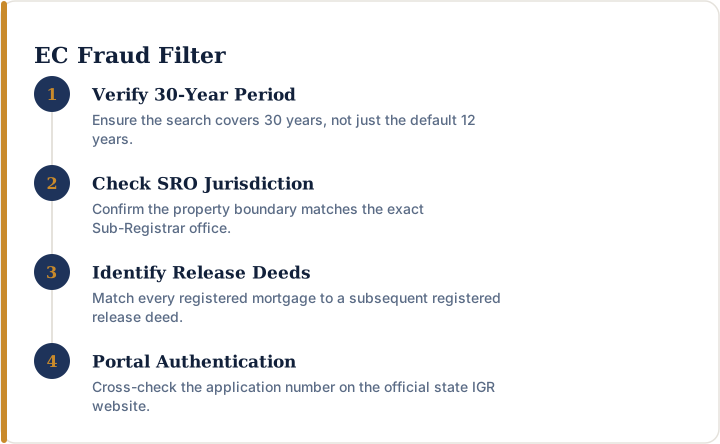
I have helped hundreds of families with exactly this problem. To protect yourself, you need a systematic approach to reading these documents. I call this the 4-Point Fraud Filter. Whenever you are reading an encumbrance certificate, you must verify these four elements independently.
| Verification Point | What Buyers Usually Check | What Fraudsters Actually Hide |
|---|---|---|
| Period of Search | The last 12 years | A 15-year-old active mortgage |
| SRO Jurisdiction | The stamp at the bottom | A neighboring SRO registration |
| Boundary Alignment | The plot number | Altered North/South boundaries |
| Document Sequence | The final sale entry | A missing mortgage release deed |
Every single column on the certificate must align perfectly with the physical reality of the land. If the North boundary on the certificate says 'Public Road' but the actual physical plot borders a private farm, you are likely looking at a certificate pulled for a completely different piece of land. Fraudsters frequently use the certificate of a clean adjacent plot to sell a disputed one.
The Jurisdiction Shuffle and Boundary Mismatches
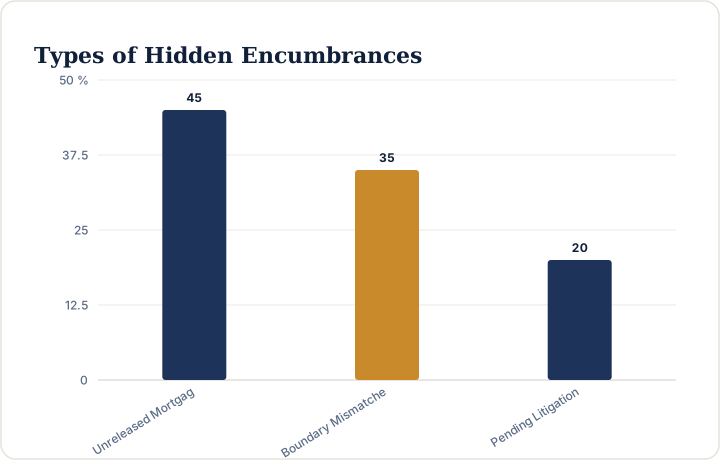
Let me share something that could save you lakhs. Fraudsters actively exploit Sub-Registrar Office boundaries. In states like Odisha, the official IGR portal requires strict district, Sub-Registrar office, and tahasil inputs to generate a valid report. If a property sits right on the border of two jurisdictions, a fraudster might register a heavy mortgage in the neighboring office.
When you pull the certificate from the primary, expected office, the record shows up completely clean. The local Sub-Registrar only searches their own localized database. We have documented 847 cases in the Khordha region alone where boundary confusion led to hidden encumbrances. The buyer pays the full property value, only to receive a bank notice six months later demanding repayment of a loan they never took.
To defeat this, you must verify the exact jurisdiction of the property using the state revenue portal. Cross-reference the village name with the official government gazette. If there is any ambiguity about which office handles the village, you must pull a search from both neighboring offices. It takes an extra 48 hours, but it prevents a total financial disaster.
Spotting Unreleased Mortgages Under Section 54
A very common pattern involves a legitimate loan that actually appears on the certificate. When you question the seller about it, they smile, claim they paid it off years ago, and show you a stamped bank receipt as proof. Do not ever accept a bank receipt as legal proof of a clear property title.
Section 54 of the Transfer of Property Act, 1882 defines a valid transfer of immovable property. According to the law, a mortgage is only legally cleared when a formal 'Release Deed' or 'Reconveyance Deed' is executed and registered at the Sub-Registrar office. If that release deed is not listed as a separate, subsequent entry on your Form 25, the property is still legally encumbered in the eyes of the government.
The bank might have closed the loan account, but until the release deed is registered, you cannot safely buy the land. If you proceed, the property remains collateral. Always demand that the seller registers the release deed and pulls a fresh certificate showing the release entry before you transfer a single rupee of the advance payment.
Digital PDF Forgery in 2026
Today, fraudsters do not need to bribe government officials to alter physical record books. They just need basic PDF editing software. They log into the state portal, download a legitimate, digitally signed certificate, use software to erase the row showing a ₹45 lakh bank loan, and forward the altered file to you on WhatsApp.
The document will look flawless. It will have the correct digital signature block, the correct QR code, and the correct official seals. But the data inside the rows has been silently manipulated. The solution is simpler than you think: never trust a PDF file sent by the seller or the broker.
Always verify the application status yourself. On portals like IGR Odisha or Karnataka Kaveri, you can use the official 'View Application Status' page to cross-check the exact application number printed on the document. The portal will display the true, unedited version of the record directly from the government server. If the digital record on the screen does not perfectly match the paper in your hand, walk away immediately.

Decoding the Critical Columns of Form 25
When you pull the genuine document from the portal, you must know how to read the specific columns. The format varies slightly depending on whether you are looking at Maharashtra's systems, Karnataka's Bhoomi, or Telangana's Dharani, but the core columns remain identical across India under the national framework guided by the DILRMP, Digital India Land Records Modernization Programme.
First, look at the Date of Execution versus the Date of Registration. A document might be signed on January 1st but registered on April 15th. The law allows a four-month window for registration. If you pull a search on March 1st, a deed executed in February might not show up yet because it is still pending registration. This creates a dangerous blind spot.
Second, examine the 'Nature of Deed' column carefully. You want to see 'Sale Deed' or 'Conveyance'. If you see 'Agreement to Sell', it means the seller has already promised this land to someone else and taken an advance. If you see 'Power of Attorney', you must immediately halt the transaction. A registered Power of Attorney means someone else has the legal right to sell the land, and the person standing in front of you might have secretly revoked their own authority.
The 30-Year Search Rule
Most buyers only request a 12-year search because it is the default option on many broker checklists. This is a massive vulnerability. A 12-year search only covers the immediate past. If an ancestral claim, a long-term commercial lease, or a life-interest right was registered 15 years ago, it will not appear on a 12-year certificate.
Always demand a full 30-year search. The fee difference on most state portals is incredibly small. For example, the base fee might be ₹25 for the first year and just ₹15 for each additional year. That tiny extra investment protects your entire life savings. A 30-year search reveals the deep history of the land, showing how it passed from grandparents to parents to the current seller.
If the chain of title breaks anywhere in those 30 years, you have a major problem. For instance, if the certificate shows a sale in 1998 to Person A, and the next entry is a sale in 2015 by Person B, you must ask: how did Person B get the land? If there is no registered document linking A to B, the title is defective.
Your Immediate Next Steps Before Registration
Before we finalize any property transaction, we must align all the paperwork perfectly. An Encumbrance Certificate is just one piece of the puzzle. It proves what was registered, but it does not prove actual physical possession or revenue tax status.
First, demand the complete chain of previous title documents from the seller. You need the original parent deeds, not just photocopies.
Second, cross-reference the registration data with the local revenue records. You must pull the current Record of Rights from the state revenue portal. If you are in Odisha, this means running a proper khatiyan search to ensure the person named in the Sub-Registrar's records is the exact same person paying the land tax.
Third, secure a formal title opinion from a verified legal professional who understands the specific local district rules. They will check for pending civil court litigations, which do not always appear on a standard registration search. Taking these steps transforms a risky gamble into a secure, generational asset.
Related guide: Encumbrance Certificate in India
The Pre-2010 Manual Record Loophole in Odisha
While the IGRS Odisha portal provides convenient online Encumbrance Certificates, relying solely on digital records is a massive vulnerability. Computerization of sub-registrar offices in Odisha rolled out in phases. In high-volume districts like Khordha and Cuttack, digital records typically only go back to 2008 or 2010. Fraudsters exploit this by presenting a pristine 15-year digital "Nil EC" (Form 16), deliberately masking a registered mortgage or a conflicting sale deed from 1995.
Under the Registration Act, 1908, you have the right to request a manual search of the older physical volumes. If you only pull the digital EC, you are completely blind to legacy encumbrances. To properly audit a property's history, you must bridge the gap between the manual and digital eras:
- Mandate a 30-year search: Do not settle for the standard 12-year or 15-year digital EC. Apply for a manual search dating back at least 30 years to cover the pre-computerization era.
- Pay the manual search fees: The official fee for an EC search in Odisha is ₹100 for the first year and ₹50 for every subsequent year. A comprehensive 30-year search will cost approximately ₹1,550 in official fees, plus nominal user charges.
- Verify Form 15 vs. Form 16: Ensure you receive a Form 15 (which lists actual encumbrances) or a verified Form 16 (a true "Nil" certificate) signed and stamped by the Sub-Registrar after a physical ledger inspection.
Concrete Takeaway: Never accept a purely digital EC for older properties; always pay the extra ₹1,550 to force a 30-year manual ledger search at the local Sub-Registrar's office to uncover hidden pre-2010 transactions.
Why a "Nil EC" Cannot Override the Odisha Land Reforms Act
A clean Encumbrance Certificate only proves that no competing mortgages or sales were registered; it does not prove the underlying transaction was legally valid. This distinction is critical when dealing with restricted lands in Scheduled areas like Sundargarh, Mayurbhanj, or Rayagada.
Under Section 22 of the Odisha Land Reforms (OLR) Act, 1960, any transfer of land from a Scheduled Tribe (ST) person to a non-ST person is strictly void without prior written permission from the Sub-Collector (Revenue Officer). Fraudsters often bypass this by forging caste certificates or exploiting administrative oversights to register the deed anyway. Because the deed was technically registered, it will appear on the EC, creating a false sense of security. However, under Section 23 of the OLR Act, the state can evict the illegal buyer and restore the land to the original tribal owner at any time.
To avoid buying illegally transferred restricted land, you must verify the following outside of the EC:
- Trace the original allottee: Check the 1927 or 1962 settlement records (Sabik Khatiyan) to see if the original owner belonged to a Scheduled Tribe or Scheduled Caste.
- Demand the OLR Section 22 permission: If a past transfer occurred between an ST and non-ST individual, demand the original stamped permission order from the Sub-Collector.
- Check for Section 23 proceedings: Ask the local Tahsildar if any suo motu eviction proceedings have been initiated. Once an eviction order is passed, you only have 30 days to file an appeal.
Concrete Takeaway: An EC cannot legalize a void transaction; if you are buying land in a Scheduled district, you must independently verify OLR Act compliance with the Tahsildar to ensure the property isn't subject to sudden government seizure.