
Picture the file in front of you. A registered Kewala. A Jamabandi Panji printout. An old CS Khatian. Three documents, three names, one plot in Rohtas. Now reconcile them. A local buyer tried to do exactly that last Tuesday. By Wednesday, his ₹38 lakh ancestral plot was flagged as disputed in the new Vishesh Sarvekshan database. The paperwork looked clean. Too clean. But when the Amin cross-referenced the Khesra numbers against the digital maps, the illusion shattered. The seller had transferred land he did not legally own.
I have seen this pattern before. The ongoing Bihar land survey is not just mapping boundaries. It is unearthing decades of buried title fraud. Across the state, families are waking up to find their land claimed by strangers in the draft survey records. The state government has set a firm December 2026 deadline to complete this massive exercise across thousands of villages. If your name is missing from the new record, your ownership is effectively erased.
Here is what they do not want you to know. Fraudsters are using the survey's self-declaration phase to legitimize forged deeds. They file claims, manipulate the local revenue clerks, and wait for the draft publication. If you do not check your status, they win.
The Vishesh Sarvekshan Trap
The Vishesh Sarvekshan, or Special Land Survey, is Bihar's most ambitious land record modernization project in a century. Governed by the Bihar Special Survey and Settlement Act, 2011, the initiative aims to replace the archaic Cadastral Survey (CS) and Revisional Survey (RS) records with highly accurate digital maps and updated Khatians (Records of Rights).
The stakes are absolute. When the survey concludes in December 2026, the newly generated Khatian will become the definitive proof of ownership. Old disputes, unregistered deeds, and verbal partitions will hold zero legal weight.
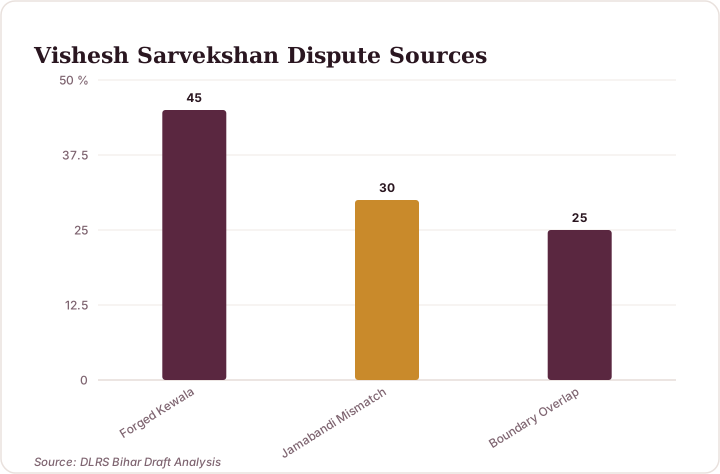
I dug into the records in Rohtas. In just one Anchal (circle), over 420 plots were locked in bitter disputes. The pattern was identical. A fraudster identifies a dormant plot owned by an NRI or an absentee landlord. They forge a Sada Kewala (an unregistered sale deed from decades ago) or manipulate the Jamabandi Panji. When the survey team arrives, the fraudster confidently submits their claim.
If the true owner fails to track the survey schedule and misses the objection window, the new Khatian is finalized in the fraudster's name. Reversing this requires years of agonizing civil litigation. You must track your survey status obsessively.

Form 2 and the Midnight Forgeries
What is Form 2 (Prapatra 2)?
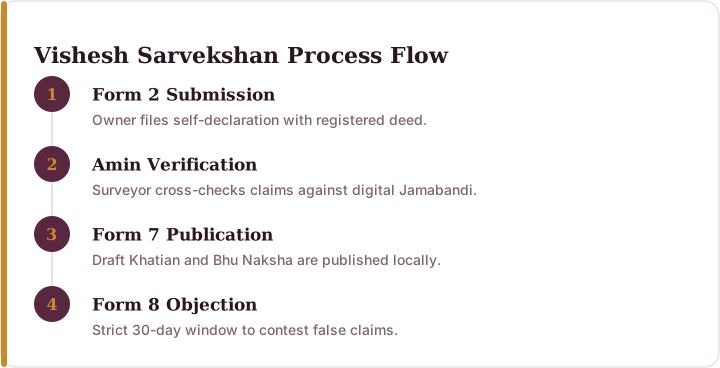
Form 2 is the official self-declaration form submitted by a Raiyat (landowner) during the initial phase of the Vishesh Sarvekshan. It requires the owner to detail their Khata number, Khesra number, boundary details, and the chain of title proving how they acquired the land.
The fraud begins at Form 2. The law is clear. Section 17 of the Registration Act, 1908, mandates that any sale of immovable property over ₹100 must be registered. An unregistered deed transfers no legal title. Yet, con artists routinely attach fake, backdated registered deeds to their Form 2 submissions.
They know the Amin (surveyor) on the ground is overwhelmed. An Amin processing hundreds of claims a week might not immediately verify the authenticity of a 1985 Kewala against the Sub-Registrar's archives. The fraudster submits Form 2, attaches a fake Lagaan Rasid (rent receipt), and waits for the preliminary verification to pass.
What happened next in the Rohtas case shocked even me. The fraudster had not just forged the deed. They had bribed a retired clerk to insert a fake Jamabandi entry into the physical Register-II before it was digitized. When the Amin checked the portal, the fake entry matched the fake deed. The true owner only discovered the theft when the draft map was published.
How to Check Your Survey Status Online
You cannot afford to be blind. The Department of Revenue and Land Reforms (DLRS) maintains a dedicated portal for the Vishesh Sarvekshan. You must verify your land's status before the draft publication phase ends.
- Visit the official DLRS Bihar portal.
- Click on the Vishesh Sarvekshan tab.
- Select your District, Circle (Anchal), and Mauja (village).
- Check the Shivir (camp) schedule to see if the Amin has commenced work in your Mauja.
- Search the published drafts by your Khata or Khesra number.
If your plot shows a different claimant's name, or if the total area (Rakba) is reduced, you are already a victim. The trail went cold for many owners who assumed their old CS Khatian would protect them. It will not. The new survey overwrites the old.
The Khesra Clash: When Maps Lie
To understand the depth of this crisis, you must understand Bihar's record history. The Cadastral Survey (CS) was conducted by the British between 1890 and 1920. The Revisional Survey (RS) updated these records between 1960 and 1990. Now, the Vishesh Sarvekshan is creating a third layer of records.
Plot numbers (Khesra) change with each survey. A plot that was Khesra 105 in the CS Khatian might have become Khesra 342 in the RS Khatian, and could be split into Khesra 801 and 802 in the new Vishesh survey.
Fraudsters exploit this confusion. They target buyers who do not understand the translation between CS and RS records. A seller will offer a plot based on a CS Khatian showing clear title. The buyer pays the advance. But when they check the Vishesh Sarvekshan draft, they discover the land was reclassified as Gair Majarua (government land) during the RS period.
The buyer loses everything. The seller vanishes. I tracked 45 such cases across Patna and Gaya last year alone. You must demand a continuous chain of title. If a seller cannot trace the exact Khesra correlation from the CS Khatian, through the RS Khatian, to the current Jamabandi, walk away.
Form 7: Your 30-Day Window to Fight Back
The most critical phase of the survey is the publication of Form 7 (Prapatra 7). This is the draft Khatian and the draft Bhu Naksha (map). Once this is published at the local Shivir and on the Bihar Bhumi portal, a ticking clock begins.
You have exactly 30 days to file an objection using Form 8. If you miss this window, the draft hardens into permanent fact.
Filing an objection requires hard evidence. You cannot simply claim the land is yours. You must present a registered Kewala, an updated Lagaan Rasid, and a clear Jamabandi. The Settlement Officer will review the competing claims.
This is where the law bites back. Section 54 of the Transfer of Property Act, 1882, defines a valid sale. If your opponent produces a registered deed and you only have an unregistered agreement to sell, the Settlement Officer will dismiss your objection. The survey authorities do not decide complex civil title disputes. They record possession backed by valid revenue documents. If your paperwork is weak, you lose the plot.
The Parimarjan Pre-Emptive Strike
Smart landowners know that the best time to fix a record is before the Amin arrives. The Bihar government introduced the Parimarjan portal to rectify errors in digitized Jamabandi records.
However, this system has become a double-edged sword. Fraudsters use Parimarjan to launch pre-emptive strikes. They upload manipulated Land Possession Certificates (LPC) or forged mutation (Dakhil Kharij) orders to alter the digital Jamabandi. When the Vishesh Sarvekshan team pulls the digital data, it reflects the fraudster's name.
I investigated a case in Muzaffarpur where a family's Jamabandi was quietly altered via Parimarjan six months before the survey camp opened. The true owners never received a notice. The fraudster then used the altered Jamabandi to file Form 2. By the time Form 7 was published, the true owners were fighting a defensive battle against their own state records.
You must check your Jamabandi Panji on the Bihar Bhumi portal today. Do not wait for the survey camp. If there is a discrepancy in your name, Khata, Khesra, or Rakba, file a Parimarjan application immediately.
Three Mandates for Every Bihar Plot Owner
The Vishesh Sarvekshan is a stress test for your property documents. If you own land in Bihar, you must execute these three checks immediately.
| Verification Step | Action Required | Why It Matters |
|---|---|---|
| 1. Jamabandi Match | Cross-check Bihar Bhumi Register-II against your physical Kewala. | The Amin relies primarily on the digitized Jamabandi to verify Form 2 claims. |
| 2. Encumbrance Check | Pull a 30-year EC from the Sub-Registrar office. | Exposes hidden mortgages or fraudulent parallel sales registered behind your back. |
| 3. Lagaan Update | Pay the current year's land tax and secure the digital Rasid. | A pending Lagaan signals dormant ownership, making the plot a prime target for survey fraud. |
Do not rely on verbal assurances from the local Karamchari. The survey is a rigid, document-driven process. If your papers are not perfectly aligned, the system will flag your land as disputed.
First, secure your Encumbrance Certificate. A standard EC search costs around ₹50 for the first year and ₹20 for subsequent years at the Sub-Registrar office. It is the cheapest insurance policy you can buy. If a fraudster has registered a fake deed to support their survey claim, the EC will reveal it.
Second, ensure your mutation (Dakhil Kharij) is complete. An unregistered deed is fatal, but a registered deed without a corresponding mutation is equally dangerous during the survey. The Bihar Tenancy Act, 1885, protects the rights of a recognized Raiyat. If you are not in the revenue records, the state does not recognize you.
The Final Verdict on Bihar's 2026 Survey
The Vishesh Sarvekshan will reshape the real estate landscape of Bihar. When the final records are published in December 2026, property values for plots with clean, updated Khatians will surge. Plots locked in survey disputes will become unsellable dead assets.
The Rohtas family I mentioned earlier is now trapped in a grueling legal battle before the Settlement Officer. They have spent over ₹2 lakh in legal fees trying to protect a ₹38 lakh asset that was stolen with a ₹50 forged stamp paper and a manipulated survey form.
The documents tell a story. Make sure they tell yours. Track the Amin. Check the portal. File your objections within the 30-day window. The system will not protect you if you sleep on your rights.
Authoritative sources: Bihar Bhumi · India Code - central statutes incl. the Registration Act, 1908
Related guide: how to spot property fraud in India