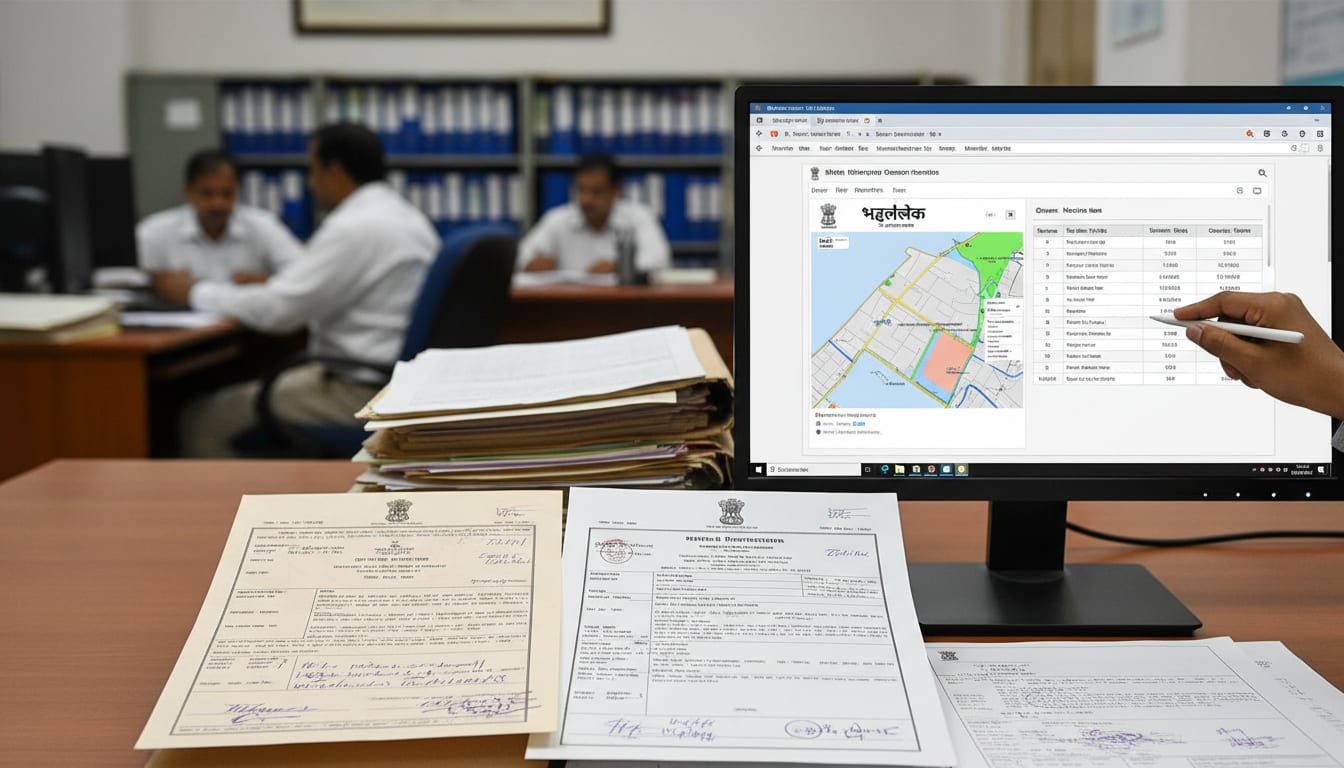
A buyer in a major Indian tech hub signed the sale deed on a Tuesday. By Friday, the land belonged to a bank. The buyer had done what most people do. He logged into the state land portal, typed in the survey number, and saw the seller's name shining brightly on the screen. The digital record looked perfect. Too perfect. He paid ₹2.4 Crores and registered the deed. Three weeks later, a recovery notice arrived. The seller's father had mortgaged that exact plot in 2012. The state portal only showed the current revenue mutation, completely hiding the historical bank charge. I have seen this pattern before. Hundreds of families lose their life savings every year because they trust a digital dashboard without understanding how Indian property law actually works. The documents told a different story when I dug into the archives. The truth is that a single portal check is never enough. India runs no national title guarantee. A buyer in any state must verify the chain of title document-by-document because the system is fragmented by design.
What is Presumptive Title in India?
Presumptive title means that a government land record is only a presumption of ownership, not a guarantee. Unlike countries with Torrens title systems, India does not certify that you own a property. The state merely records who is currently paying the land revenue. Section 17 of the Registration Act, 1908 mandates that any sale of immovable property above ₹100 must be registered. However, registration only records the transaction. It does not prove the seller had the legal right to sell it in the first place. If someone sells you a property they do not own, the Sub-Registrar will still register the deed. The burden of verifying the true owner falls entirely on you. If a dispute arises, the courts will look at the entire historical chain, not just the latest online entry.
The Two-Crore Illusion on State Portals
The ₹2.4 Crore trap works because buyers confuse revenue records with title records. When you check portals like Karnataka Bhoomi, Telangana Dharani, or Odisha Bhulekh, you are looking at the Record of Rights. This document is maintained by the local Tahsildar. It exists primarily for agricultural tax collection. Fraudsters know this. They exploit the gap between the revenue office and the Sub-Registrar office. A scammer might sell a plot to Person A, who registers the deed but forgets to apply for mutation. The scammer's name remains on the state portal. The scammer then shows this clean online record to Person B and sells the same plot again. This double-registration scam is the most common way buyers encounter fake property documents today. The portal lies by omission.
Revenue Records vs Registration Records
Here is what they do not want you to know. India maintains two parallel, completely separate systems for land. The Revenue Department handles mutations, land use, and property tax. The Registration Department handles sale deeds, gift deeds, and mortgages. In most states, these two systems do not talk to each other in real time. A transaction at the Sub-Registrar office might take up to 45 days to reflect in the revenue portal. During this 45-day window, the online record is dangerously outdated. You cannot rely on a single source. You must cross-reference the revenue data with the registration data. If the seller's name is on the Record of Rights but they cannot produce the original registered sale deed, you are walking into a trap. The registered deed is the primary document of title.
The Digital India Land Records Reality
The government launched the DILRMP, Digital India Land Records Modernization Programme to fix this disconnect. The goal was to digitize all land records and integrate the registration offices with the revenue offices across 28 states. Progress in 2026 remains uneven. Some states have fully integrated systems where a registered sale deed automatically triggers a mutation notice. Other states still rely on manual paperwork that can take months to process. Because land is a state subject under the Indian Constitution, every state has its own portal, its own local terminology, and its own rules. What is called a Khatian in Bihar or Odisha is called a Pahani or RTC in Karnataka, and a 7/12 Extract in Maharashtra. This fragmentation makes pan-India verification incredibly complex for the average buyer.
The 3-Step Title Chain Check
I dug deeper to find out how professional investigators verify land. You cannot just look at the current owner. You must trace the history back to the original source. This requires a strict, methodical approach.
- Pull the Encumbrance Certificate. Visit your state's registration portal and download the encumbrance certificate. This document lists every registered transaction on the property. You must check a minimum of 12 to 30 years of history. Look for mortgages, lease agreements, or previous sales.
- Verify the Mutation Chain. Go to the state revenue portal. Check the current mutation status. Compare the name on the revenue record with the name on the latest sale deed. If they do not match, stop the transaction immediately. You can track this through specific local guides, like checking mutation status in your respective state.
- Inspect the Original Documents. Demand to see the original, physical sale deed. Scammers often use color photocopies. Check the stamp paper, the registration number, and the signatures. If the property was inherited, demand the legal heir certificate and the partition deed.
Comparing State Portals in 2026
Every state uses different terminology for the exact same documents. You must know what to search for when verifying ownership online. Here is a breakdown of the major state portals and their key documents.
| State | Portal Name | Revenue Record Name | Registration Portal |
|---|---|---|---|
| Karnataka | Bhoomi | RTC / Pahani | Kaveri Online |
| Maharashtra | Mahabhumi | 7/12 Extract | IGR Maharashtra |
| Telangana | Dharani | Pattadar Passbook | Dharani / IGRS |
| Tamil Nadu | Tamil Nilam | Patta-Chitta | TNREGINET |
| Odisha | Bhulekh | RoR / Khatian | IGR Odisha |
Laws That Govern Your Property Title
Two central laws dictate whether your property purchase is legally valid. You cannot ignore them. Section 54 of the Transfer of Property Act, 1882 defines a sale as a transfer of ownership in exchange for a price paid or promised. It explicitly states that the sale of tangible immovable property worth ₹100 or more can only be made by a registered instrument. An unregistered agreement to sell, a notarized power of attorney, or a verbal promise gives you absolutely no legal title. If a seller tries to transfer property using an unregistered deed to save on stamp duty, the law will not protect you. Furthermore, Form 25 of the Indian Stamp Rules governs the issuance of the Encumbrance Certificate. This certificate is your primary defense against hidden bank loans. If a charge is registered under Form 25, it binds the property, no matter who buys it next.
How to Verify Property Ownership Online
The paperwork always leaves a trail if you know where to look. Do not let the digital convenience of a modern portal blind you to the historical reality of the land. You must act as your own investigator.
- Identify the exact survey number, khata number, and village name.
- Search the state revenue portal for the current Record of Rights.
- Search the state registration portal for the Encumbrance Certificate spanning at least 15 years.
- Cross-match the boundaries and dimensions on the online record with the physical site plan.
- Hire a local advocate to physically visit the Sub-Registrar office to verify the volume and page numbers of the registered deed.
The next victim could be you. Or not. Your choice.
Title verification is not a one-click process in India. It is a rigorous investigation into decades of paperwork, legal statutes, and bureaucratic records. Protect your investment by verifying every single link in the chain.
Authoritative sources: DILRMP - Digital India Land Records Modernization Programme · India Code - central statutes incl. the Registration Act, 1908
Related guide: online land title verification in India
Decoding Bhulekh Odisha: The Hidden Mutation Trap
While central portals provide a broad overview, property verification in Odisha requires deep-diving into the state-specific Bhulekh platform. A common trap for buyers in high-demand districts like Khordha and Cuttack is relying solely on the finalized Record of Rights (RoR or Patta). The finalized RoR does not reflect properties currently locked in ownership disputes or pending mutation applications, which can instantly derail a transaction.
Under Section 19 of the Odisha Survey and Settlement Act, 1958, land records must be updated to reflect lawful transfers. While uncontested mutations are legally expected to be resolved within 90 days by the local Tahasildar, bureaucratic backlogs frequently stretch this timeline. If you attempt to register a sale deed for a property with an active, unresolved mutation, the Sub-Registrar will block the transaction.
To avoid this, you must actively verify the mutation status on the Bhulekh Odisha portal. Execute the following steps:
- Navigate to the "View RoR" section and select the exact district, Tahasil, and village.
- Input the Khatiyan number or tenant name to pull the current land schedule.
- Click on the "Pending Mutation" tab linked to that specific plot to check for active legal disputes.
- Pay the ₹30 statutory user fee via the Odisha Treasury portal to download a digitally signed, legally admissible copy of the RoR for your records.
Takeaway: Never transfer a token advance to a seller in Odisha if the Bhulekh portal indicates an active, unresolved mutation on the target plot. Wait for the Tahasildar’s final order to be officially reflected in the Khatiyan.
Extracting Certified Deeds via IGR Odisha
An Encumbrance Certificate (EC) proves that a transaction occurred, but it does not reveal the specific terms, restrictive covenants, or boundary disputes hidden within the actual sale deed. To verify true ownership, you must retrieve the certified copy of the registered document directly through the Inspector General of Registration (IGR) Odisha portal.
Under Section 57 of the Registration Act, 1908, any citizen has the statutory right to inspect and obtain certified copies of registered documents pertaining to immovable property. In districts with heavy legacy paperwork like Ganjam or Puri, relying on the seller's photocopies is a massive financial risk. Forgeries of stamp papers are common, and the only unassailable source of truth is the Sub-Registrar's digital archive.
When requesting a certified copy online through IGR Odisha, keep the following parameters in mind:
- Fee Structure: You must pay a base application fee of ₹20, plus an additional ₹10 for every printed page of the registered deed.
- Processing Timeline: Once the online payment is authenticated, the Sub-Registrar’s office typically takes 3 to 7 days to process the request and issue the digitally signed copy to your portal dashboard.
- Verification Points: Upon receiving the document, immediately cross-reference the thumb impressions, the execution date, and the exact stamp duty paid against the seller's provided photocopy.
Takeaway: A clean Encumbrance Certificate is only half the battle. Always spend the extra time and nominal fees on IGR Odisha to extract the full certified deed to verify the exact legal boundaries and ownership clauses.