

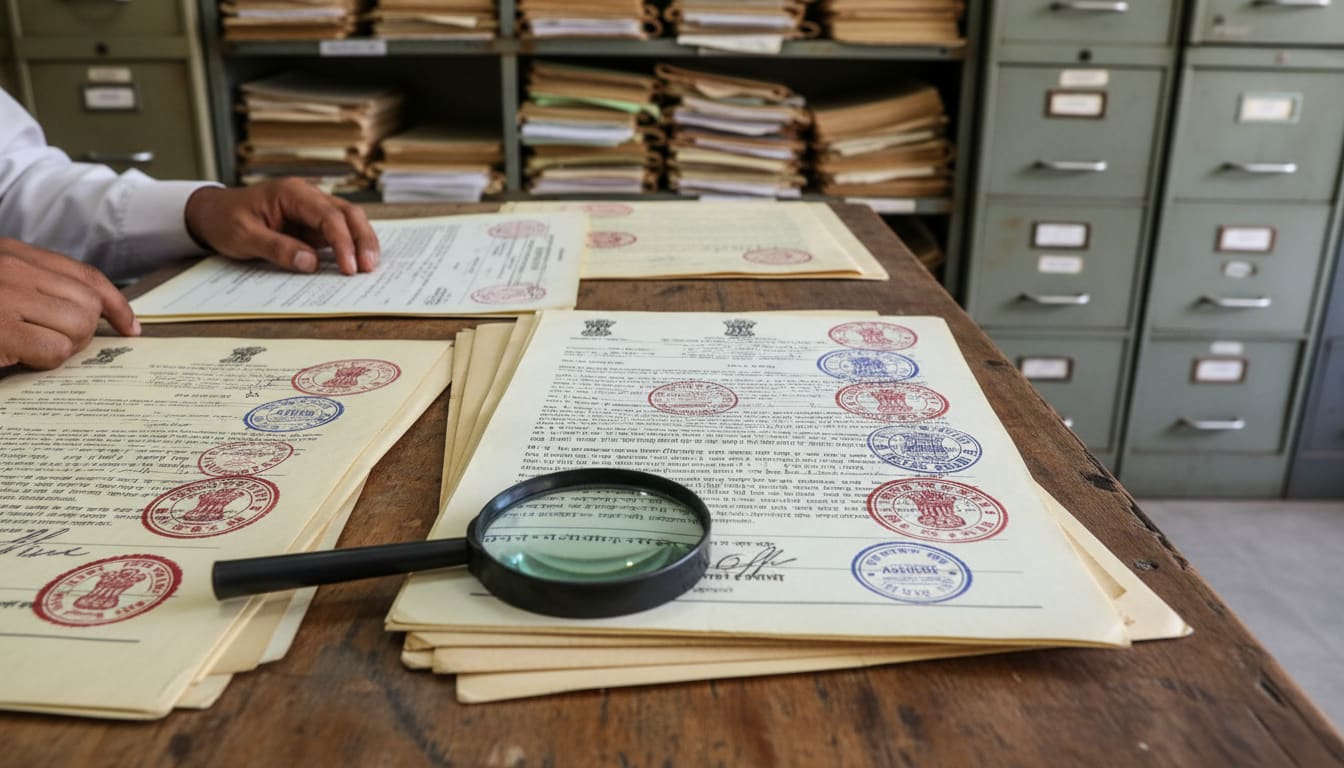
What do you do when the state portal shows a clear title, the Encumbrance Certificate is spotless, but a court bailiff knocks on your door three years later?
Picture this: 3 AM. A loud knock. A family in Hyderabad wakes up to a court summons. They had purchased a prime 2,400 square foot plot for ₹3.2 crores in 2023. The paperwork looked clean. Too clean. The seller's name was on the state portal. The Encumbrance Certificate showed zero active loans. They paid the stamp duty, registered the deed, and started building their dream home.
Then the seller's two estranged brothers filed a partition suit.
Here is what they do not want you to know. India runs no national title guarantee. When you buy land anywhere in the country, you are not buying an absolute, state-backed guarantee of ownership. You are buying a presumption. If you do not verify the historical chain of title document by document, you are playing Russian roulette with your life savings. The digital portals give a false sense of security. I have seen this pattern before. When I dug into the records of this specific ₹3.2 crore disaster, the truth was worse than a simple scam. It was a perfectly legal blind spot that exists in every state from Maharashtra to Odisha.
The Illusion of the Digital Land Record
State governments have spent the last decade digitising land records under DILRMP, the Digital India Land Records Modernization Programme. You can now pull up Karnataka Bhoomi, Maharashtra 7/12, Telangana Dharani, or Odisha Bhulekh on your phone.
Buyers look at these portals, see the seller's name, and transfer the advance. This is a fatal error.
Revenue records are not documents of title. They are documents of tax collection. A name on a digital Record of Rights simply means the government knows who to bill for property tax. It does not prove that person has the legal right to sell the land. The Supreme Court of India has repeatedly ruled that mutation entries do not confer title. Yet, buyers treat these portals as gospel.
The trail went cold for the Hyderabad family because they only checked the digital present. They failed to check the analogue past. The seller had inherited the land from his father. The digital portal showed the seller as the sole owner because he was the one paying the taxes. But under the Hindu Succession Act, his two brothers had an equal, undivided share.
Because the family never executed a registered partition deed, the brothers' claims remained invisible to the digital system. The buyer lost the ₹3.2 crore property and is now locked in a decade-long civil suit.
What is the Encumbrance Certificate?
The Encumbrance Certificate is a legal document issued by the Sub-Registrar office under Form 25 of the Indian Stamp Rules. It records all registered transactions, mortgages, and leases on a specific property over a requested period, typically 13 to 30 years.
However, the Encumbrance Certificate only reflects what is actually registered. If a family partitions land via an unregistered settlement, or if someone mortgages the original title deed to an unorganized private lender without registering a memorandum of deposit, the Encumbrance Certificate remains entirely blank. Relying solely on a 15-year Encumbrance Certificate is the fastest way to walk into a title dispute.
Section 17 and the Registration Act Trap
The legal framework governing property in India is archaic and unforgiving. Section 17 of the Registration Act, 1908 mandates that any document transferring an interest in immovable property worth more than ₹100 must be registered.
Parallel to this, Section 54 of the Transfer of Property Act, 1882 defines a sale and strictly requires a registered instrument for execution.
These two statutes form the bedrock of your legal due diligence. If a prior transfer in the 30-year chain was executed merely on a ₹500 stamp paper and notarized but never registered at the Sub-Registrar office, the chain of title is broken. The current seller does not legally own the property, regardless of what the mutation records say.
I dug deeper into recent 2026 data. In cases of double-sale fraud, perpetrators exploit this exact gap. They show one buyer the unregistered agreement and another buyer the digital mutation. Without a rigorous, multi-layered document checklist, you will miss the discrepancy.
The 5-Point Title Chain Verification
You must verify the property independently of the seller's claims. This requires a systematic approach that cross-references the revenue department with the registration department.
- Trace the Mother Deed: Demand the original document that established the first ownership, ideally tracing back 30 years or to a government grant.
- Pull a 30-Year Encumbrance Certificate: Do not settle for the standard 12-year search. Request a manual search for the full 30 years to uncover dormant mortgages.
- Verify the Mutation Extracts: Cross-check the Sub-Registrar sale deed against the local revenue office mutation order. The dates and plot dimensions must match perfectly.
- Mandate a Legal Heir Certificate: If the property was inherited at any point in the chain, demand the official legal heir certificate and death certificate of the deceased owner.
- Check for Government Acquisition: Search the local gazette or development authority portal to ensure the land is not earmarked for road widening or infrastructure projects.
Skipping even one of these steps leaves a backdoor open for litigation. When you need a legal clearance before land purchase, this 5-point framework is your primary shield.
State by State Record Fragmentation
India's land record vocabulary changes every time you cross a state border. A buyer from Delhi investing in Bangalore or Bhubaneswar will face entirely different documentation standards.
In Maharashtra, you must verify the 7/12 extract and the Property Card for urban areas. In Karnataka, the RTC or Pahani is the primary revenue document. In Telangana, the Dharani portal issues an e-Passbook. In Odisha, buyers must navigate the Bhulekh portal and understand the critical difference between Sabak (old) and Hal (new) Khata records.
This fragmentation is dangerous. A buyer might secure a perfect bank-panel legal opinion template for an eastern state, but apply the wrong logic to a southern purchase. You must demand the specific revenue document mandated by the local State Land Revenue Act.
For example, if you buy agricultural land in Karnataka, you must verify the Form 11E sketch. In Odisha, missing the mutation order can lead to buying illegal plots under fire from the revenue department. The name of the document changes, but the legal requirement for unbroken continuity remains absolute.
The Cost of Missing the Mutation Link
Many buyers believe their job is done once the Sub-Registrar hands over the registered sale deed. This is a catastrophic 2026 mistake.
Registration transfers the legal title, but mutation updates the government tax records. If you fail to apply for mutation within the standard 45-day window, the previous owner's name remains on the state portal.
What happens next? The previous owner can easily apply for a duplicate copy of the old deed, pull the current digital record showing their name, and sell your land to an unsuspecting third party. You will eventually win the court battle because your registered deed predates theirs, but you will spend ₹15 lakhs in legal fees and a decade in civil courts to prove it.
You must track the mutation process to completion. A registered deed without a corresponding mutation entry is a loaded weapon pointing directly at your investment.
Your 2026 Legal Document Checklist
Do not rely on memory. Use this definitive checklist before you transfer a single rupee to the seller.
| Document Name | Issuing Authority | What It Proves | Risk If Missing |
|---|---|---|---|
| Original Title Deed | Sub-Registrar Office | Current seller's absolute legal ownership | Complete loss of property title |
| 30-Year Encumbrance | Sub-Registrar Office | Absence of registered mortgages or liens | Taking on the seller's hidden debts |
| Mutation Extract | Local Revenue Office / Tahsildar | Government recognition for tax purposes | Double-sale fraud vulnerability |
| Approved Layout Plan | Municipal / Development Authority | Legal zoning and construction compliance | Demolition by civic authorities |
| Up-to-date Tax Receipts | Municipal Corporation | No pending civic dues or attachments | Forced payment of historical arrears |
| Khata / Patta Certificate | Revenue Department | Official entry in the municipal property register | Inability to secure bank loans |
| NOC from Society | Housing Society / RWA | Clearance of local maintenance dues | Denial of possession or utility access |
Every single document in this table must be verified in its original form. Photocopies are easily manipulated using basic PDF editing software. I have seen forged Encumbrance Certificates where a single digit was altered to hide a ₹50 lakh bank attachment.
How to Bulletproof Your Purchase Today
The documents tell a story. Your job is to find the missing chapters.
Do not accept a seller's promise that a missing link will be provided after the advance payment. Do not rely on a real estate broker to perform your legal due diligence. The broker is incentivized to close the deal, not to protect your capital.
Start by requesting the complete chain of title. Take those documents to the respective government offices or use state portals to cross-verify the document numbers, dates, and names. If a seller hesitates to provide the original Mother Deed, walk away. If the Encumbrance Certificate shows a mortgage but the seller claims it was paid off without a registered release deed, walk away.
The ₹3.2 crore loss in Hyderabad was entirely preventable. The buyer just needed to ask the right questions at the right time.
Authoritative sources: DILRMP - Digital India Land Records Modernization Programme · India Code - central statutes incl. the Registration Act, 1908
Related guide: property document verification checklist