

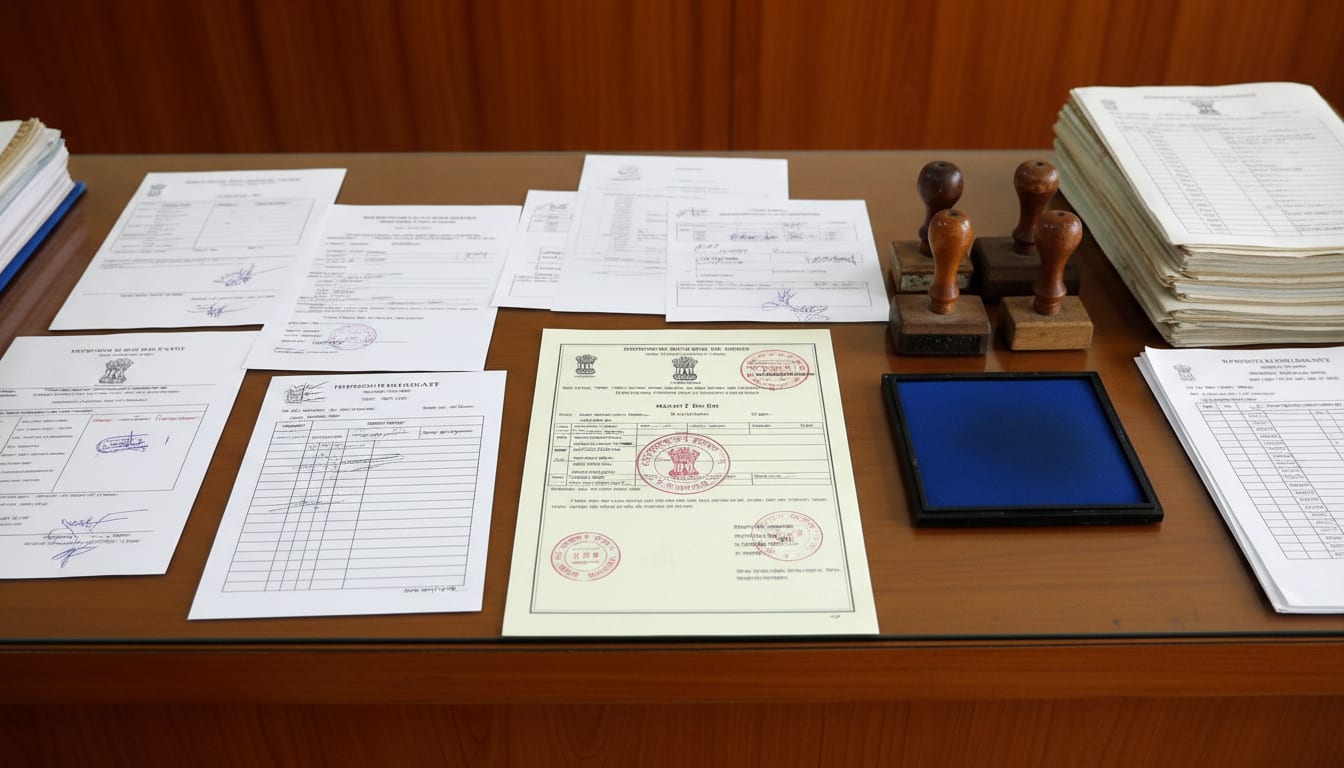
Picture this: 3 AM. A knock on the door. It is the Muzaffarpur local police, holding a court injunction. You just spent your life savings on a 1,200 sq ft residential plot in Ahiyapur. You have the registered deed. You have the tax receipts. But the man at the door says you are trespassing on property owned by a third party since 1998.
The paperwork looked clean. Too clean. The seller smiled, handed over a stack of stamped documents, and walked away with the money. When the buyer finally checked the backend revenue records, the truth surfaced. The seller had forged the historical title chain, registering a new deed on a plot he never legally owned.
Here is what they do not want you to know. In Bihar, a registered sale deed alone does not prove ownership. Registration merely records a transaction. If the seller did not have a valid title, your shiny new deed is legally worthless. To protect your capital in 2026, you must look past the surface and interrogate the entire chain of custody.
Across Patna, Gaya, and Muzaffarpur, syndicates are exploiting the digital transition gap between old paper records and the modern portals. If you are buying property this year, you need a bulletproof verification protocol.
A Khesra Manipulation Example
Consider a classic Khesra manipulation scam. The seller provided a genuine Kewala (sale deed). He provided a recent Lagaan Rasid (tax receipt). The buyer's local broker gave the green light.
A check of the records on the Bihar Bhumi portal shows the fatal flaw immediately. The Khesra (plot number) listed on the Kewala belonged to a different Mauja (revenue village) entirely. The seller had bribed a low-level clerk years ago to issue a manual tax receipt for a plot he did not own. Because the buyer never cross-referenced the deed against the digital Jamabandi Panji (Register-II), the transaction went through smoothly.
Unravelling the mess in court can take years, and the seller has vanished. This is why a simple glance at a deed is financial suicide. You need a systematic approach to title chain verification that catches fraud or forgery.
What is the Bihar Property Document Checklist?
The Bihar property document checklist is a sequential verification protocol used to establish clear legal title before a land purchase. It mandates the cross-examination of the Khatian (Record of Rights), the Jamabandi Panji (Register-II), the Encumbrance Certificate (EC), the continuous Kewala (Sale Deed) chain, and the Dakhil Kharij (mutation) orders under Section 17 of the Registration Act, 1908.
If any single document in this chain breaks, the title is defective. You cannot skip steps. You cannot trust photocopies. Every piece of paper handed to you by the seller must be independently verified against the state's digital and physical archives.
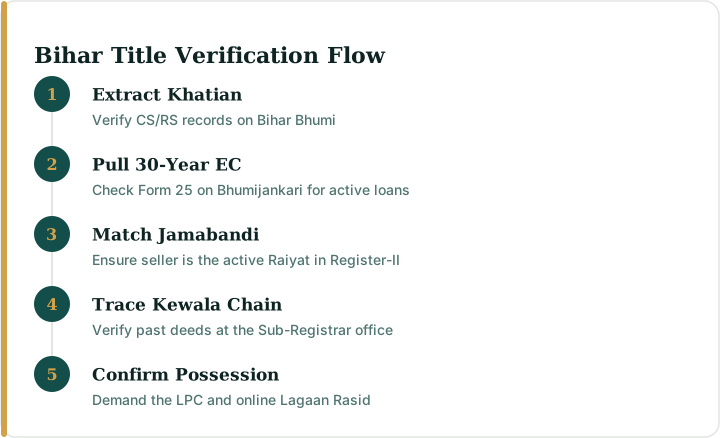
Step 1: The Khatian and Apna Khata Extraction
The foundation of any Bihar land transaction is the Khatian. This is the master Record of Rights prepared during the survey settlements. It defines who originally owned the land, the nature of the land (agricultural or residential), and the exact area.
You must ask the seller for the Khata number and Khesra number. Then, you bypass the seller entirely. Log into the Apna Khata section of the Bihar Bhumi portal. Search by the district, Anchal (block), and Mauja.
Look for discrepancies between the Cadastral Survey (CS Khatian) and the Revisional Survey (RS Khatian). Fraudsters often sell land based on an outdated CS Khatian, ignoring the fact that the RS Khatian updated the ownership decades ago. Furthermore, verify the land classification. If the Khatian marks the plot as 'Gair Majarua' (government land) or 'Khas Mahal', you cannot legally buy it. Section 22 of the Bihar Tenancy Act, 1885 dictates strict rules on who can hold certain types of tenancy land. Do not ignore the Khatian.
Step 2: The 30-Year Encumbrance Certificate
A Kewala proves someone sold the land. It does not prove the land is free from bank loans, court attachments, or prior secret sales. For that, you need the Encumbrance Certificate (EC).
The EC is issued by the Sub-Registrar under Form 25. You must demand a continuous 30-year EC. Why 30 years? Because property disputes in Bihar often span generations. A 12-year EC might look clean, hiding a massive bank loan defaulted upon 15 years ago.
You can apply for this via the Bhumijankari portal. The government fee is nominal: ₹150 for the first year and ₹50 for every subsequent year searched. A 30-year search will cost you under ₹2,000. That small fee is the only thing standing between you and a catastrophic loss. If the EC shows a mortgage, the seller must clear it and provide a 'No Dues Certificate' before you proceed.
Step 3: The Jamabandi Panji Cross-Match
The Jamabandi Panji (Register-II) is the continuous ledger of land revenue. When a property is sold, the new owner's name must be entered into this register.
A seller hands you a Kewala showing he bought the land in 2015. You must immediately check the Bihar Bhumi portal to see if his name reflects in the Jamabandi. If the Jamabandi still shows the name of the person who sold it to him in 2015, the seller never completed his mutation.
Buying land from a seller whose name is not in the Jamabandi is a massive legal risk. If the seller claims the portal is just 'not updated yet', walk away. Force them to file a Parimarjan (rectification) request and update the digital register before you sign any agreement.

Step 4: Tracking the Kewala (Sale Deed) Chain
A single sale deed is meaningless. You must trace the chain of title backward. If the current seller bought it in 2018, you need the 2018 Kewala. Who did they buy it from? Say, an earlier owner in 2005. You need the 2005 Kewala.
Under Section 54 of the Transfer of Property Act, 1882, a valid sale requires a transfer of ownership from a person competent to transfer. If that earlier owner never legally owned the land, his sale to your current seller is void. Consequently, your purchase is void.
Every link in the chain must be registered under Section 17 of the Registration Act, 1908. Unregistered sale agreements or notarised power of attorney documents do not confer legal title in Bihar. You must verify each historical Kewala at the local Sub-Registrar office. Match the thumbprints, check the stamp duty paid, and ensure the boundaries (Chauhaddi) described in the 1990 deed perfectly match the boundaries in the 2026 draft deed.
Step 5: Dakhil Kharij and the Lagaan Rasid
Dakhil Kharij is the Bihar term for mutation. It is the process of striking the old owner's name from the revenue records and entering the new owner's name.
When reviewing the seller's documents, demand the Dakhil Kharij order copy. This proves the Circle Officer (CO) formally approved the transfer of revenue liability. The statutory deadline for uncontested Dakhil Kharij in Bihar is 35 days. If the seller has owned the land for five years but cannot produce the mutation order, they are hiding a dispute.
Next, ask for the current year's Lagaan Rasid (revenue tax receipt). The receipt must be generated online. Manual, handwritten receipts are easily forged and are no longer considered primary proof of possession in 2026. The online receipt will show the exact Khata, Khesra, and area for which the tax was paid. If the receipt shows 5 decimals of land, but the seller is trying to sell you 8 decimals, you have caught them in a lie.
Step 6: The Land Possession Certificate Test
Picture a buyer who verified the Kewala, the Jamabandi, and the tax receipts. Everything matched. They bought the land. When they went to build a boundary wall, they found a local strongman already occupying the plot.
Title is one thing. Physical possession is another. This is why the Land Possession Certificate (LPC) is critical. The LPC is issued by the Circle Officer and certifies that the seller is in actual, physical possession of the land.
In 2026, banks will not approve a home loan in Bihar without an LPC. If the seller refuses to apply for an LPC, or if the Circle Officer rejects their application, it means there is a physical dispute on the ground. Never buy land based purely on paper title. The LPC bridges the gap between the revenue office and the physical dirt.
The 2026 Red Flags: When to Walk Away
Not every document discrepancy is a clerical error. Some are deliberate traps. Here are common red flags in Bihar land transactions. If you see any of these, halt the transaction immediately.
| Document Type | Safe Baseline | Critical Red Flag |
|---|---|---|
| Kewala (Sale Deed) | Registered under Section 17, matches Jamabandi exactly. | Unregistered agreement to sell, or seller uses a revoked Power of Attorney. |
| Jamabandi Panji | Seller's name is actively visible on the Bihar Bhumi portal. | Seller's name is missing, or the portal shows a 'Digitization Error' for the specific Khata. |
| Lagaan Rasid | Online generated receipt for the current financial year. | Handwritten receipt from 2019, seller claims the portal is 'down'. |
| Encumbrance Certificate | 30-year continuous search shows zero active charges. | EC shows a court attachment order or an unresolved bank mortgage. |
Fraudsters rely on your impatience. They will tell you another buyer is ready to pay cash tomorrow. Let the other buyer take the bait. A clean property will withstand rigorous scrutiny.
What to Do Next: Your 48-Hour Action Plan
You have the checklist. Now you need to execute it. Do not rely on the broker to do this for you. The broker gets paid when the deal closes, regardless of whether the title is defective.
- Demand photocopies of the entire title chain from the seller, including the latest Kewala, Khatian extract, and Jamabandi details.
- Cross-check the Khata and Khesra numbers on the Bihar Bhumi portal yourself. Ensure the seller's name is the current active Raiyat.
- Apply for a 30-year Encumbrance Certificate via the Bhumijankari portal. Pay the ₹150 base fee and wait the required days for the official report.
- Pull the Khatian records to verify the original nature of the land. Ensure it is not government-allotted land prohibited from transfer.
- Request the current online Lagaan Rasid and the Land Possession Certificate (LPC) directly from the seller.
The documents will always tell you the truth if you know how to read them. Protect your capital. Verify the chain.
Authoritative sources: India Code - central statutes incl. the Registration Act, 1908