

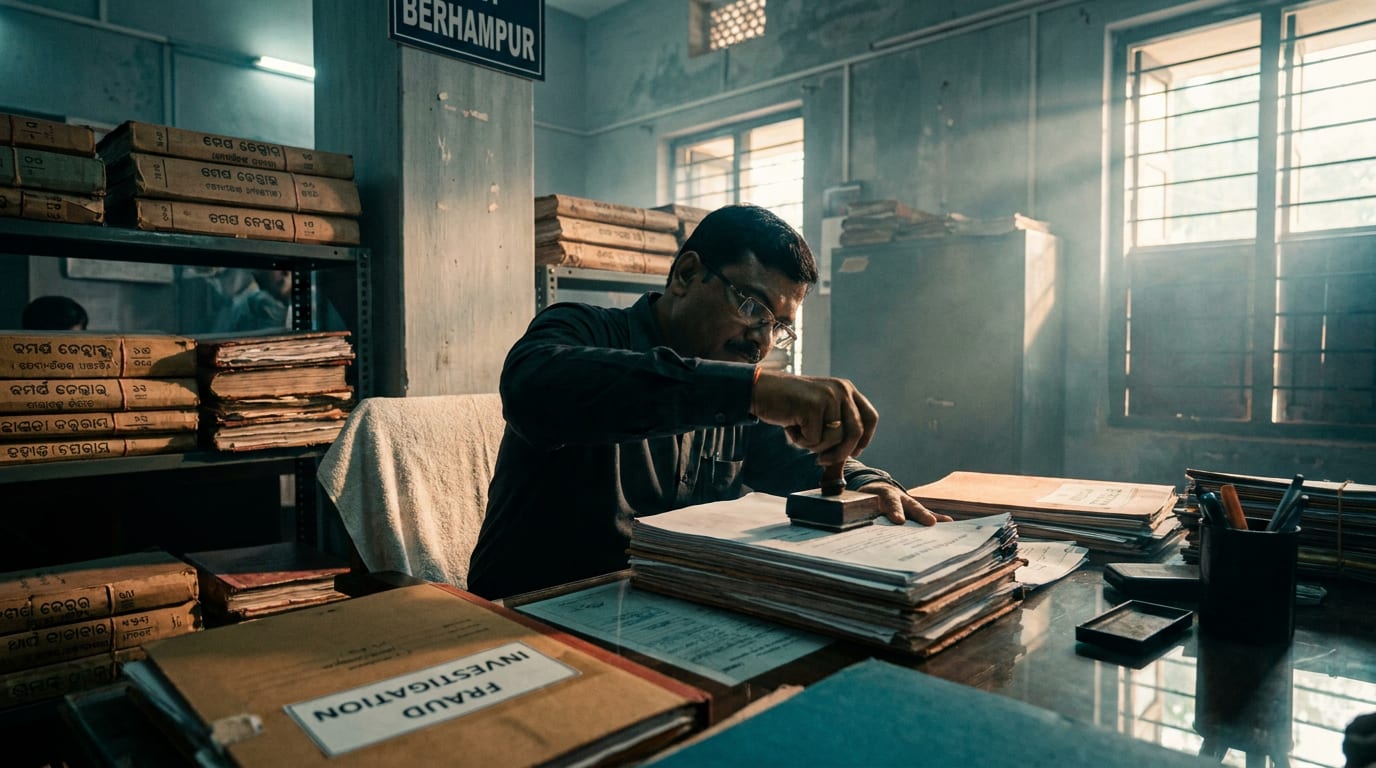
Pull up a 1982 Sabik khatiyan from Berhampur Tahasil and tell me who legally owns Plot 402 today. Most readers get it wrong. Families in Ganjam district have lost their life savings because they trusted a translated deed instead of hiring a specialist to trace the revenue records. Buyers arrive in Berhampur with capital, find a prime plot in Gosaninuagaon or Baidyanathpur, and rely entirely on a standard online search. They skip the deep archival verification that a local property advocate performs. The result is a legally defective purchase that cannot be mutated, cannot be resold, and cannot be used as collateral for a bank loan.
A Berhampur Example
Consider an example. A buyer purchased a residential plot in Berhampur. The seller presented a flawless registered sale deed and a clear 15-year Encumbrance Certificate. The buyer paid the full amount, registered the new deed, and paid the 5% stamp duty (IGR Odisha fee schedule). When the buyer applied for mutation at the local Tahasil office, the Tahasildar rejected the application outright. The reason was buried in the archives. The seller had never mutated the land into their own name. The revenue records on the Bhulekh Odisha portal still reflected the original Sabik owner. The earlier sale was a transfer of a registered document, but it was not a valid transfer of marketable title. This is a classic trap. The buyer is now locked out of their own property. They cannot build a house because the local development authority requires a Hal (current) Record of Rights in the applicant's name to approve building plans. The capital is gone, and the only recourse is a protracted civil suit against a seller who has already spent the money (Orissa High Court). Verify your title chain with a local expert before you transfer any advance payment.
Why Standard Title Checks Fail
Here's what buyers often miss when they attempt DIY verification. A standard pan-India portal check only queries the digital registration database. It confirms whether a document was registered. It does not confirm whether the person registering the document had the legal right to do so. Under Section 54 of the Transfer of Property Act, 1882, a sale is a transfer of ownership in exchange for a price paid or promised. However, ownership in Odisha is established by a continuous, unbroken chain linking the physical registration to the state's revenue records. If the revenue record (the Khatiyan) does not match the registration record, the chain is broken. Standard checks ignore the Sabik-to-Hal transition. During the major settlement operations in Ganjam, land parcels were re-measured, and new Hal Khata numbers were generated. A property lawyer in Berhampur physically correlates the old Sabik Khata with the new Hal Khata. They ensure that the person selling the land today is the exact legal heir or legitimate purchaser of the person listed in the settlement records.
The Ganjam Title Verification Protocol
To prevent capital loss, leading property advocates in Ganjam utilize a strict 4-point verification protocol. This framework goes beyond surface-level digital checks and digs into the administrative history of the plot. First, they perform the Sabik-Hal correlation. They pull the correlation register from the Tahasil office to map the exact historical boundaries to the modern plot dimensions. Second, they analyze the 30-year Encumbrance Certificate. Third, they verify physical boundaries against the official village map (Naksha) to rule out government land encroachment. Fourth, they audit the joint family partition history to ensure compliance with Section 17 of the Registration Act, 1908. If any of these four points fail, the advocate flags the property as unmarketable. This level of scrutiny is the only reliable defense against sophisticated title fraud in southern Odisha.
What is the Encumbrance Certificate?
The Encumbrance Certificate (EC) is a legal document issued by the Sub-Registrar's office as Form 25 (Nil) or Form 26 under the Orissa Registration Rules, 1988 (IGR Odisha SRO directory). It records all registered transactions, mortgages, and leases associated with a specific property over a requested period, typically 15 to 30 years. You can apply for an EC online via the IGR Odisha portal. The government fee structure is strictly regulated: ₹25 for the first year of search, and ₹15 for each subsequent year. An advocate uses the EC to verify that the property is free from undisclosed bank loans or prior sale agreements. However, the EC only reflects registered documents. It does not reflect unregistered agreements, pending civil litigation, or inheritance disputes. This is why the EC is just one component of a comprehensive legal verification. Access the same data banks use. Free.
Identifying Fake Power of Attorney
The abuse of Power of Attorney (PoA) documents is a major fraud vector. Many property owners in Berhampur live outside the state or country. They execute a PoA to a local relative or broker to manage or sell their land. Fraudsters forge these documents or continue to use them after they have become legally void. A PoA automatically terminates upon the death of the principal. In some PoA-driven sales, the principal is already deceased. The local broker registers the sale, pockets the cash, and leaves the buyer with a legally invalid deed. A competent property lawyer mitigates this risk by demanding a recent survival certificate for the principal. They also physically inspect the revocation register at the Sub-Registrar office to ensure the PoA was not canceled prior to the sale execution.
Tehsil Risk Profiles in Ganjam
Risk is not distributed evenly across the district. Different tehsils present entirely different fraud profiles, requiring specialized local knowledge. Berhampur Tahasil sees urban encroachment, where private boundaries slowly bleed into Khasmahal (government) lands. In contrast, Chatrapur faces complex Coastal Regulation Zone (CRZ) restrictions. Buyers purchase sea-facing plots only to discover that construction is permanently banned under environmental laws. Hinjilicut sees agricultural-to-residential conversion frauds. Sellers market farmland as premium residential plots without obtaining the mandatory conversion order under Section 8A of the Odisha Land Reforms Act, 1960. Hiring an advocate who understands these micro-local nuances is critical. A lawyer based in Bhubaneswar might miss a Chatrapur CRZ violation entirely because they are unfamiliar with the specific local notification zones.
The Cost of Legal Verification 2026
Many buyers skip legal verification because they assume it is prohibitively expensive. This is a dangerous misconception. Compared to losing the capital, advocate fees are a rounding error. Paying an advocate to secure your investment is basic risk management. The fee covers the advocate's time spent navigating the Tahasil office, retrieving archival records, and drafting a legally binding title opinion.
Civil Court Timelines for Disputes
Let me show you the pattern that unfolds when buyers skip this expense. When a defective title is registered, the dispute inevitably moves to the Berhampur Civil Judge (Senior Division) court. A contested property title suit can take years to resolve. During that time, the property can be frozen by an injunction. You cannot build, you cannot sell, and you must keep paying litigation fees. Upfront verification is always cheaper than backend litigation. Don't be a statistic.
The Sabik vs Hal Mismatch Resolution
If your advocate discovers a Sabik-Hal mismatch before the sale, the transaction must be paused. The seller must resolve the discrepancy before you sign the final deed. This is a formal administrative process. The mutation case opens at the local Tahasil on the Form No. 3 the registration office sends, or on the buyer's application. They must submit the original registered deeds connecting the Sabik owner to the current seller. The Tahasildar will issue a general notice inviting objections within fifteen days (Rule 40 of the Orissa Survey and Settlement Rules, 1962). If no objections are filed, the Revenue Inspector (RI) and the Amin will physically verify the plot boundaries. Only after the RI submits a favorable report will the Tahasildar order the creation of a new Record of Rights in the seller's name. Once the Hal Khatiyan reflects the seller, the property is safe to purchase.
Next Steps for Property Buyers
Do not rely on verbal assurances or photocopied documents. Take control of the verification process by following a strict sequence of actions. 1. Demand the latest Hal Khatiyan from the seller and verify it independently on the Bhulekh portal. 2. Extract a 30-year Encumbrance Certificate using Form 25. 3. Cross-reference the boundaries mentioned in the deed with the official village Naksha. 4. Hire a verified property lawyer in Berhampur to draft a formal title opinion. 5. Run the documents through a digital verification platform to catch algorithmic anomalies. By treating property acquisition as a rigorous data-gathering exercise rather than a casual transaction, you eliminate the risk of total capital loss. Secure your investment by securing your data.