

Picture the file in front of you: a Sale Deed CC, a Khatiyan, an EC (Bhulekh Odisha portal). Three documents, three names, three plot numbers. Now reconcile them. In the shadow of the Kashipur bauxite mines, that reconciliation is currently destroying fortunes. When you cross-reference the registered sale deeds with the actual flow of corporate money, a dark pattern emerges. Buyers who think they are outsmarting the system walk straight into a statutory buzzsaw. Here is what they do not want you to know about bauxite-adjacent land fraud.
What Is The Benami Bauxite Pattern
What is the Benami Bauxite Pattern? The Benami Bauxite Pattern is a fraudulent land acquisition method where corporate entities fund local proxy buyers to purchase agricultural land near mining zones. This evades the Odisha Land Reforms Act ceiling limits, but triggers immediate provisional attachment under Section 24 of the Prohibition of Benami Property Transactions Act, 1988. The mechanics of this trap are deceptively simple. Rayagada sits on some of the most lucrative bauxite reserves in the world. Industrial players need land for ancillary processing, storage, and transport corridors. But the law strictly limits how much land a single entity can hold. To bypass these restrictions, shadow buyers step in. They use local agricultural workers as fronts. The front man signs the deed. The corporate backer supplies the cash. On the surface of the Bhulekh Odisha portal, everything appears normal. A local resident bought a local plot. But the paper trail always leaves a faint, undeniable trace. Pull the encumbrance certificates for adjacent plots and the pattern can show through (IGR Odisha (Inspector General of Registration)): proxy buyers with no documented income registering high-value sale deeds.
Why Rayagada Red Dirt Attracts Black Money

To understand the fraud, you must understand the geology and the legislation governing it. Bauxite is the lifeblood of the aluminum industry. Where bauxite flows, infrastructure follows. But you cannot simply arrive with a suitcase of cash and buy a mountain. Section 37A of the Odisha Land Reforms Act, 1960 establishes a strict ceiling limit. A person or a family cannot hold more than 10 standard acres of agricultural land. If you are a corporate entity trying to amass 150 acres for a logistics hub, you hit a statutory wall immediately. Any surplus land acquired beyond this ceiling vests automatically in the State Government under Section 39 of the OLR Act. The proxies exist to circumvent Section 37A. By distributing the 150 acres across fifteen different local names, the true buyer attempts to stay under the radar. They draft unregistered agreements in the background, securing their control over the front men. This is where the fatal miscalculation occurs. They treat the OLR Act as the only obstacle, completely ignoring the federal hammer of the Benami Act.
The Wake-Up Call
Consider how this plays out in a Tahasil like Kashipur. A group of out-of-state investors targets a contiguous block of agricultural land. They know about the OLR ceiling, so they recruit local laborers to act as the official buyers. The sale deeds are executed perfectly. The 5 percent stamp duty is paid. The mutation cases open at the Tahasildar office. The hal khatiyan (ଖତିୟାନ) is updated. The investors think they have secured their logistics corridor. Then the authorities trace the money from the investors' companies into the laborers' accounts just before the registration dates. Under Section 24 of the Prohibition of Benami Property Transactions Act, 1988, the property can be placed under a 90-day provisional attachment order. The land is frozen. The investors lose their money, and the laborers face prosecution. The risk is real. Verify before you sign.
The authorities are no longer just looking at the paper title. They are looking at the source of funds.
The Three Step Benami Disconnect Pattern
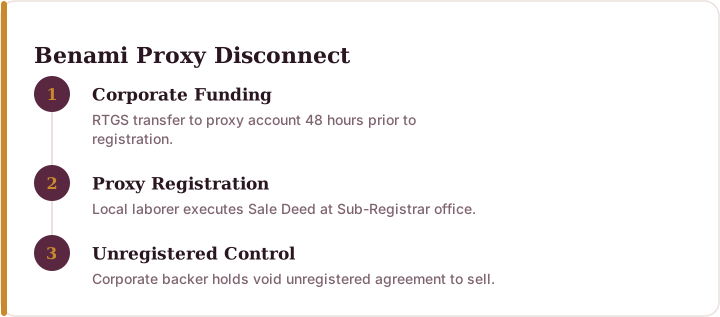
The pattern typically follows three steps. If you are an advocate reviewing a title chain in Rayagada, you must look for these specific disconnects. 1. The Sudden Liquidity Event: The buyer profile on the sale deed is a local resident with no historical wealth. Yet, the IGR Odisha records show a massive RTGS transfer covering the exact consideration amount just days before execution. 2. The Unregistered Control Document: The true owner forces the proxy to sign an unregistered agreement to sell or an irrevocable power of attorney. This document is kept hidden off the public record. 3. The Silent Possession: The proxy name appears on the parcha (ପର୍ଚ୍ଚା), but the physical boundary walls are erected by corporate contractors. The Tahasildar field inspector notes this discrepancy during the mutation enquiry. When the local revenue inspector visits the plot, they ask the proxy buyer basic questions about the soil quality or the boundary markers. The proxy rarely knows the answers. Want to see what investigators see? Look here.
Section 54 and the Illusion of Legal Sale
The orchestrators of these schemes rely on a fundamental misunderstanding of property law. They believe their hidden, unregistered agreements protect their investment. The documents tell a different story. Section 54 of the Transfer of Property Act, 1882 clearly defines a sale. It explicitly states that an agreement to sell does not, of itself, create any interest in or charge on such property (IGR Odisha fee schedule). Furthermore, Section 17 of the Registration Act, 1908 mandates that any document creating or extinguishing a right in immovable property worth more than ₹100 must be registered. Because the corporate backers cannot register their control documents without exposing the Benami nature of the transaction, they rely on legally void paper. When the government seizes the land, the corporate backers have no legal standing to contest the attachment. They cannot claim ownership without admitting to a federal crime. The trap snaps shut, and there is no legal exit.
Spotting the Proxy Pattern on Bhulekh Odisha
Start with the digital footprint, not the physical land. Bhulekh Odisha is a goldmine if you know how to read the negative space. You are looking for anomalies in the mutation timeline and the khata structure. First, pull the Record of Rights. Look at the transaction history. In these proxy zones, you will see a plot change hands from an Adivasi owner to a general category local (a transfer that Regulation 2 of 1956 makes void in a Scheduled Area such as Rayagada, whatever papers are produced), and then immediately subjected to boundary wall construction. Second, check the mutation status. Proxy buyers often face delays at the Tahasildar office. Proxy mutations often stall indefinitely because the revenue inspector cannot verify the true possession. If you see a plot in Kashipur with a sale deed registered in 2024 but the Bhulekh record still shows the previous owner in 2026, you may be looking at a stalled proxy investigation.
The Advocate's Problem: Defending a Void Chain
Bank panel advocates are walking into a minefield here. If a bank finances a project on this land, the legal opinion is the only shield. The penalty under Section 3 of the Prohibition of Benami Property Transactions Act, 1988 is severe. It includes rigorous imprisonment for a term which shall not be less than one year, but which may extend to seven years, and a fine which may extend to 25 percent of the fair market value of the property. If you issue a clean legal opinion on a plot that is actively being fronted by a proxy, you are not just making a professional error. The authorities may view you as a facilitator of the Benami transaction. You must demand the income tax returns and the source of funds declaration from the buyer before you sign off on any commercial plot near the Rayagada bauxite belt. Don't become another case file. Check your land NOW.
How to Verify Rayagada Bauxite Belt Land
You cannot rely on a simple Encumbrance Certificate anymore. The EC only shows what was registered. It does not show the shadow money. You need a multi-layered verification protocol.
| Verification Step | Target Authority | What to Look For |
|---|---|---|
| Source of Funds Check | Buyer Bank Statements | RTGS/NEFT transfers matching the sale consideration exactly, originating from corporate accounts. |
| Ceiling Limit Audit | Tahasildar Office | Cross-reference the buyer's family tree to ensure they do not exceed the 10-acre OLR Section 37A limit. |
| Provisional Attachment Search | Sub-Registrar / IGR Odisha | Look for Section 24 PBPT Act notices explicitly recorded in the Book 1 registers. |
| Physical Possession Match | Field Verification | Does the person named on the Bhulekh parcha actually control the boundary gates? |
If you skip even one of these steps, you are gambling with your entire investment.
Your Next Move Before the Notice Arrives
The days of easy, undocumented land grabs in Odisha are over. If you are currently holding land in Rayagada through a local proxy, your timeline is already running out. If you are a legitimate buyer looking at land in this region, you must assume every plot is compromised until proven otherwise. You need an advocate who understands both the OLR ceiling limits and the Benami Act implications. You need to trace the money, not just the paper. The next victim could be you. Or not. Your choice.