

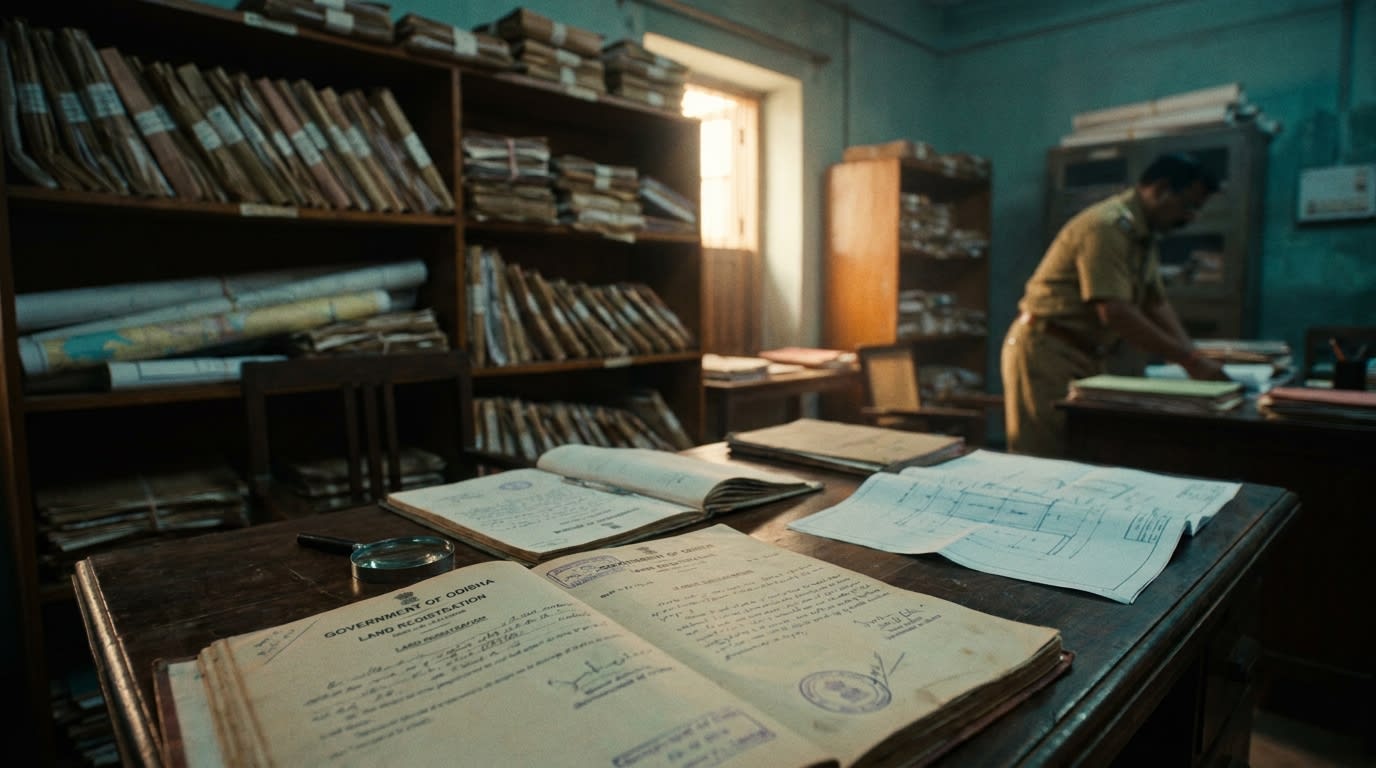
Consider a buyer whose legal counsel pulls a standard 15-year Encumbrance Certificate instead of tracing the Sabik settlement (IGR Odisha (Inspector General of Registration)), for a flat-fee title clearance report (IGR Odisha fee schedule). The advocate checks the records, sees a clear 15-year history, and issues a green light. Later, an heir of an earlier titleholder files a partition suit, and the entire transaction collapses. Buyers assume any lawyer can verify land. Without a stringent, advocate-grade title verification process, your investment is entirely exposed to historical settlement gaps.
The 2026 Cuttack Title Verification Reality
In the tehsils of Cuttack Sadar, Choudwar, and Niali, property buyers often accept a surface-level title report. A surface-level report relies exclusively on the digital Bhulekh Odisha portal and a recent Encumbrance Certificate. This creates a massive blind spot. The digital records only reflect the Hal settlement, which in Cuttack finalized between 1973 and 1985. Anything that happened before that year requires manual verification at the district record room. Fraudsters exploit this exact gap. They identify plots where the Hal khatiyan (ଖତିୟାନ) shows a single owner, but the underlying Sabik record from 1932 lists multiple co-sharers. They sell the land using the modern digital record. The buyer's retail lawyer checks the modern record, confirms the seller's name matches, and approves the sale. The root cause is always a failure to correlate the historical chain of ownership. To understand the scale of the risk, you must look at the financial mechanics. A ₹48,500,000 property purchase in Cuttack carries a 5 percent stamp duty and a 2 percent registration fee. That is ₹3,395,000 in sunk government taxes alone. When a title defect emerges, the government does not refund your stamp duty. You lose the principal, you lose the taxes, and you enter a slow civil litigation system.
The Advocate-Grade Title Check Definition
An advocate-grade title verification is a comprehensive legal audit that traces property ownership back a minimum of 30 years or to the last major settlement, verifying the Chain of Title through physical Sub-Registrar records, correlating Sabik and Hal khatiyans, and confirming the absence of unrecorded mortgages under the Transfer of Property Act. This definition separates a true legal audit from a basic document reading. A true legal audit requires physical visits to the Cuttack Sub-Registrar Office and the local Tahasildar (IGR Odisha SRO directory). The advocate must pull the physical volumes of the registration records because digital Encumbrance Certificates in Odisha only became highly reliable post-2010. Every title verification checklist for Odisha must mandate this physical cross-referencing. If your legal counsel is only handing you printouts from online portals, they are not performing a title verification. They are performing a data retrieval exercise. The legal standard for due diligence requires establishing an unbroken chain of valid transfers. If a single link in that chain is defective, the subsequent transfers are voidable. Many buyers hesitate at the fees charged by bank-panel advocates for this level of scrutiny. They opt for the cheaper alternative, completely unaware that the cheaper alternative excludes the manual Sabik-to-Hal correlation that guards against partition suit frauds. The risk is real. Verify before you sign.
Now let us examine the specific certificates that create these false senses of security.
The 42-Year Encumbrance Certificate Gap

Here Is What Buyers Often Miss
Here is what buyers often miss. An Encumbrance Certificate (EC) is issued by the Sub-Registrar as Form 25 (a Nil certificate) or Form 26 (the documents found), the forms the Orissa Registration Rules, 1988 prescribe. It lists registered transactions within a specific requested timeframe. Most buyers request a 15-year EC. In Cuttack, a 15-year EC only takes you back to 2011. This leaves a massive 42-year gap between the Hal settlement of the 1980s and the start of your EC search. Under Section 17 of the Registration Act, 1908, the sale of immovable property valued over ₹100 must be registered. However, certain transactions like oral partitions among family members or unregistered wills historically bypassed this system. If a family partitioned their land in 1995 and did not register it, that partition will never appear on a 15-year EC pulled in 2026. The seller presents a clean EC, but a dormant co-sharer from the 1995 partition still holds a valid legal claim to the land. To close that gap, an advocate can ask for a search reaching back to the Hal settlement's publication. If the Sub-Registrar's digital database does not cover those years, the advocate must manually inspect the Index II registers in the Cuttack record room. Relying on a 15-year digital EC is a common failure point in modern property transactions. This gap is further complicated by mortgage registrations. If a previous owner took a loan from a cooperative bank in 1998 and mortgaged the property, that charge might not reflect in a modern 15-year search. You purchase the land, and three years later, the bank initiates recovery proceedings against your plot. The law holds that the buyer should have exercised caveat emptor (buyer beware) by conducting a full historical search.
Sabik vs Hal Cuttack Settlement Gap
The evolution of land records in Odisha is the primary battleground for title disputes. The British conducted the Sabik settlement in Cuttack between 1927 and 1932. The post-independence government conducted the Hal settlement between 1973 and 1985. The gap between these two settlements represents 50 years of unrecorded births, deaths, marriages, and informal land transfers. When conducting a title verification, the advocate must pull the Sabik khatiyan and compare it to the Hal khatiyan. If the Sabik record shows Rama Chandra as the owner, and the Hal record shows his son Hari as the owner, the advocate must ask for the legal heir certificate or the registered partition deed that moved the title from Rama to Hari. If Hari had three brothers, and the Hal record only shows Hari, those three brothers have a dormant claim to the land. This is where Section 54 of the Transfer of Property Act, 1882 becomes critical. Section 54 defines a sale as a transfer of ownership in exchange for a price paid. A valid sale requires the seller to have absolute ownership. If the transition from the Sabik to the Hal record bypassed legal co-sharers, the current seller does not possess absolute ownership. They only possess a fractional share, even if the modern digital record mistakenly lists them as the sole owner. Fraud rings in Cuttack specifically target these Sabik-Hal discrepancies. They find plots where the mutation was done incorrectly in the 1980s, buy the land cheaply from the recorded owner, and immediately flip it to an unsuspecting buyer at market rate. By the time the unrecorded co-sharers file a civil suit, the fraud ring has vanished, leaving the new buyer to fight a decade-long legal battle.
Tracing the Adhikar Abhilekh Title Chain
A common question from buyers is regarding the Adhikar Abhilekh (Record of Rights) and how far back it shows the chain of title. In Cuttack, the digital Adhikar Abhilekh available online only shows the current Hal settlement data, effectively starting from the 1980s. It does not show the chain of title prior to that settlement. To trace the full chain, advocates must follow a strict manual protocol. This protocol is what separates a loss from a safe investment. If your legal counsel skips these steps, you are flying blind. 1. Obtain the current digital Adhikar Abhilekh from the Bhulekh portal using the plot and khata number. 2. Cross-reference the current owner with a 30-year Encumbrance Certificate from the IGR Odisha registration manual portal or Sub-Registrar office.
- Identify the prior owner from the oldest sale deed listed on the Encumbrance Certificate. 4. Visit the Tahasildar office to physically pull the Hal settlement register from the 1980s. 5. Request the Sabik-Hal correlation statement (Yadast) to link the 1980s record back to the 1932 settlement. 6. Verify that all legal heirs between the 1932 owner and the 1980s owner formally relinquished their rights. This process is tedious, which is exactly why retail lawyers skip it. They rely on the assumption that if the government issued a Hal patta in 1985, the government must have done the verification. This is a fatal assumption. Revenue courts in Odisha are burdened with cases where Hal records were generated incorrectly due to clerical errors or localized corruption during the settlement camps.
The reliance on shallow digital records is a systemic issue; see How to Verify Property Title in Odisha: Bhadrak Guide. Advocates are incentivized to close transactions quickly to collect their fees. Digging into 1932 records delays the transaction and frustrates the seller. A good advocate is willing to frustrate the seller to protect the buyer. Furthermore, the timeline for these checks is rigid. You cannot compress a 90-year historical audit into a 24-hour turnaround. If an advocate promises you a complete title clearance report by tomorrow afternoon, they are mathematically incapable of having checked the Sabik records.
Section 22 OLR Act Tribal Restrictions
Beyond historical settlement gaps, advocates must verify statutory transfer restrictions. The most critical of these is Section 22 of the Odisha Land Reforms Act, 1960. This section strictly prohibits the transfer of land from a Scheduled Tribe (ST) person to a non-ST person without the explicit prior written permission of the Revenue Officer (usually the Sub-Collector). Standard title checks frequently miss this because they only look at the current seller. If the current seller is a General category citizen, the retail lawyer assumes the transaction is safe. However, if you trace the chain of title back 25 years and find that a General category person bought the land from an ST person in 2001 without Section 22 permission, that 2001 sale is legally void. Because the 2001 sale is void, every subsequent sale is also void. You could be the fourth buyer in the chain, purchasing from a General category seller, and you will still lose the land when the original ST family files a reclamation petition under Section 23 of the OLR Act. The State Government actively enforces these provisions, and there is no statute of limitations for restoring tribal land. An advocate-grade title check mandates reviewing the caste status of every single transacting party in the chain of title for the past 40 years. If an ST or SC (Scheduled Caste, covered by Section 22(5)) individual appears anywhere in the chain, the advocate must demand the original permission order from the Sub-Collector's office. A missing order is an automatic dealbreaker, regardless of how clean the modern Bhulekh portal record looks.
The Five-Step Advocate Verification Protocol
To protect your capital in 2026, you must manage your legal counsel. You cannot simply hand them the seller's documents and wait for a certificate. You must require them to document their adherence to the following five-step protocol. This is how you escape the traps outlined in Property Title Defects Buyers Miss in India. First, mandate a 40-year physical Encumbrance Certificate search. Do not accept a digital-only Form 25. The advocate must provide a written statement that they have inspected the Index II registers for the years prior to digital record keeping in Cuttack. Second, require a Sabik-to-Hal correlation report. The advocate must provide the names of the recorded tenants from the 1932 settlement and map exactly how the title flowed to the current Hal settlement owners. Every legal heir must be accounted for. Third, demand a statutory restriction audit. The written legal opinion must explicitly state that the chain of title has been checked against Section 22 of the Odisha Land Reforms Act, 1960 (and, in a Scheduled Area, Regulation 2 of 1956), and Section 54 of the Transfer of Property Act, 1882. Fourth, verify physical possession against revenue maps. The advocate or their appointed surveyor must take the Tahasildar's village map (Bhunaksha) and physically measure the boundaries to ensure the plot on paper matches the plot on the ground. Encroachments do not show up on an Encumbrance Certificate. Fifth, check for active litigation. The advocate must search the e-Courts portal for the Cuttack Civil Courts and the Orissa High Court using the names of all current and historical co-sharers, not just the property schedule. Many partition suits are filed under family names before specific plot numbers are attached to the injunctions. By enforcing this protocol, you elevate your transaction from a retail gamble to an institutional-grade investment. The cost of verification is a fraction of the cost of litigation.