

In Jagatsinghpur, families in the Erasama and Kujang tehsils are watching their ancestral plots get acquired for industrial and port expansion projects, only to receive compensation awards lower than their legal entitlement. A family can lose out on compensation simply because a grandfather's partition deed was never formally registered (IGR Odisha (Inspector General of Registration)). Losing your ancestral land is emotional enough. Fighting the government for your rightful compensation shouldn't be. If you have received a preliminary acquisition notice, start here. The government is not actively trying to cheat you, but the administrative machinery relies strictly on what is written in the revenue records today, not on what you know to be true. If your documents have gaps, the Land Acquisition Collector has no legal authority to release the full funds. Families can accept inadequate offers because they do not understand their right to appeal. Before you sign the final acceptance form, we need to understand exactly how the compensation framework operates in 2026 and where the most expensive mistakes happen.
What LARR Compensation Actually Means
The LARR Compensation award is a legally mandated payment calculated under Section 26 of the Right to Fair Compensation and Transparency in Land Acquisition, Rehabilitation and Resettlement Act, 2013. It requires the government to pay the higher of the minimum land value specified in the Indian Stamp Act, 1899, or the average sale price of similar situated lands, multiplied by a factor of 1 to 2, plus a 100 percent solatium. Think of this law as a protective shield. Prior to 2013, the old Land Acquisition Act of 1894 allowed the government to acquire land at highly depressed rates. The current framework was designed specifically to ensure displaced families receive enough capital to rebuild their lives. However, the exact amount you receive depends entirely on the classification of your land in the Bhulekh Odisha portal and the recent sale deeds registered in your specific mauza (Bhulekh Odisha portal). In Jagatsinghpur, particularly around the Paradip Port LARR zone, there can be a massive discrepancy between the commercial reality of the land and its official classification. A plot might be used for lucrative cash crops or commercial storage, but if the Record of Rights (RoR) still lists it as barren agricultural land (Sarad-III), the baseline valuation will be devastatingly low. The Land Acquisition Officer calculates the award based on documented evidence, not ground reality. This is where proactive legal strategy becomes critical. You have the right to challenge the baseline valuation before the final award is published, provided you submit concrete evidence of higher market values in your vicinity.
The Unregistered Sale Deed Risk
Let Me Share Something That Could Save You Lakhs
Let me share something that could save you lakhs. A common reason compensation funds get frozen in the government treasury is the presence of unregistered transfer documents in your family history. Many families in rural Jagatsinghpur rely on plain-paper agreements or unregistered partition deeds executed decades ago. Under Section 17 of the Registration Act, 1908, any document transferring immovable property worth more than Rs 100 must be compulsorily registered. Furthermore, Section 54 of the Transfer of Property Act, 1882, clearly states that a sale of tangible immovable property can only be made by a registered instrument. When the Land Acquisition Collector reviews your file, they apply these statutes strictly. If your grandfather bought the land on a plain paper, the law does not recognize you as the legal owner for the purpose of receiving the compensation cheque. In these scenarios, the government will still acquire the land, but they will deposit the compensation amount in the Authority's account under Section 77 of the LARR Act, pending a civil court resolution. Your family will be forced into years of costly litigation just to prove ownership, while the money sits inaccessible. The solution is to regularize these defects long before the Section 11 preliminary notification is published. If your family is relying on an unregistered partition, you need to execute a formal family settlement deed and register it at the local Sub-Registrar office immediately. The stamp duty and registration fees you pay today are a tiny fraction of the compensation you risk losing tomorrow (IGR Odisha fee schedule).
The Sabik Versus Hal Khatian Problem
Another major roadblock is the mismatch between the Sabik (old settlement) and Hal (new settlement) records. During the major settlement operations in Odisha, many plots were incorrectly recorded under the State Government's khata instead of the rightful private owner's name. If your land is currently notified for acquisition, the Land Acquisition Officer will pull the Hal RoR. If your name is missing, or if the area recorded is less than your actual physical possession, your compensation will be reduced proportionally. Consider a family that possesses 2.5 acres according to their Sabik patta, while the Hal RoR only reflects 1.8 acres. If the remaining 0.7 acres have been erroneously classified as government wasteland, that clerical error costs the family the compensation for those 0.7 acres. Fixing this requires filing a revision petition before the Board of Revenue or the appropriate settlement authority, depending on the stage of the record-of-rights publication. You cannot simply explain the error to the Land Acquisition Collector. They do not have the statutory power to alter revenue records; they only act upon them. The risk is real. Verify your records before the acquisition notice arrives.
Now let us look at the specific legal mechanism you must use if the government's offer is fundamentally unfair.
Section 64 Appeals and Strict Deadlines
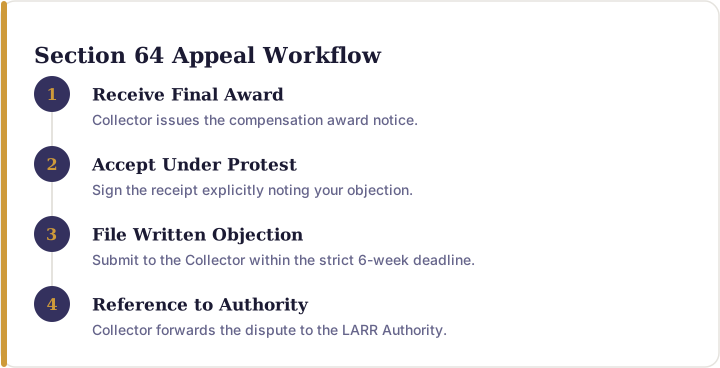
If you receive the final award notice and realize the compensation is drastically lower than the actual market value, you are not out of options. Section 64 of the Right to Fair Compensation and Transparency in Land Acquisition, Rehabilitation and Resettlement Act, 2013, gives you the right to file a written objection and demand that the matter be referred to the Land Acquisition, Rehabilitation and Resettlement Authority. However, the law imposes a brutal time limit. You must file this written objection within exactly 6 weeks from the date of the Collector's award if you or your representative were present when the award was made. If you were not present, the deadline is 6 weeks from the receipt of the notice under Section 21(2), or within 6 months from the date of the Collector's award, whichever period expires first. When filing the Section 64 application, you must explicitly state the grounds of your objection, whether it is regarding the measurement of the land, the amount of compensation, the persons to whom it is payable, or the apportionment of the compensation among the persons interested. Do not accept the compensation amount unconditionally if you plan to appeal. You must accept the payment 'under protest'. If you sign the standard receipt without noting your protest, you forfeit your right to seek a higher enhancement later.
Calculating Your True 2026 Entitlement
To know if you should file a Section 64 appeal, you need to understand how the numbers are actually crunched. The LARR Act mandates a specific formula. First, the base market value is determined. Then, a multiplier is applied (which is 1.0 for urban areas and can go up to 2.0 for rural areas, depending on the distance from the urban local body). Finally, a 100 percent solatium is added to that subtotal under Section 30 of the Act. Here is a realistic breakdown of how a Rs 10 lakh base valuation translates into the final award in a rural Jagatsinghpur mauza in 2026:
| Compensation Component | Calculation Method | Resulting Amount |
|---|---|---|
| Base Market Value | Average of top 50% registered sales | ₹10,000,00 |
| Rural Multiplier | Base Value × 1.5 (Example factor) | ₹15,000,00 |
| Value of Assets | Trees, wells, structures evaluated | ₹2,00,000 |
| Solatium (Section 30) | 100% of (Multiplier value + Assets) | ₹17,000,00 |
| Total Final Award | Sum of all above components | ₹34,00,000 |
If the government delays the process, you are also entitled to interest. Under Section 80 of the LARR Act, if the compensation is not paid or deposited before taking possession of the land, the Collector must pay interest at the rate of 9 percent per annum for the first year, and 15 percent per annum for any subsequent period of delay. Always audit the final worksheet to ensure this interest has been correctly applied.
Three Documents That Secure Your Claim
When the Section 11 preliminary notification is published, a clock starts ticking. You will eventually be called for a hearing under Section 15 to register your claims and objections. To ensure your compensation is processed smoothly, you must prepare a specific dossier of documents. 1. The Updated Record of Rights (RoR): You need the latest certified copy from the Tahasildar's office, not an old photocopy from your grandfather's trunk. You can verify the current status through the Bhulekh Jagatsinghpur online check portal, but you must obtain the physically certified or digitally signed copy for the hearing. 2. The Legal Heir Certificate: If the recorded tenant has passed away, the compensation cannot be released to the children without formal proof of succession. You must apply for a Legal Heir Certificate at the Tahasildar's office. If there are disputes among siblings, you may need a formal succession certificate from the civil court under Section 375 of the Indian Succession Act, 1925. 3. The Encumbrance Certificate (Form 25): The Land Acquisition Officer needs proof that the land is free from mortgages or bank loans. You must pull an Encumbrance Certificate from the local Sub-Registrar covering at least the last 15 years. If there is an old agricultural loan showing up that was paid off years ago but never formally released, you must get the bank to issue a no-objection certificate immediately. Gathering these papers takes time, and government deadlines wait for no one. Families often scramble at the last minute, making critical errors in their submissions.
If your documents are in order, the next challenge is managing the bureaucratic timeline.
Bypassing Land Acquisition Officer Delays
Even with perfect documentation, the administrative machinery can grind to a halt. Files get stuck moving between the Tahasildar (who verifies the land records) and the Land Acquisition Collector (who authorizes the payment). If you find your file languishing after the final award has been declared, you can leverage the Odisha Right to Public Services Act (ORTPSA). While land acquisition itself is complex, the issuance of supporting documents like the Legal Heir Certificate or the correction of minor RoR errors falls strictly under ORTPSA deadlines. If the Tahasildar misses an ORTPSA deadline, you have the right to file an appeal to the Sub-Collector, and subsequently to the Additional District Magistrate. Furthermore, if you have applied for Jagatsinghpur Land Conversion prior to the acquisition notice to reflect the true commercial nature of your plot, ensure that application is tracked relentlessly. A successful conversion before the Section 11 notification can exponentially increase your base market value.
Securing Your Family Wealth Today
The landscape of land acquisition in Odisha is highly structured, and the laws are designed to compensate you fairly, provided you play by the strict evidentiary rules. The burden of proof rests entirely on your shoulders. You must prove ownership, you must prove the market value, and you must file your appeals within the unforgiving statutory windows. Do not wait for the final award notice to arrive in the mail before you start organizing your family's documents. The families who secure their full entitlements are the ones who audit their land records months or years before the industrial project is officially announced. They fix the Sabik/Hal mismatches, they register the old partitions, and they clear the encumbrances. Your ancestral land represents generations of hard work. Protect its value with the same dedication.