
Three advocates in Bengaluru and Hyderabad last month flagged the exact same gap in a 30-year title chain we are about to explore. A family buying a ₹4.2 crore villa plot discovered that while the online records from 2010 looked perfect, a critical 1998 transfer was entirely missing from the physical archives. Here is what I tell every client who walks into my office: India runs no national title guarantee. Registration under the law gives you a presumptive title, not a conclusive one. You carry the burden of verifying every single document for three decades.
Today, a 30-year search means digging back to 1996, crossing the messy divide between modern digital portals and dusty physical ledgers. The solution is simpler than you think, provided you know exactly where to look. Let me share something that could save you lakhs in legal fees and years of court battles.
Why Banks Demand a Three-Decade History in 2026
Before you pay a heavy advance, let us understand what is actually happening when a bank or a senior advocate asks for a 30-year title search report. Many buyers ask me why 12 years is not enough. The answer lies in the Limitation Act, 1963.
While the standard limitation period for claiming adverse possession against a private individual is 12 years, Article 112 of the Limitation Act gives the government a full 30 years to claim ownership or recover arrears on a piece of land. Furthermore, if a minor had an interest in the property, they have up to 12 years after turning 18 to stake their claim. This combined 30-year window is the absolute standard for legal safety in India.
Under Section 17 of the Registration Act, 1908, any document that creates or extinguishes a right in immovable property worth more than ₹100 must be registered. However, the registrar does not verify if the seller actually owns the land. They only record the transaction. This means a chain of beautifully registered documents can still be completely invalid if the person who sold the land in 1998 had no legal right to do so. A 30-year search reconstructs this exact timeline, ensuring every single seller had the legal authority to pass the title to the next buyer.
The 1996 Digital Divide in Land Records
We are currently in 2026. If we count back 30 years, we land in 1996. This specific year creates a massive trap for modern property buyers across the country.
The Digital India Land Records Modernization Programme began pushing states to digitize their revenue and registration records heavily around 2008. Today, if you log into Karnataka Bhoomi, Telangana Dharani, Maharashtra 7/12, or the Bhulekh portal in Odisha, you will find beautifully formatted digital records for the last 10 to 15 years. Buyers see these clean digital entries and assume the title is perfect.
However, the records from 1996 to 2008 are often completely offline. They exist only in physical Book 1 ledgers at the local Sub-Registrar office. When a seller hands you an Encumbrance Certificate that only goes back 15 years, they are effectively hiding the most dangerous part of the property history. You cannot rely on a digital portal to verify a 1997 transaction. You or your advocate must physically visit the office, pull the Index II registers, and trace the manual entries to ensure the chain remains unbroken.
The Missing Link Document Trap Costing Crores
Let me share a specific case pattern that surfaced in early 2025. In a major dispute, a buyer lost ₹3.8 crore because of a missing link document from 1999 that was never properly scrutinised by their initial legal team.
A link document is simply the previous sale deed or partition deed that gave the current seller their ownership rights. In this case, the seller had a valid 2012 sale deed. The online mutation records matched perfectly. But when the buyer tried to sell the land later, a deep search revealed that the person who sold the land in 2012 had acquired it through an unregistered family settlement in 1999.
Under Section 54 of the Transfer of Property Act, 1882, a sale of immovable property can only be made by a registered instrument. Because that 1999 document was never registered, the 2012 sale was legally void. The family lost their entire investment. If the seller cannot produce the unbroken chain of registered link documents going back 30 years, the risk of hidden encumbrances rises sharply.
The risk is real. Verify before you sign.
State-by-State Variations in the 30-Year Search
India's land record system is highly fragmented. Because land is a state subject under the Constitution, the exact method for checking a 1996 record changes the moment you cross a state border.
For example, in Karnataka, the Kaveri portal manages registration while the Bhoomi portal manages revenue records. A 30-year search requires reconciling the historical RTC (Record of Rights, Tenancy and Crops) from Bhoomi with the Encumbrance Certificate from Kaveri. In Maharashtra, you must cross-reference the 7/12 extract from Mahabhulekh with the IGR Maharashtra portal. In Telangana, the Dharani portal has integrated agricultural records, but a 30-year historical check still requires pulling the older CARD system records from the Sub-Registrar.
This fragmentation is exactly why a unified, pan-India approach to document verification is so critical. You cannot apply the rules of one state to another, but you must demand the same 30-year continuous timeline regardless of where the land is located.
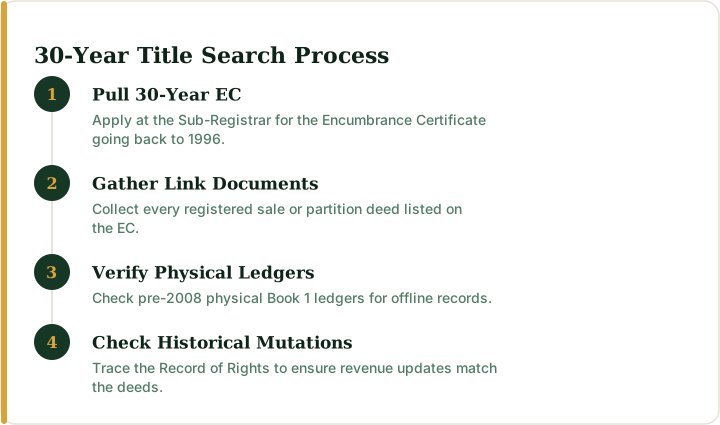
Step 1: Extracting the 30-Year Encumbrance Certificate
The very first step in any deep title verification is securing a 30-year Encumbrance Certificate. The Encumbrance Certificate, commonly issued under Form 15 or Form 25 depending on your state, lists every registered transaction, mortgage, or court attachment on that specific plot of land.
Do not accept an Encumbrance Certificate pulled by the seller. You must apply for a fresh one. In states like Tamil Nadu and Andhra Pradesh, you can pull long-term certificates online, but in many districts across India, a 30-year search requires a manual application at the Sub-Registrar office.
When you review the certificate, you are looking for continuity. If Ram sold to Shyam in 2002, and Shyam sold to Hari in 2015, the certificate must show both transactions clearly. If the certificate shows a gap, for instance, Ram selling to Shyam, but then a random person named Gita selling to Hari, you have a broken chain of title.
Step 2: Reconstructing the Physical Chain of Title
Once you have the Encumbrance Certificate, you must gather the actual physical sale deeds for every transaction listed. This is where the real investigative work happens.
For every transfer of ownership, you need the registered deed. If the land was inherited, you need the registered partition deed or the legal heir certificate accompanied by a court-issued succession certificate. I have helped hundreds of families with exactly this problem. Sellers often claim that old documents were lost in a flood or misplaced during a house shift.
If a physical document is missing, you must apply for a Certified Copy from the Sub-Registrar office. Do not proceed with the purchase based on a photocopy. Photocopies are easily forged. A Certified Copy carries the official seal and confirms that the document actually exists in the government archives.
Step 3: Verifying the Mutation and Revenue Records
Think of mutation like a change of address for property tax purposes. While the Sub-Registrar handles the legal transfer of ownership, the local Tahsildar or revenue office handles the mutation.
A registered sale deed proves you bought the land, but the mutation proves the government recognizes you as the person liable to pay property tax. You must trace the Record of Rights across the 30-year period. In Maharashtra, this is the 7/12 extract. In Karnataka, it is the RTC or Pahani. In Bihar and Odisha, it is the Khatian.
A major red flag is a seller who has a registered sale deed from 2005 but never mutated the revenue records into their name. If the revenue records still show the 1995 owner, the title is incomplete. You will face immense difficulty getting a bank loan or registering the property cleanly until that historical mutation is resolved.
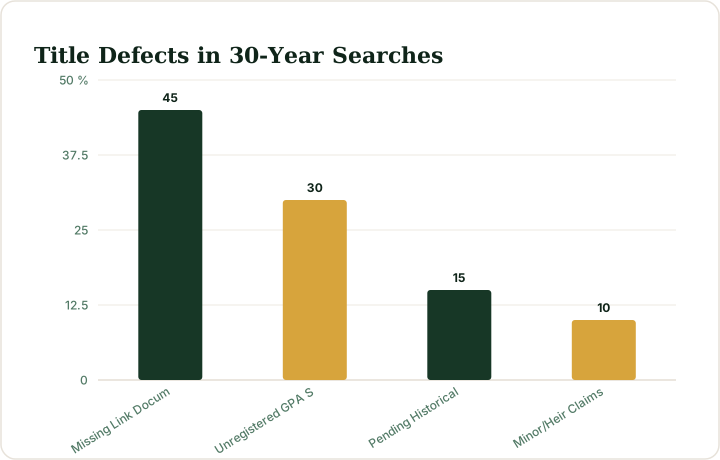
Understanding the Old vs New Record Transitions
When you dig back 30 years, you will inevitably encounter the transition between old settlement records and new settlement records. In many Eastern states, this is known as the difference between Sabak (old) and Hal (new) records.
During a government land settlement, all boundaries are re-measured and new plot numbers are assigned. If your 30-year chain crosses a settlement year, the plot number will change mid-chain. For example, Plot 450 in the 1996 sale deed might become Plot 812 in the 2015 sale deed. If the seller cannot produce the official correlation certificate linking the old plot number to the new plot number, you have a massive legal defect. The bank will reject the loan because they cannot mathematically prove that the land sold in 2015 is the exact same piece of earth sold in 1996.
Hidden Red Flags in Pre-2000 Property Records
The rules governing property transactions were much looser three decades ago. When reviewing records from the 1990s, you must watch for specific legal traps that are no longer common today.
The most dangerous trap is the General Power of Attorney sale. Before the landmark 2011 Supreme Court ruling, it was common practice in cities like Delhi and Bengaluru to transfer property using a General Power of Attorney, an Agreement to Sell, and a Will, rather than a registered sale deed. If your 30-year chain includes a General Power of Attorney transfer from 1998, you need an advocate to verify if that transfer was legally perfected.
Another common issue is unregistered wills. While the law does not strictly mandate the registration of a will, an unregistered will from 1997 used to transfer property between siblings is a prime target for litigation by other legal heirs today.
2026 Fees and Timelines for a Three-Decade Search
The cost of a 30-year search varies heavily by state, but the structure of the government fees remains largely consistent. You will pay a base fee for the first year of the search, and a smaller incremental fee for every additional year.
Here is a breakdown of what you can expect to spend on official government fees in 2026.
| Document Type | Average Government Fee (2026) | Typical Processing Time |
|---|---|---|
| 30-Year Encumbrance Certificate | ₹25 to ₹150 first year, ₹10 to ₹50 per subsequent year | 7 to 14 days (offline) |
| Certified Copy of Old Sale Deed | ₹200 to ₹500 per document | 10 to 21 days |
| Historical Record of Rights | ₹30 to ₹100 per extract | 2 to 5 days |
| Advocate Title Search Report | ₹15,000 to ₹50,000 | 14 to 30 days |
Do not let a broker rush you. Reconstructing a 30-year history takes a minimum of three to four weeks. If someone promises a complete 30-year clearance in 48 hours, they are likely skipping the physical Book 1 ledger checks entirely.
What to Do Next Before You Sign the Agreement
The excitement of finding the perfect property often blinds buyers to the historical risks buried in the paperwork. Before you transfer any advance payment, follow these exact steps to protect your capital.
- Demand the complete chain of title documents from the seller, going back to at least 1996.
- Apply independently for a 30-year Encumbrance Certificate at the local Sub-Registrar office.
- Cross-reference the Encumbrance Certificate against the physical deeds provided by the seller.
- Pull the historical revenue extracts from your state portal to ensure the mutation was completed after every single past sale.
- Hire a verified local advocate to conduct a physical search of the pre-2008 Volume 1 ledgers.
Taking these steps ensures you are buying a clean, marketable title, free from the ghosts of decades past.
Related guide: online land title verification in India