


Picture this. The sea breeze hitting your face in Mahakalapada. You hold a perfectly stamped Sale Deed. The plot is yours. Or so you think. Take a buyer who pays for a prime coastal plot in Kendrapara. The paperwork looks clean. Too clean. That land? It sits squarely inside a Coastal Regulation Zone (CRZ). You can't build on it. You can't even mutate it. The seller knew. The broker knew. Now, the buyer owns a very expensive patch of saltwater. Welcome to the 2026 Kendrapara coastal land trap. Here's what they don't want you to know. Families are losing their life savings because they trust a registered deed over a revenue court verification (IGR Odisha (Inspector General of Registration)).
How the Coastal Plot Pattern Works
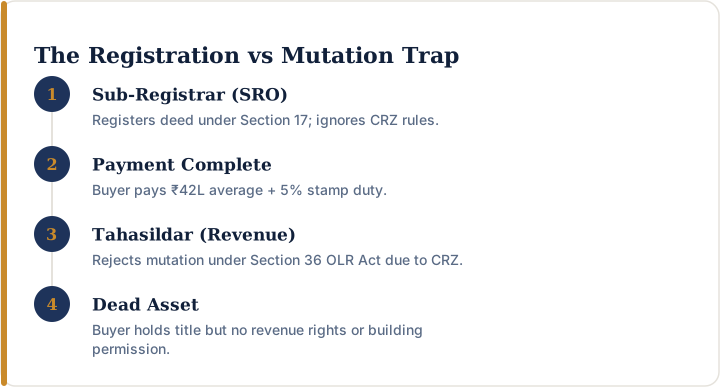
Brokers are targeting non-resident Odias (NROs) and city dwellers looking for "farmhouse" or "resort" properties near the coast. They show you a beautiful piece of land. They show you a clear Hal Khatiyan (ହଲ ଖତିୟାନ). They even help you register the Sale Deed at the local Sub-Registrar's office (IGR Odisha SRO directory). You pay the asking price. You pay the 5% stamp duty. You walk away thinking you own a piece of paradise. Then you apply for mutation at the Tahasildar's office, and the application stalls: the land falls in a No Development Zone under the Coastal Regulation Zone (CRZ) Notification of 2019, issued under the Environment (Protection) Act, 1986. This isn't a mistake. It is a calculated offloading of dead assets.
Once the money changes hands and the deed is registered, recovering your funds from a fraudulent seller in a civil court can take years.
Why the SRO Registers What the Tahasildar Won't Mutate
How does a government office register the sale of land that another government office refuses to mutate? This is the fundamental loophole in Indian property law, and it is destroying families in Kendrapara. Under Section 17 of the Registration Act, 1908, the Sub-Registrar Office (SRO) is legally bound to register a Sale Deed if the stamp duty is paid and the identities of the buyer and seller are verified (IGR Odisha fee schedule). The SRO does not verify if the land is legally buildable. They do not check if it falls under a restricted eco-sensitive zone. They are merely recording a transaction. However, mutation is governed by the Odisha Land Reforms Act, 1960. Specifically, Rule 34 of the Orissa Survey and Settlement Rules, 1962 gives the Tahasildar the authority for mutation, and the Odisha Right to Public Services Act its time limit. When your mutation case opens, the Revenue Inspector (RI) may conduct a field enquiry. If the RI finds the land is within the 500-meter High Tide Line (HTL) restriction of a CRZ, or if it violates the Kendrapara Coastal Land: CRZ Regulations, they will reject the mutation. You are left with a registered deed, but your name will never appear on the Bhulekh Odisha portal. You have title, but no revenue rights. You cannot get a bank loan. You cannot build a boundary wall.
The Bhitarkanika No Development Zone
Let's look at the geography of the fraud. Kendrapara is bordered by the Bay of Bengal and houses the Bhitarkanika National Park. The CRZ maps demarcate No Development Zones (NDZ) along the High Tide Line (HTL) and along tidal-influenced water bodies (like the creeks branching off the Brahmani and Baitarani rivers). A plot inside one is dead land for a residential buyer. Brokers exploit the fact that Bhulekh records do not have a big red "CRZ" stamp on them. The Record of Rights (RoR) might just show the Kisam (land type) as 'Sarad' (agricultural) or 'Taila' (dry land). But environmental law supersedes revenue classification. If you are buying anywhere near Rajnagar or Mahakalapada, you are walking through a minefield. You must cross-reference the plot coordinates with the Odisha Coastal Zone Management Authority (OCZMA) maps before paying a single rupee in advance.
Decoding the Sabak vs Hal Khata for Coastal Plots
The documents told a different story. Always pull both the Sabak (old settlement) and Hal (current settlement) records. Fraudsters often manipulate the Kisam during the transition from Sabak to Hal. A plot that was historically 'Chingudi Gheri' (prawn farming pond) or 'Nadi' (riverbed) in the 1920 settlement might mysteriously appear as 'Gharabari' (homestead) in a recent, illegally manipulated Hal record. Here is what you must look for on the bhulekh.ori.nic.in portal:
- Check the Kisam: If the land is marked as 'Jungle', 'Gochar' (pasture), or 'Nadi', it is strictly non-transferable for residential use. 2. Verify the Remarks (ମନ୍ତବ୍ୟ) Section: Look for any notes regarding "Eco-Sensitive Zone" or pending cases under Section 8-A of the OLA (Odisha Land Encroachment Act). 3. Trace the Title Chain: Ensure the transition from the Sabak Khatiyan to the Hal Khatiyan was done through a legal settlement order, not a sudden, unexplained mutation. A deep dive into the Sabak records can reveal that the "prime coastal plot" was actually government wasteland encroached upon decades ago.
The Flood-Zone Disclosure Loophole in 2026

Beyond the CRZ restrictions, there is the physical reality of Kendrapara. It is a delta region prone to severe cyclonic flooding. Watch for sellers offloading flood-prone land during the dry months (January to May). They utilize the Kendrapara Delta Region: Mutation Timeline loophole. Because the mutation process takes time, a buyer registering in March may not get the RI field visit until the monsoon has arrived. By then, the plot may be under water, and the RI can reject the mutation because the physical boundaries cannot be verified. Sellers are legally required to disclose flood-zone status under Section 55 of the Transfer of Property Act, 1882 (duty to disclose material defects). But in reality? They stay silent, take your money, and vanish. You can read more about how this impacts local valuations in our deep dive on the Plot Rate Kendrapara: The Hidden Price War.
4 Steps to Verify Kendrapara Coastal Land
The prevention is straightforward if you know where to look. Do not rely solely on the Encumbrance Certificate. The EC only tells you about registered transactions; it tells you nothing about environmental restrictions or mutation blocks. Before you sign any agreement or pay an advance, execute this 4-step verification:
| Step | Action Required | Expected Outcome | Risk if Skipped |
|---|---|---|---|
| 1. Bhulekh Kisam Check | Verify Hal and Sabak Khata on bhulekh.ori.nic.in | Must not be 'Nadi', 'Jungle', or 'Gochar' | Buying non-transferable government land |
| 2. CRZ Map Overlay | Check plot coordinates against OCZMA maps | Plot must be outside the NDZ | Mutation rejection, building ban |
| 3. IGR Encumbrance | Pull Form 25 EC from igrodisha.gov.in for 30 years | Clean chain of title, no hidden mortgages | Inheriting previous owner's debt |
| 4. Tahasil Case Search | Check for pending mutation or other revenue cases on the plot | Zero pending revenue court disputes | Years of legal battles in revenue court |
If a seller pressures you to skip these steps, walk away. The money you save will be your own.
The Final Verdict: Don't Buy the View Blindly
The allure of coastal land in Kendrapara is undeniable. But the legal landscape in 2026 is unforgiving. The gap between the Sub-Registrar's mandate to register and the Tahasildar's mandate to mutate is where fraudsters make their millions. Never assume a registered Sale Deed guarantees ownership. Ownership in Odisha is only truly established when your name is updated in the Record of Rights on the Bhulekh portal. Until that mutation is complete, you are vulnerable.
Do your homework. Check the CRZ maps. Read the Sabak records. The paperwork might look clean, but in Kendrapara, you have to look beneath the surface.
The Prawn Gheri Risk: Buying Illegal Aquaculture Land
In Kendrapara blocks like Mahakalapada and Rajnagar, a massive chunk of coastal land was historically used for illegal shrimp farming (prawn gheries). When the Coastal Aquaculture Authority (CAA) cracks down, fraudsters hastily fill these abandoned ponds with sand and market them as prime ocean-view residential plots. The legal trap here is land classification. These lands are almost always classified as Sarad (agricultural) or Jalashaya (water body) in the Bhulekh records. Building a house on agricultural land without formal conversion violates Section 8-A of the Odisha Land Reforms (OLR) Act, 1960.
To protect yourself from buying an illegal aquaculture dump, mandate these checks:
- **Verify the Kisam (Land Type):** If the Record of Rights (RoR) lists the land as anything other than Gharabari (homestead), you cannot legally build a residential structure.
- Calculate the Conversion Cost: Under OLR Section 8-A, converting agricultural land to homestead requires paying a premium. In coastal Kendrapara, this premium is based on the benchmark valuation, plus a ₹100 application fee.
- Track the 180-Day Deadline: The Sub-Collector has up to 180 days to approve or reject a conversion application. Never buy land where the conversion is merely "pending."
Concrete Takeaway: Never buy a filled-in prawn gheri without a finalized OLR Section 8-A conversion order; otherwise, the Tahasildar can levy a penalty and order demolition of your property.
The Khasmahal Leasehold Illusion: Purchasing Government Land
Another devastating trap in the Kendrapara coastal belt is the illicit sale of Khasmahal (government leasehold) properties. Fraudsters target out-of-state buyers by offering a "General Power of Attorney" (GPA) or an unregistered sale agreement, falsely claiming these documents grant permanent possession rights. Under the Odisha Government Land Settlement Act, 1962, leasehold land belongs entirely to the State. You cannot buy, sell, or inherit it without explicit, written permission from the District Collector.
Before transferring any funds, execute this defensive checklist:
- Inspect the Khata Ownership: If the Bhulekh portal lists the land under Rakhit, Abada Jogya Anabadi, or Sarbasa Dharana, it is strictly state property and cannot be sold by a private citizen.
- Demand the Collector's NOC: If the seller claims valid leasehold rights, demand the original lease document and the District Collector’s No Objection Certificate for transfer.
- Avoid the GPA Trap: A GPA does not transfer legal title under Section 17 of the Registration Act. Paying stamp duty to register a GPA for Khasmahal land is a complete waste of capital.
- Anticipate the Rejection: If you attempt to mutate government land without Collector approval, the Tahasildar will reject your mutation application.
Concrete Takeaway: If the RoR shows the State Government as the owner, walk away immediately-no Collector in Odisha will approve the transfer of coastal Khasmahal land to a private buyer in 2026.