


Chennai know the Form 15 Encumbrance Certificate you just downloaded might completely contradict the revenue records? Buyers trust the digital registration portal blindly, assuming a clear Encumbrance Certificate guarantees a safe purchase. They are wrong. Buyers in South Chennai can lose their savings when they skip independent legal verification and rely solely on seller-provided documents. The gap between what is registered and what is actually owned is where fraudsters operate. Property document verification lawyers in Chennai do not just read deeds. They cross-reference conflicting government databases to find the hidden liabilities that DIY buyers miss.
For a foundational understanding of the documents involved across states, review the title verification checklist for Odisha, and then apply those principles to the Tamil Nadu framework below.
The 2026 Chennai Database Disconnect
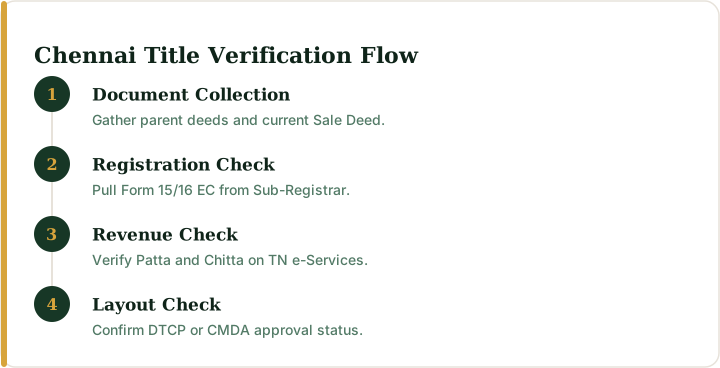
Tamil Nadu has made massive strides in digitizing land records through the Patta Chitta (TN e-Services) portal and the TNREGINET registration system. However, these two databases do not always speak to each other in real time. A sale deed registered today at the Sub-Registrar Office in Velachery might not reflect in the Taluk office A-Register for weeks. Fraudsters exploit this exact window.
They register a property, wait for the Encumbrance Certificate to update, but sell the same parcel again before the revenue records update the Patta. A buyer checking only the registration records sees a clean title. A buyer checking only the revenue records sees the old owner. Only a systematic, parallel check of both systems reveals the anomaly. This is why relying on a single portal is the fastest way to lose your life savings.
Experienced property document verification lawyers in Chennai know that a clear title requires unbroken harmony between the registration chain and the revenue chain. If the Sale Deed says one thing but the Chitta says another, the transaction must halt immediately.
What is the Encumbrance Certificate?
The Encumbrance Certificate (EC) is a legal document issued by the Sub-Registrar under the Indian Stamp Act 1899 and Registration Rules. It lists all registered transactions, mortgages, and liabilities on a specific property over a requested period. In Tamil Nadu, Form 15 is issued when encumbrances exist, while Form 16 is issued for a nil encumbrance period.
While the EC is mandatory, it is not exhaustive. It only reflects transactions formally registered with the Sub-Registrar. It does not show equitable mortgages created by depositing title deeds without registration, nor does it show pending civil litigation in the Madras High Court or local district courts.
This limitation is exactly why Section 17 of the Registration Act, 1908, is so critical. It mandates the registration of specific documents to make them legally binding. However, because certain historical family settlements or unregistered agreements might still hold weight in a protracted legal battle, lawyers look beyond the Form 15 EC. They demand the parent documents, the Field Measurement Book (FMB) sketch, and the Town Survey Land Register (TSLR) extract for urban Chennai properties.
The Tambaram Patta Forgery Pattern
Let me show you the pattern. Picture a sophisticated document forgery ring operating out of Tambaram. The sellers presented buyers with pristine Sale Deeds and a Form 16 Nil Encumbrance Certificate. Everything looked perfect on paper. The buyers paid their advances.
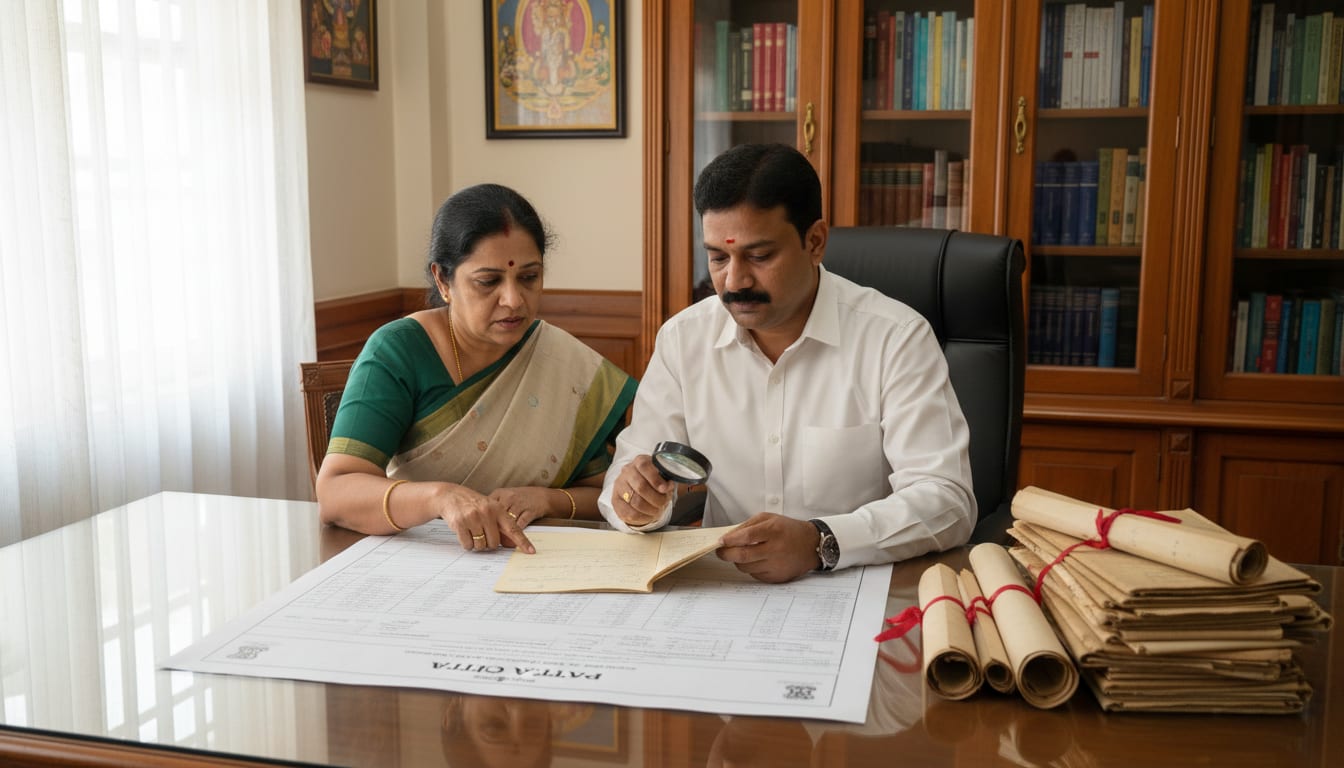
The trap snapped shut during the final registration. The Sub-Registrar rejected the applications. Why? The Patta provided by the sellers was a highly convincing forgery. Under Section 3 of the Tamil Nadu Patta Pass Book Act, 1983, the Patta is the ultimate prima facie evidence of possession and revenue liability. The fraudsters had hacked a visually identical PDF but altered the survey numbers.
The buyers who used property document verification lawyers in Chennai caught the fraud on day one. Their advocates physically pulled the A-Register extract from the Taluk office and compared the sub-division numbers against the forged Patta. The buyers who relied on DIY checks lost their entire advance.
A verified advocate in your district, free to connect.
Now let us examine the exact checks these advocates perform to protect your capital.
The 5-Point Title Chain Check
Your odds of avoiding litigation drop sharply if the parent document is missing. Lawyers employ a rigid 5-point framework to verify the title chain.
First, they trace the origin of the property. For a plot in Chennai, this means tracing the title back at least 30 years, or to the original government allotment. They verify the root document, ensuring the first recorded owner had the legal right to sell.
Second, they verify the flow of title. Every subsequent Sale Deed, Gift Deed, or Settlement Deed must link perfectly to the previous one. A missing link, such as a property passing from a grandfather to a grandson without a registered Will or legal heir certificate, breaks the chain.
Third, they check for minor rights. If a property was sold while a legal heir was a minor, the lawyer verifies that court permission was obtained under the Hindu Minority and Guardianship Act.
Fourth, they cross-reference the physical dimensions. The extent of land mentioned in the Sale Deed must match the FMB sketch and the Patta. If the deed claims 2400 square feet but the FMB shows 2100 square feet, you are paying for phantom land.
Fifth, they verify the encumbrances. This goes beyond downloading the EC. It involves checking the Central Registry of Securitisation Asset Reconstruction and Security Interest of India (CERSAI) portal for equitable mortgages.
Unapproved Layouts and the DTCP Verification
A frequent issue in Tamil Nadu property transactions is unauthorized construction or plan deviation. You might find a beautiful villa in OMR, completely built and ready to occupy. The title is clear, the Patta is in the seller's name, and the EC is clean.
However, the layout itself might be unapproved. Under Section 22-A of the Registration Act (Tamil Nadu Amendment), the registering officer shall refuse to register any document relating to the transfer of immovable property if it is an unapproved plot. The Directorate of Town and Country Planning (DTCP) or the Chennai Metropolitan Development Authority (CMDA) must sanction the layout.
Some sellers present fake DTCP approval numbers. Property document verification lawyers in Chennai do not just look at the approval number on the brochure. They pull the master plan from the CMDA portal and verify the specific survey number against the approved layout grid. If the plot falls under Open Space Reservation (OSR) land or a designated water body (Eri or Kuttai), it cannot be legally sold.
Fraud often succeeds because the buyer never checked the records. Don't be a statistic.
Protecting yourself requires understanding the financial investment required for this level of diligence.
The Cost of Legal Verification in Chennai
Many buyers hesitate to hire property document verification lawyers in Chennai because they fear exorbitant fees. This hesitation is the root cause of the problem. When you are paying 11 percent total registration costs (7 percent stamp duty plus 4 percent registration fee) on a Rs 1 Crore property, skipping a minor legal fee is a catastrophic risk miscalculation.
The fee for a comprehensive title verification and legal opinion in Chennai depends on the complexity of the title chain and the location of the property.
This fee covers the physical retrieval of certified copies from the Sub-Registrar Office, the translation of old Tamil documents, the CERSAI mortgage check, and the drafting of a legally binding Title Scrutiny Report. If a bank is financing your purchase, they will insist on their panel advocate performing this check. However, a bank's advocate protects the bank's loan amount, not your equity. You need independent counsel.
5 Red Flags Your Lawyer Must Catch
When reviewing a property file, your advocate is actively looking for specific failure points. If any of these five red flags appear, the transaction requires immediate renegotiation or cancellation.
- The General Power of Attorney (GPA) is unregistered or the principal is deceased. A GPA becomes invalid the moment the principal dies. Fraudsters frequently use old GPAs to sell properties belonging to deceased NRIs.
- The property is classified as Panchami Land. These lands were assigned to marginalized communities and cannot be sold to individuals outside those communities. Any such sale is void ab initio.
- The Patta is a Joint Patta but not all co-owners are signing the Sale Deed. Every name on the Joint Patta must execute the transfer.
- There is an active civil dispute noted in the Encumbrance Certificate or local court registry. Buying a property under litigation makes you a party to a multi-decade legal battle.
- The land conversion certificate is missing. If agricultural land (Nanjai or Punjai) is being sold as a residential plot without formal conversion from the District Collector, you will never get a building approval.
The Exact Process to Verify Chennai Real Estate
Do not let the excitement of a new property blind you to the legal realities. The verification process must be clinical, detached, and exhaustive.
First, demand the complete chain of documents from the seller, not just the current Sale Deed. Second, hire an independent property document verification lawyer in Chennai who specializes in local real estate law, not a general practitioner. Third, insist on a physical inspection of the property boundaries using the FMB sketch to ensure there is no encroachment.
Fourth, verify the utility tax receipts. Unpaid property tax, water tax, or electricity bills to the Chennai Corporation or TANGEDCO remain attached to the property, not the previous owner. You will inherit those debts.
Finally, do not transfer the full advance amount until the Title Scrutiny Report is signed and delivered by your advocate. The trap only catches those who act before they verify.
Smart investors verify first. Start your analysis.
Authoritative sources: Patta Chitta (TN e-Services) · India Code - central statutes incl. the Registration Act, 1908