
Consider a bank-panel advocate who signs off on a title report, only to find days later that the client's commercial plot belongs to someone else. The paperwork looks clean. Too clean. The seller has weaponized the transition to Odisha's 2026 Smart RoR system. Here is what they don't want you to know about the new digitized land records. If you are an advocate issuing title opinions in Odisha today, the old checklist will get you sued. Fraudsters are exploiting the exact digital tools designed to stop them.
What is the Smart RoR in Odisha?
The Smart Record of Rights (RoR) is Odisha's 2026 digitized land document featuring an embedded electronic security chip and a scannable QR code. Issued by the Tahasildar's office, scanning the code reveals the parcel's complete transaction history, past sale deeds, and mutation records directly from the Bhulekh portal database. This system was built to eliminate forged RoRs and multiple registrations of the same plot. The government designed it to trigger instant alerts to the Revenue Inspector (RI) and Tehsildar if unauthorized alterations are detected. When you build a taller wall, criminals build a taller ladder. Advocates must understand how the gaps in this system are being actively exploited.
Legacy Record Gaps
Picture this: the police are asking an advocate why he approved a title for a plot that was already sold twice. The answer lies in the state’s land-record computerisation background. Some villages, tracts, and patches remain without an RoR or are entirely unsurveyed. These legacy gaps are the ultimate playground for boundary manipulation and identity misuse. Fraudsters find a plot in one of these unsurveyed patches. They fabricate a paper deed from the Sabik era. Because the digital Record of Rights (ROR) is incomplete for that specific mauza, the sub-registrar cannot electronically verify the chain of title (IGR Odisha (Inspector General of Registration)). The advocate checks the online portal, sees nothing, assumes the paper deed is the only source of truth, and approves the sale.
Pattern 1: The CLR Dashboard Mismatch
Odisha tracks district-level computerisation progress through the Computerization of Land Records (CLR) dashboard. A massive red flag for any advocate is when a disputed parcel has inconsistent entries across its RoR history, its village CLR status, and its registered transaction records. For example: the CLR dashboard shows the village as 100% digitized, yet the seller presents a freshly printed paper RoR, claiming the servers were down. If the CLR says the village is digitized, but the seller insists on a manual paper trail, walk away. The mismatch between online CLR status and offline documentation is where the fraud lives.
Pattern 2: Unauthorized Mutation on Inactive Holdings
Mutation time limits are set under the Odisha Right to Public Services Act. But fraudsters target remote or inactive holdings, lands owned by NRIs or deceased individuals whose heirs haven't updated the records. They file a mutation application using a fabricated power of attorney or false inheritance claims. Because the original owner is inactive, no one files an objection within the fifteen days the Tahasildar's notice allows. The Tahasildar's office, following procedure, approves the mutation. Now the fraudster has a legitimate Smart RoR. The QR code scans perfectly. The electronic chip validates. The system worked exactly as intended, but it validated a lie. Advocates cannot just scan the QR code and stop there; you must trace the origin of the mutation itself.
Pattern 3: The Duplicate Sale History Illusion
The state government explicitly identified repeat sales of the same land parcel as a primary target for the Smart RoR initiative. Yet, the fraud persists. Here is how they bypass the system. The fraudster sells the land using an older paper deed to Buyer A. The registration happens, but Buyer A delays filing for mutation. Before the digital records update, the fraudster uses their still-valid name on the Bhulekh portal to sell the exact same land to Buyer B, this time presenting the digital RoR. By the time Buyer A's mutation application hits the Tahasildar's desk, Buyer B has already registered their deed. This creates a catastrophic title dispute. As an advocate, if you are not mandating that your client files for mutation on the exact day of registration, you are leaving them exposed to a duplicate sale.
How to Read the Smart RoR Transaction Chain
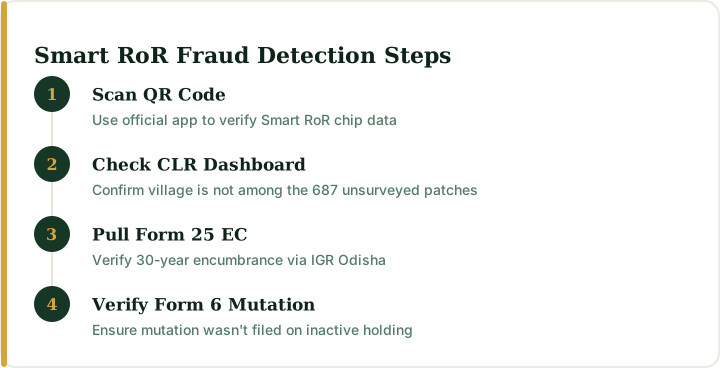
Do not skip these steps when verifying a Smart RoR in 2026. This is your professional shield. 1. Scan the Smart RoR QR code using the official Odisha Revenue app. 2. Cross-reference the digital output with the physical printed copy for any overwritten ownership data. 3. Log into the IGR Odisha portal and pull the Encumbrance Certificate (Form 25) for the last 30 years. 4. Verify the village status on the CLR dashboard to ensure it is not one of the unsurveyed patches. 5. Check the mutation case record at the Tahasildar's office to confirm the basis of the current owner's title. 6. Compare the Sabik (old) khatiyan with the Hal (current) khatiyan to ensure continuity of area and boundaries. 7. Look for any active RI or Tehsildar alerts triggered by the security chip.
The Tribal Land Rejection Risk
The risk is worse when tribal land is involved. If you are dealing with plots in Sundargarh, Mayurbhanj, or Koraput, which lie in the Scheduled Areas, you must navigate Regulation 2 of 1956, which makes a transfer by a Scheduled Tribe member to a non-member void (Section 3); elsewhere, Section 22 of the OLR Act requires the Revenue Officer's permission. Fraudsters will often mask the tribal status of the original landowner in the Smart RoR. They manage to get the caste status altered in the digital record through local bribery. The advocate sees a non-tribal owner on Bhulekh and approves the sale. Months later, the transfer is found void, and the land can be ordered restored to the tribal owner or his heirs. You can read more about this specific nightmare in our Koraput tribal land: advocate pre-sale checklist.
The Advocate's 2026 Title Verification Checklist
Do not rely on memory. Use this matrix to verify every file that crosses your desk.
| Document / System | What to Verify | Red Flag to Catch |
|---|---|---|
| Smart RoR | QR Code and Security Chip | Mismatch between scanned data and printed text |
| CLR Dashboard | Village Digitization Status | 100% digitized village but seller uses paper RoR |
| IGR Odisha Form 25 | 30-Year Encumbrance | Missing links in the chain of title |
| Mutation case record | Basis of Ownership Change | Recent mutation on an inactive/NRI holding |
| Sabik vs Hal Records | Continuity of Plot Area | Unexplained increase in decimal area |
Stop Relying on Sabik Records Alone
Another fatal error advocates make is trusting the Sabik records without forcing the seller to update to the Hal records. If the land is near industrial zones, the risk multiplies. For example, if you are looking at Angul Coal Belt Land: NTPC + MCL Acquisition Risk for Private Buyers, relying on outdated records can mean your client buys land that has already been earmarked for government acquisition. The Smart RoR is supposed to show acquisition notices, but if the mutation from Sabik to Hal was never completed, those notices won't appear on the seller's current record. You must bridge the historical gap yourself.
The Financial Fallout of Bad Verification
When an advocate misses these patterns, the client loses everything. If a bank-panel advocate approves a flawed Smart RoR, the bank issues the loan. When the fraud is discovered, the true owner reclaims the land, the bank demands their money back, and the buyer is left holding the debt with zero collateral. And who do they sue? You. The advocate who signed the title verification report.
Your Next Steps Before Approving Title
The days of glancing at a physical RoR and signing a title certificate are over. The Smart RoR is a powerful tool, but it is only as reliable as the data entered into it. As an advocate, you must assume every digital record is hiding a legacy survey gap or an unauthorized mutation until proven otherwise. Check the CLR dashboard. Pull the 30-year Form 25 Encumbrance Certificate. Verify the mutation triggers. Do not let your signature be the one that validates a fraud.
Authoritative source: IGR Odisha fee schedule
Authoritative source: IGR Odisha SRO directory
The "Missing Caste" Exploit: Bypassing OLR Section 22
One of the most devastating frauds hidden within digitized records involves the deliberate manipulation of a landowner's caste designation. Under Section 22 of the Odisha Land Reforms (OLR) Act, 1960, transferring land from a Scheduled Tribe (ST) or Scheduled Caste (SC) individual to a non-ST/SC person is strictly prohibited without prior written permission from the Revenue Sub-Collector.
In districts with significant tribal populations like Sundargarh, Mayurbhanj, and Rayagada, fraudsters exploit the data migration process. They bribe data entry operators to "accidentally" drop the ST/SC identifier from the remarks column of the new Smart RoR. The buyer, relying solely on the digital record, purchases the land and pays the standard 5% stamp duty.
Years later, the original owner's heirs file a restoration petition under Section 23 of the OLR Act. The transaction is declared void ab initio (invalid from the start), and the buyer loses both the land and their money.
To catch this, advocates must look for these red flags:
- Sudden name changes: The Sabik (old) record shows a traditional tribal surname, but the Hal (new) Smart RoR lists a generic title.
- Missing OLR 22 orders: The chain of title shows a past transfer from an ST seller, but no application fee receipt or Sub-Collector approval order is attached to the deed.
- Blank remarks columns: The digital RoR lacks the standard caste classification data that existed in the physical Khatiyan.
Concrete Takeaway: Never rely exclusively on the caste column in a Smart RoR. Always pull the physical Sabik RoR and verify the seller's community status to ensure OLR Act compliance before approving the title.
Sabik-to-Hal Manipulation During Consolidation
The transition from Sabik (old settlement) to Hal (current settlement) records is a prime breeding ground for title fabrication, particularly in areas governed by the Odisha Consolidation of Holdings and Prevention of Fragmentation of Land Act, 1972. Fraudsters manipulate the correlation between old plots and newly consolidated "Chaka" plots.
In rapidly developing districts like Khordha and Cuttack, a common scam involves linking a highly valuable Hal plot (e.g., prime highway frontage) to a Sabik plot the fraudster actually owns. However, the original Sabik plot was historically classified as low-value agricultural land (Sarad) or even non-transferable communal land (Gochar). The Smart RoR displays a clean, unencumbered Hal plot, completely masking the illegal classification upgrade. If the Tahasildar discovers this mismatch, they will initiate a suo motu revision, leading to immediate cancellation of the Patta.
When verifying consolidation records, advocates must execute the following checks:
- Obtain the Yadast (Correlation Register): Cross-check the exact Sabik plot numbers against the Hal plot numbers to ensure a 1:1 match.
- Verify the Chaka Map: Ensure the physical boundaries of the new consolidated plot align with the historical trace map.
- Check the Appeal Window: Confirm no objections were filed within the statutory 30-day window under Section 15 of the Consolidation Act.
- Pay for Certified Copies: Pay the nominal fee at the Tahasil office to get the certified manual Sabik RoR rather than trusting the digital summary.
Concrete Takeaway: A Hal Smart RoR is only the tip of the iceberg. Always demand the Sabik RoR and the official correlation sheet to prove the modern digital plot legally evolved from the original landholding.