
A NIL Encumbrance Certificate proves absolutely nothing about legal ownership (IGR Odisha (Inspector General of Registration)). Buyers can walk into the Sub-Registrar office with a clean Form 25 Encumbrance Certificate, pay their stamp duty, and unknowingly buy land the seller does not legally own (IGR Odisha fee schedule). A pattern runs through fraud cases across Odisha: buyers rely on single documents instead of verifying the complete chain of title. If you are preparing to buy land in 2026, relying solely on an online Bhulekh printout is a catastrophic financial risk (Bhulekh Odisha portal). The system requires a multi-layered verification approach that cross-references historical settlement records with current digital entries.
What is a Property Title in Odisha?
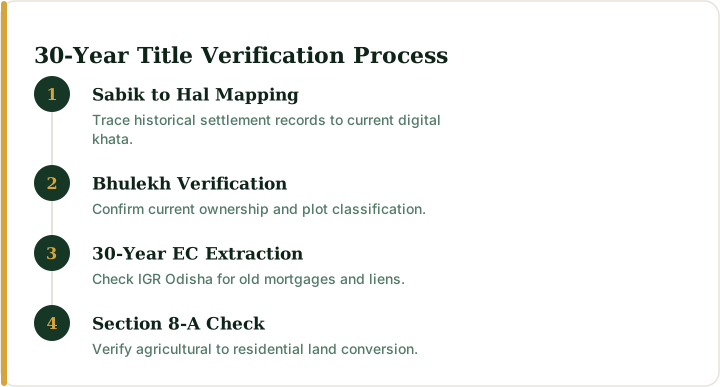
A property title is the legal right to own, use, and transfer a specific parcel of land. Under Section 54 of the Transfer of Property Act 1882, a valid title transfer requires a registered instrument. In Odisha, proving this title requires tracing the Record of Rights from the historical Sabik settlement to the current Hal digital records on the Bhulekh Odisha portal. The title is not a single piece of paper. It is a continuous, unbroken chain of historical documentation that proves how the current seller acquired the legal right to sell. Many first-time buyers confuse the physical possession of a plot with legal ownership. You can physically occupy a plot in Basudevpur for a decade, but if the Record of Rights (khatiyan) lists the state government or a tribal entity as the owner, you hold zero legal title. Verifying this requires looking past the immediate seller and interrogating the history of the land itself.
The Sabik to Hal Pattern
Let me show you the pattern. Consider a buyer in Bhadrak district who lost the purchase money in a sophisticated but common title trap. The seller presented a pristine digital Hal khatiyan (the current record) showing his name as the sole owner of a plot. The buyer checked the IGR Odisha portal, pulled a 15-year Encumbrance Certificate, saw zero existing loans, and proceeded to registration. Six months later, the buyer received an eviction notice from the Tahasildar. The trap was hidden in the historical Sabik records. During the 1970s land settlement, this specific plot was designated as Chaka land (consolidation land) belonging to a minor. The seller had manipulated a local revenue clerk in the 1990s to alter the manual mutation register before records were digitized. Because the buyer only checked the modern Hal record and ignored the Sabik history, they missed the illegal transfer. The current digital record was built on a fraudulent foundation.
This specific Sabik-Hal mismatch often leads to title disputes in coastal Odisha districts. When you buy land without tracing the title back to the original settlement, you are effectively gambling your life savings on the assumption that every revenue clerk over the last fifty years did their job perfectly.
Why the Form 25 Encumbrance Certificate Fails You
Here is what buyers often miss: the Encumbrance Certificate only records what people voluntarily register. Issued under Form 25, the EC is merely a ledger of transactions executed at the Sub-Registrar office. It is not a guarantee of title. Under Section 17 of the Registration Act 1908, certain documents must be registered, such as sale deeds above ₹100. However, many events that destroy a title never make it to the Sub-Registrar. If the seller's brother files a civil partition suit in the Bhadrak District Court claiming half the land, that pending litigation does not appear on the EC. If the land was acquired by the National Highway Authority last year, that acquisition order does not appear on the EC. If the property was mortgaged to a cooperative bank through a deposit of title deeds without a registered mortgage document, the EC will show a completely clean slate. Relying on an EC to verify a title is like looking at a car's paint job to determine if the engine works. You need the EC, but you cannot stop there. A robust title verification requires cross-referencing the Sub-Registrar's data with the Tahasildar's revenue records and the civil court's pending litigation registry.
The 5-Point Title Chain Verification Framework
To protect yourself from this scenario, you must execute a specific verification sequence. 1. Extract the 30-Year Encumbrance Certificate: Do not settle for the standard 15-year search. Request a manual search going back 30 years to uncover old mortgages that were never formally released. 2. Trace Sabik to Hal Mapping: Obtain the Sabik parcha (old settlement record) and compare the plot boundaries and ownership with the current Hal khatiyan. 3. Verify Section 8-A Conversion: If you are buying land for a house, check if the agricultural land was legally converted under Section 8-A of the Odisha Land Reforms Act 1960. 4. Cross-Check Khata and Plot Numbers: Ensure the khata number on the seller's sale deed exactly matches the khata number currently active on Bhulekh. 5. Physical Boundary Verification: Hire a private amin (surveyor) to measure the physical boundaries and confirm they match the dimensions listed in the digital bhu-naksha (cadastral map).
Skipping even one of these steps leaves a massive vulnerability in your legal due diligence. Most buyers skip the Sabik-Hal mapping because it requires physical visits to the district record room, but this is exactly where the most expensive frauds are hidden.
Sabik vs Hal Khata: The Historical Disconnect
The most critical component of Odisha title verification is understanding the difference between historical and modern records. Discrepancies between these two datasets fuel many civil land disputes today.
| Feature | Sabik Khata (Old Settlement) | Hal Khata (Current Settlement) |
|---|---|---|
| Era of Creation | Typically 1920s to 1930s (British era) | Typically 1970s to 1980s (Post-independence) |
| Primary Function | Establishing original family lineage and ancestral rights | Modern tax collection and current digital ownership tracking |
| Format | Handwritten Odia records, stored in district record rooms | Digitized database available on Bhulekh Odisha |
| Legal Weight | Used by courts to resolve ancestral partition disputes | Used by Sub-Registrars for immediate sale registration |
When a seller claims ownership through inheritance, the Hal khata is insufficient. You must pull the Sabik record to see how many legal heirs existed during the original settlement. If the Sabik record shows three brothers, but the Hal record only shows one seller, you must demand the registered partition deed or the death certificates of the other brothers. Without them, the unlisted heirs can return decades later and claim their share of the property you just bought.
Section 8-A and the Agricultural Land Illusion
Another massive risk involves land use regulations. In districts like Bhadrak and Khordha, agricultural land is significantly cheaper than homestead (Gharabari) land. Sellers frequently market agricultural plots as premium residential layouts. Under Section 8-A of the Odisha Land Reforms Act 1960, agricultural land cannot be used for non-agricultural purposes without explicit permission from the authorized revenue officer. If you buy a plot classified as agricultural (Chasa) on the Record of Rights and build a house on it, the Tahasildar has the statutory authority to impose heavy penalties and, in severe cases, order demolition. The conversion process requires an application in Form 8, payment of conversion fees based on the benchmark valuation, and a formal order from the Tahasildar.
Before you finalize any purchase, you must verify the land classification (Kisam) on the Bhulekh portal. If the classification is agricultural, the seller must provide the Section 8-A conversion order. If they cannot produce this document, you are buying a legal liability, not an asset.
The Cost of Title Defects
Let us look at the real costs of buying defective titles. When you purchase a property without proper verification, you are not just risking the purchase price. You are taking on the financial burden of future litigation. A title dispute in an Odisha civil court can run for years. During this entire period, you cannot build on the land, you cannot sell the land, and you cannot secure a bank loan against it. The property becomes a dead asset. Additionally, if you discover a defect after registration, the mutation process becomes a nightmare. The Tahasildar may reject your mutation if there is a discrepancy in the title chain. You will be left holding a registered sale deed but no Record of Rights in your name. In the eyes of the revenue department, the seller remains the owner until the mutation is complete.
How to Secure Your Investment Next
The era of casual property transactions in Odisha is over. With land values in districts like Bhadrak surging, fraudsters are deploying increasingly sophisticated methods to fake ownership. You cannot rely on the seller's assurances, and you cannot rely on a basic online check. Your next steps must be deliberate and legally sound. First, demand the complete chain of title documents from the seller, including the Sabik parcha, the Hal khatiyan, and every sale deed for the past thirty years. Second, verify the current status of the khata on the Bhulekh portal to ensure no recent transactions have altered the ownership. Third, apply for a 30-year Encumbrance Certificate through the IGR Odisha portal to rule out hidden mortgages. Do not let the excitement of a real estate purchase blind you to the legal realities. A thorough title verification takes time and effort, but it is the only way to ensure your investment remains secure for generations.