
Encumbrance Certificate (EC) in Odisha: How to Get It, Fees and Forms
How to get an encumbrance certificate in Odisha from IGR Odisha: the online application, IGR's fee table, Form 25 and Form 26, and what it does not show.
Reviewed by Anant Mohanty, Managing Editor — Title Research
The short answer
How do I get an encumbrance certificate in Odisha?
An encumbrance certificate (EC) lists the registered documents on a piece of land over the years you ask it to search: sales, mortgages, gifts, leases, releases. Apply online at IGR Odisha (igrodisha.gov.in): sign in, choose Online Encumbrance Certificate, enter the district, the registration office, the years to search and the land's tehsil, village, khata and plot, then pay through the Treasury payment gateway. The Sub-Registrar's office checks the application and signs the certificate digitally, within 7 days by IGR's public-service timeline, and you download it from your IGR dashboard. IGR sets the fee by the years searched: its table shows Rs 25 for the first year of a general search and Rs 15 for each further year, plus charges. A certificate that finds nothing is Form No. 25 (Nil); one that lists registered documents is Form No. 26. To read a Form No. 26, check each document's date, nature and parties against the chain of title you were given: before you buy, every sale should lead from one owner to the next, and a registered mortgage with no later release may still be outstanding. Or we fetch it for you: ₹199 plus the IGR fee at cost, delivered 1 to 7 days after payment.
What an encumbrance certificate is
An encumbrance certificate (EC) is a certificate from a Sub-Registrar's office that lists the registered documents affecting a piece of land over the years you ask it to search: sales, mortgages, gifts, leases, partitions, releases, whatever was registered for that land in that period.
The Registration Act, 1908 opens the registration books to search: under Section 57, Book 1 and its indexes are open to anyone who pays the fee, and copies are given on application. The Orissa Registration Rules, 1988 say how the certificate is made. Rule 123(2): "A certificate of encumbrance shall contain a complete list of all acts and encumbrances affecting the property in question."
Form No. 25, Form No. 26 and Form No. 27
The Rules prescribe three forms (Rule 123(1) and Appendix-I of the Orissa Registration Rules, 1988):
- Form No. 25 is the Nil certificate: the search found no registered acts or encumbrances affecting the property in the period searched.
- Form No. 26 is the certificate that lists what the search found: for each document, the date of execution, its nature and value, the parties (the executants and the claimants) and where it is registered (volume, page, number and year).
- Form No. 27 is a different search: the documents a named person executed or received, searched in Books 1, 3 and 4.
An EC for a piece of land comes back as Form No. 25 or Form No. 26, depending on what the search finds.
How to apply online at IGR Odisha
IGR Odisha publishes the steps in its own process document:
- Sign in at igrodisha.gov.in and open Online Encumbrance Certificate.
- Fill in the application: the applicant's details; the district and the registration office; the search period, from one date to another; and the land's tehsil, village, khata number and plot number, with its area.
- Confirm the details. The fee is shown before you pay; click Pay Now, and the Treasury payment gateway (SBI ePay) takes the payment. IGR's site then issues a money receipt.
- The application goes to the Sub-Registrar's office. The head clerk checks it and forwards it to the Sub-Registrar (or District Sub-Registrar), who approves it and signs the certificate digitally. A query, if there is one, comes back to your IGR home page.
- When the certificate is signed you get a message, and you download the signed PDF from your IGR dashboard.
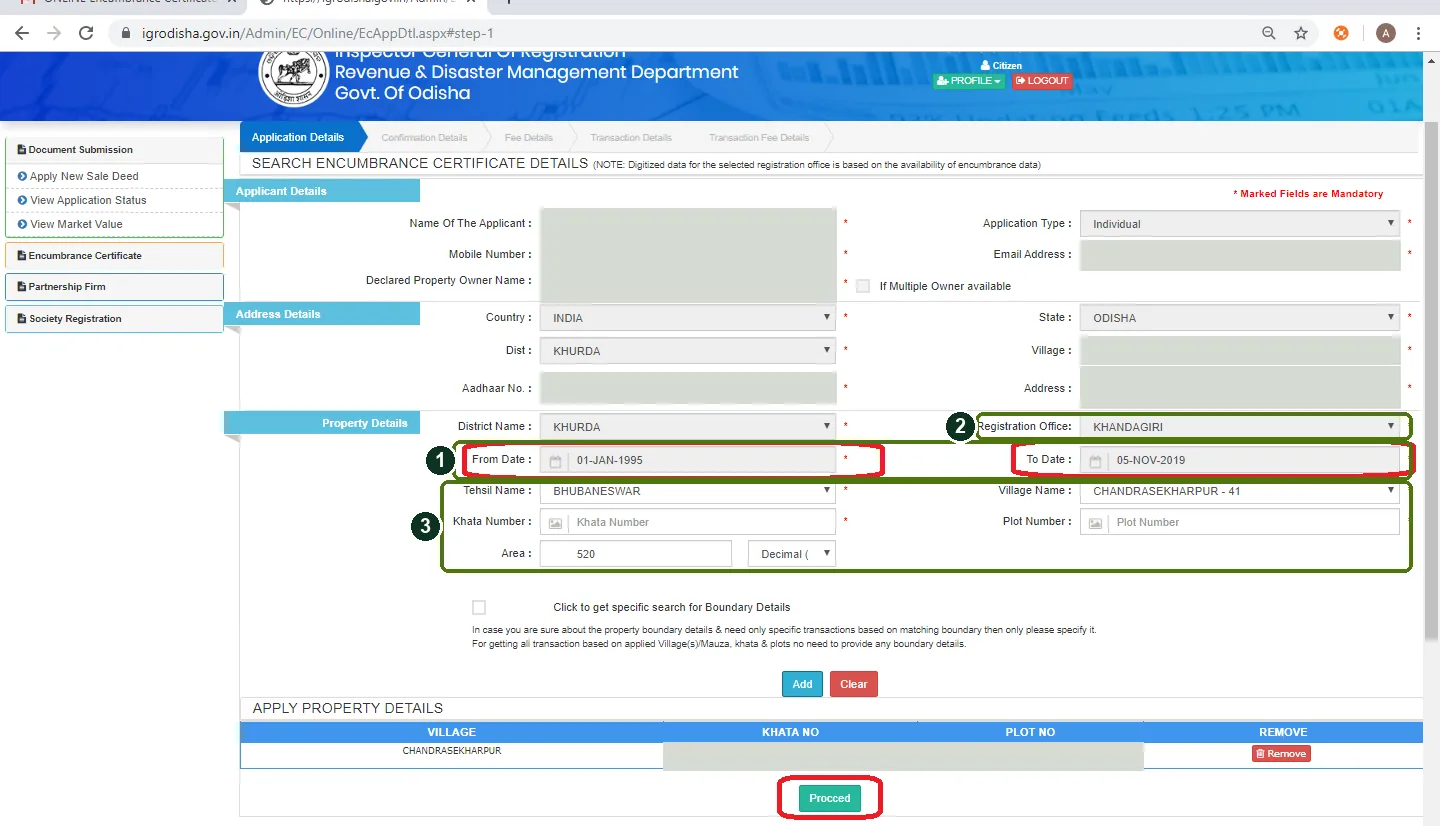
What to have ready: the land as the registers describe it
The search follows the description you give. The note printed on the certificate says so: if the same property has been described in registered documents differently from the way the applicant described it, the transactions in those documents will not be included in the certificate (Orissa Registration Rules, 1988, Forms 25 and 26).
So take the details from the land's Record of Rights (the khatiyan): the tehsil, the village, the khata number and the plot number as recorded. You can look up the Record of Rights by plot first. If a search has to cover the records of more than one office, the office you applied to issues one consolidated certificate after getting the other office's report (Rule 123(3)).
What it costs at IGR
IGR Odisha sets the fee and publishes it. Its EC fee table, as read on 25 September 2026, prices a general search at Rs 25 for the first year and Rs 15 for every further year, and lists an application fee, user charges and a fee for immediate delivery. The exact amount for your search is shown on screen before you pay (step 3 above); check the table on the day you apply.
How long it takes
IGR's public-service timeline gives the Sub-Registrar (the designated officer) 7 days to issue an encumbrance certificate, under the Odisha Right to Public Services Act. If it takes longer, the appeal lies with the District Registrar-cum-ADM, and the revision with the IGR. In those days the head clerk checks the application, and the Sub-Registrar approves and signs it (IGR process document); a query from the office adds a round trip through your IGR home page.
When we fetch it for you, the EC is delivered 1 to 7 days after payment.
Reading the certificate
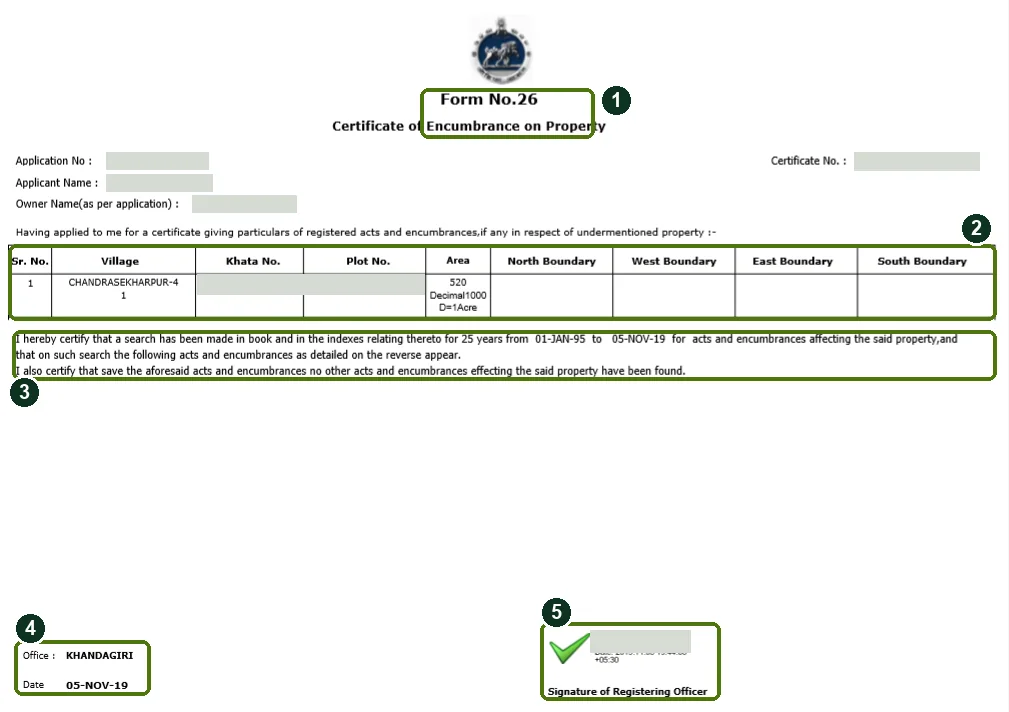
The certificate above is from IGR's process document; its wording is the Rules' Form No. 26 (Orissa Registration Rules, 1988). On the list, check each document's nature and parties against the chain of title you have been given: every sale should lead from one owner to the next, and a registered mortgage with no later release on the list may still be outstanding.
What an EC does not show
- Documents that describe the land differently from your application (the certificate's own note).
- Anything that was never registered. The search is of the registration office's books and their indexes; an unregistered agreement, or possession without a document, is not in them.
- Court cases. The EC is not a search of the courts. A case appears only if a document about it was registered or filed in that office.
- Mutation and the Record of Rights. Those are the Tahasil's records, published on Bhulekh, not the registration office's.
Two ways to get it
- Apply yourself at IGR Odisha, as above.
- Have it fetched: an expert applies to IGR Odisha for the land you name; ₹199 service fee per EC plus IGR's fee at cost, delivered 1 to 7 days after payment.
Once you have the EC
The EC names the parties in the land's registered chain: the sellers, the buyers, the mortgagees. The Land Litigation Check searches every one of those names in the Orissa High Court and in the district court where the land lies: 499 credits for up to 30 names.
The AI title report reads the EC with the Record of Rights and the deeds, every finding cited to its page; our empanelled advocates give a written, signed opinion; and for a home loan, the bank's panel advocate prepares a title search report from the same papers. Before any of it, the land records by name search shows every indexed parcel recorded under the seller's name, and the court case check by name searches one name across the courts.
Frequently Asked Questions
What is an encumbrance certificate in Odisha?
A certificate from the Sub-Registrar's office listing the registered documents affecting a piece of land in the years searched. The Orissa Registration Rules, 1988 require it to contain a complete list of all acts and encumbrances affecting the property (Rule 123(2)).
How do I apply for an EC online in Odisha?
Sign in at igrodisha.gov.in, open Online Encumbrance Certificate, enter the district, the registration office, the search period and the land's tehsil, village, khata and plot, and pay through the Treasury payment gateway. The Sub-Registrar's office checks it and signs the certificate digitally.
How do I download my EC from IGR Odisha?
When the Sub-Registrar has approved and signed it, IGR sends a message, and the signed PDF is in your dashboard on igrodisha.gov.in, where you download and save it.
What is the fee for an encumbrance certificate in Odisha?
IGR sets it by the years searched. Its EC fee table, as read on 25 September 2026, shows Rs 25 for the first year of a general search and Rs 15 for each further year, plus an application fee and user charges. The exact amount is shown before you pay.
How many days does it take to get an EC in Odisha?
Seven days: IGR's public-service timeline gives the Sub-Registrar 7 days to issue an EC, under the Odisha Right to Public Services Act, and the appeal lies with the District Registrar-cum-ADM. When we fetch it for you, it is delivered 1 to 7 days after payment.
What is the difference between Form 25 and Form 26?
Form No. 25 is the Nil certificate: the search found no registered acts or encumbrances in the period. Form No. 26 lists what the search found, document by document. Both are prescribed by the Orissa Registration Rules, 1988.
Does an encumbrance certificate show court cases?
No. It is a search of the registration office's books, not of the courts. A case appears only if a document about it was registered or filed there. To search the courts, use the names the EC gives you.
Can someone get the EC for me?
Yes. We fetch it from IGR Odisha for the land you name: ₹199 service fee per EC plus IGR's fee at cost, delivered 1 to 7 days after payment.