


Title verifications often get one fundamental thing wrong. Buyers assume a registered sale deed proves absolute ownership. Let me share something that could save you lakhs. In India, a registered deed only proves a transaction took place, not that the seller actually had the legal right to sell the property. A family can nearly lose everything by trusting an old registered document without checking the state revenue records to see who actually held possession. India does not have a state-guaranteed title system. We operate entirely on presumptive titles. If you are buying land anywhere from Karnataka to Odisha, you have to verify the real owner yourself. The solution is simpler than you think, but you need to know exactly which portals and documents to cross-reference. Here is a framework you can use.
The Presumptive Title Problem in India
The Indian government does not guarantee that the person selling you a property is the true owner. This sounds scary, but understanding it is your first layer of protection. Under Section 17 of the Registration Act, 1908, the registration of a document is mandatory for the sale of immovable property worth more than ₹100. However, the Sub-Registrar's job is merely to verify that the buyer and seller are present, that they have paid the correct stamp duty, and that their identities match their Aadhaar or PAN cards. The Sub-Registrar does not investigate whether the seller actually owns the land.
This creates a massive loophole. A fraudster can theoretically register a sale deed for a property they do not own, provided they pay the stamp duty. The buyer walks away with a legally registered document that is practically worthless in a court of law. Section 54 of the Transfer of Property Act, 1882, defines a sale as a transfer of ownership in exchange for a price paid. But if the transferor has no ownership to transfer, the sale is void.
To combat this, the central government initiated the DILRMP, Digital India Land Records Modernization Programme to digitise and integrate property records across all states. While this has made records more accessible, the fundamental law remains unchanged: buyer beware. You must look beyond the registration office and dive into the revenue department's records to find the truth.
How the Mutation and Registration Systems Disconnect
A common fraud pattern across India is the mutation-registration mismatch. When a property is sold, the transaction is recorded at the Sub-Registrar's office. However, the ownership record in the government's revenue department does not update automatically in most states. The buyer must apply for a process called mutation (Dakhil Kharij) to have their name entered into the Record of Rights (RoR).
Think of mutation like updating the billing name on your electricity meter after buying a house. The sale deed proves you bought it, but the mutation ensures the government recognizes you as the person responsible for the property taxes and revenue. If a previous buyer failed to mutate the property, the revenue records will still show the original owner.
Let us look at Odisha as a prime 2026 example of how this operates on the ground. According to the official revenue services portal, an uncontested mutation has a strict 7-day time limit for approval. The costs are highly regulated: an application fee of ₹10, a user fee of ₹80, and a speed-post RoR delivery fee of ₹40. Despite these low costs and fast timelines, many buyers skip this step.
When you are verifying a seller, you must pull the current RoR from the state portal. If they show you a registered sale deed from 2018, but the 2026 RoR on Bhulekh Odisha still shows their grandfather's name, you have a broken title chain. You cannot safely buy that property until the seller completes their own mutation.
The Three-Document Cross-Check Strategy
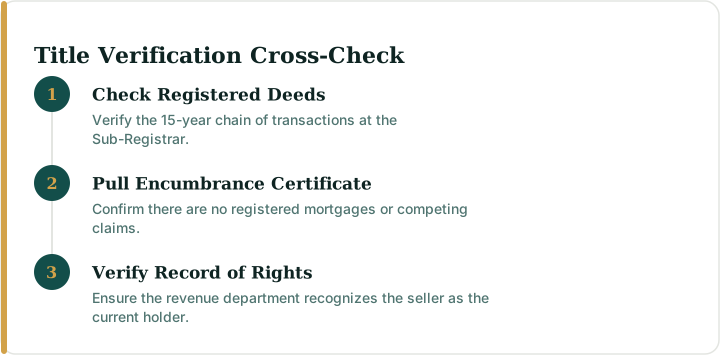
Before we panic about the complexities of local revenue offices, let us understand what is actually required for a bulletproof verification. You do not need to be a lawyer to perform the initial checks. You need to cross-reference three specific documents to ensure the seller is the undisputed owner.
First, you need the Chain of Title, which consists of the original Sale Deeds. You should ask the seller for the current sale deed and the previous sale deeds going back at least 15 to 30 years. This proves the historical sequence of transactions.
Second, you need the Record of Rights (RoR). Depending on your state, this is called the Pahani, Khatian, 7/12 Extract, or Patta-Chitta. This document proves that the local revenue authority recognizes the seller as the current possessor and taxpayer of the land. You can usually download this directly from the state's land records portal, such as Bhulekh in Odisha or Bhoomi in Karnataka.
Third, you need the Encumbrance Certificate (EC). This document is issued by the Sub-Registrar and lists every registered transaction on that specific plot of land over a chosen period. It will show you if the land has been mortgaged to a bank, leased out, or sold to someone else.
| Document Type | Issuing Authority | What It Actually Proves |
|---|---|---|
| Registered Sale Deed | Sub-Registrar (IGR) | A transaction occurred and stamp duty was paid. |
| Record of Rights (RoR) | Tahasildar / Revenue Dept | The government recognizes the person as the current landholder. |
| Encumbrance Certificate | Sub-Registrar (IGR) | The property is free from registered loans or competing registered claims. |
If the seller's name appears flawlessly on all three documents, you are looking at a highly secure transaction. If there is a mismatch on even one of these documents, you must halt the purchase and investigate.
Reading the Encumbrance Certificate Correctly
Let me share a secret most people do not know about the Encumbrance Certificate. An EC is not a magical shield against all property disputes. It is a specific legal document, issued in the form the state's registration rules prescribe (in Odisha, Form 25 or Form 26 under the Orissa Registration Rules, 1988), that only reflects transactions that were formally registered at the Sub-Registrar's office.
If the seller took an informal loan from a local moneylender and handed over the original title deed as collateral without registering the mortgage, that loan will never appear on the EC. This is why you must always demand to see the original, physical sale deed before buying. If the seller claims the original is lost, that is a massive red flag. They might have pledged it for an unregistered loan.
In 2026, obtaining an EC has become significantly easier through state portals. For instance, the official IGR Odisha portal processes an Encumbrance Certificate with a strict 7-day service time from the receipt of the application. When you receive the EC, do not just look at the final page. Read through every entry. Check for release deeds that prove past mortgages were fully paid off. Ensure the boundaries mentioned in the EC match the boundaries in the sale deed perfectly.
Why Boundary Disputes Derail Clear Titles
Even if the paperwork is flawless, the physical reality of the land can destroy a deal. Boundary ambiguity is a common reason property transactions fail or end up in civil court. You might buy a document that says you own 2000 square feet, but when you go to build a boundary wall, you discover the neighbor's house encroaches on 300 square feet of your plot.
This is where the revenue department's demarcation process becomes critical. In our 2026 Odisha example, the official revenue portal lists a specific demarcation fee of ₹20 per plot. This fee triggers a field enquiry where a government surveyor (in Odisha, the Amin) physically measures the land and marks the boundaries against the official village map (Bhu Naksha).
During this process, the Tahasildar will also issue a notice to the neighboring landowners. The Odisha state dashboard shows a Notice/Proclamation Fee of ₹20 for this exact purpose. If a neighbor disputes the boundary, they can file an objection, which stalls the mutation and demarcation process. Insist that the seller completes an official government demarcation before the final sale deed is signed. If the seller refuses, they are likely hiding an encroachment issue.
An Example of Ownership Verification
To see how this plays out, consider an example from Khordha district. A buyer is offered a plot with a pristine registered sale deed from 2012 and a clear Encumbrance Certificate showing no loans, and the seller is pushing for a quick 10 percent advance.
Run the plot details through the Bhulekh portal, and the Record of Rights does not show the seller's name. It shows a woman who died years earlier. The seller explains that he bought the land from her three sons, as his 2012 sale deed says, but never applied for mutation.
This is a classic trap. Because the mutation was never done, the revenue records still show the deceased woman as the owner. And suppose she also had a daughter, left out of the 2012 sale deed entirely. Had the sale gone ahead, the daughter could have filed a civil suit for her legal share, and the buyer would have been drawn into years of litigation. Checking the RoR and asking the seller to complete the mutation first is what prevents it.
This aligns with the patterns described in the How to Verify Property Title in Odisha: Bhadrak Guide and the broader Fake Property Documents in India: The Dead-Owner Pattern. The mechanics of fraud rely on buyers being too lazy to cross-reference the revenue portal.
Understanding Local Land Transfer Regulations
Another critical layer of verification involves checking for state-specific land transfer restrictions. The Registration Act 1908 text governs the mechanics of registration, but local state laws govern who can actually buy certain types of land.
For example, many states have strict laws preventing the sale of agricultural land to non-agriculturists, or protecting tribal land from being transferred to non-tribals. If you purchase land in violation of these local acts, the sale is completely void, and the government can confiscate the property without paying you compensation.
If you are an NRI looking to invest, you must be doubly careful about these restrictions, as detailed in our NRI Land Investment Handbook: Buying Property in Odisha. You must verify the land use classification in the RoR. If the land is marked as agricultural, but you intend to build a commercial complex, you must verify that the seller has obtained a formal land conversion order from the revenue authorities.
Your Five-Step Pre-Purchase Action Plan
We have covered a lot of ground, from the Registration Act to state revenue portals. Here is a concrete, step-by-step action plan you can use to verify the real owner before buying property anywhere in India.
- Demand the complete chain of original title deeds from the seller, tracing ownership back at least 15 to 30 years.
- Pull the current Record of Rights (RoR) from your state's official land records portal and ensure the seller's name matches exactly.
- Apply for a fresh Encumbrance Certificate (EC) from the Sub-Registrar's office covering a minimum 15-year search period.
- Verify the physical boundaries by requesting an official demarcation from the local Tahasildar or revenue office.
- Cross-check the land classification in the RoR to ensure there are no legal restrictions on the transfer of that specific plot.
By following this framework, you remove the common title risks. Remember, a registered document is just the beginning of your due diligence, not the end. The revenue records hold the final truth about possession and government recognition. Take the time to verify them, and you will protect your hard-earned money from the mismatch trap.
Related guide: AI title verification vs an advocate search