

Did you know the Form 25 Encumbrance Certificate you just downloaded might show a completely clear title, while the actual land is entirely illegal to buy (IGR Odisha (Inspector General of Registration))? Here is what I tell every client who walks into my office: a clean registration history does not equal a clean land title in Odisha. Just last month, a young IT professional came to my desk with a registered sale deed for a beautiful 2,000 square foot plot near the NH-55 expansion in Dhenkanal. He had paid ₹28.5 lakhs. The seller seemed genuine. The sub-registrar had executed the deed. But when the buyer applied for mutation, the Tahasildar rejected it outright. The land belonged to the government, leased out conditionally decades ago, and the seller had absolutely no legal right to transfer it. The devastating part? The evidence was sitting right there in the Khatiyan (ଖତିୟାନ), printed in plain Odia, in a column his local document writer completely ignored (Bhulekh Odisha portal). We often assume that if the government registers a property, the government is guaranteeing the seller's right to sell it. This is the single most expensive misconception in Indian real estate. Today, we are going to learn how to read a Record of Rights (RoR) exactly the way a senior bank-panel advocate reads it. By the end of this guide, you will know exactly where the traps are hidden.
The Sabik vs Hal Khatiyan Trap
What is the Sabik and Hal Khatiyan?
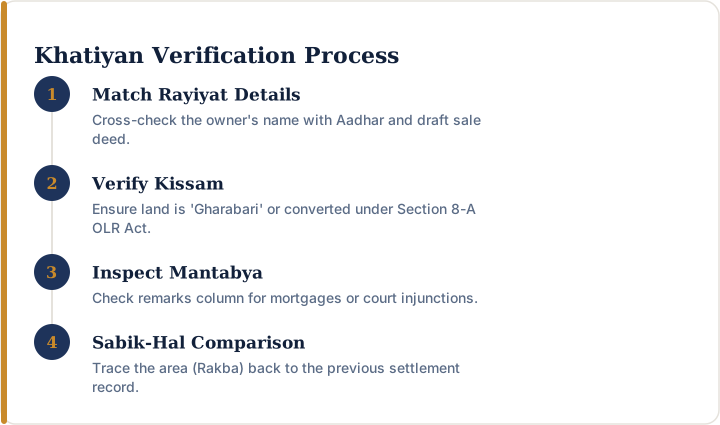
The Sabik Khatiyan refers to the older, historical Record of Rights from previous land settlements, while the Hal Khatiyan is the current, active record on the Bhulekh portal. Comparing the two is the only way to trace the unbroken chain of land ownership in Odisha. Think of land records like a family tree. You cannot understand the current generation without knowing who the grandparents were. In Odisha, land settlements take decades to complete. During a settlement operation under the Odisha Survey and Settlement Act, 1958, the revenue authorities map the land, verify possession, and issue new Khatiyans. The old record is the 'Sabik' (former), and the new record is the 'Hal' (current). In districts like Dhenkanal, the last major settlement finalized around the 1980s. When you or your advocate look at a Hal Khatiyan today on the Bhulekh Odisha portal, you are only seeing a snapshot of who claimed the land during that specific settlement period. Fraudsters love the gap between Sabik and Hal records. A common pattern we see in Dhenkanal involves a seller who legitimately owned 1.5 acres in the Sabik record. During the settlement, perhaps 0.5 acres was acquired for a road, leaving them with 1.0 acre in the Hal record. The fraudster will use the old, faded Sabik document to convince a naive buyer they are purchasing a larger tract of land. When cross-referencing these documents, any discrepancy in the 'Rakba' (area) between the Sabik and Hal records must be explained by a registered deed or a government acquisition order. If the math does not add up, you must walk away.
Let me share something that could save you lakhs. Never accept a photocopy of a Sabik Khatiyan from a seller without independently verifying the Hal status. You can obtain a certified copy of the Hal Khatiyan from the local Tahasil office for a nominal fee of ₹30 per page (IGR Odisha fee schedule). That ₹30 investment is your primary shield against a ₹30 lakh disaster.
Section 17 Registration Act Limitations
Before we look at the specific columns of the document, we need to address the legal elephant in the room. Why did the Sub-Registrar allow my client to register a ₹28.5 lakh plot that the seller did not legally own? The answer lies in Section 17 of the Registration Act, 1908. This statute mandates that any sale of immovable property valued over ₹100 must be registered. However, the Sub-Registrar's primary duty under this Act is to collect stamp duty and verify the identities of the parties executing the document. They are not a title verification agency. If you present a drafted sale deed, pay the 5% stamp duty, and bring two witnesses, the Sub-Registrar will register the document. They do not cross-check the historical Khatiyan chain to ensure the seller has absolute ownership. The legal principle in India is Caveat Emptor (Buyer Beware). This is why an Encumbrance Certificate (EC) is dangerous if used in isolation. The EC, issued under Form 25 of the Indian Stamp Rules, only shows transactions that occurred at the Sub-Registrar's office. It does not show if the original title was defective, if the land is ceiling surplus under the Odisha Land Reforms Act, or if the property is classified as tribal land requiring special permission to sell.
Anatomy of an Odisha Khatiyan
To protect yourself, you must learn to read the five critical columns of the Khatiyan. When a bank-panel advocate reviews an RoR for a home loan approval, they do not just glance at the owner's name. They dissect the document column by column. Here is the exact framework advocates use to decode the document.
| Column | Odia Term | What It Means | What Advocates Check For |
|---|---|---|---|
| 1 | Rayiyat | Name of the recorded tenant | Does the name perfectly match the seller's Aadhar card? Are there co-sharers listed? |
| 2 | Khata No. | The account number | Is this a Stitiban (settled) khata or a leasehold/government khata? |
| 3 | Plot No. | The specific land parcel | Does this match the schedule of property in your draft sale deed exactly? |
| 4 | Kissam | Classification of land | Is it Sarad (agricultural) or Gharabari (homestead)? This dictates usage. |
| 5 | Mantabya | Remarks / Notes | The most critical column. Are there civil court injunctions or bank loans noted here? |
The 'Rayiyat' column often lists multiple names, especially in undivided family properties. If the Khatiyan lists a father and three sons, and you are only buying from one son, you are buying a lawsuit. Without a registered partition deed, all co-sharers must sign your sale deed.
The Kissam Land Conversion Fraud
The fourth column, 'Kissam', dictates what you can legally do with the land. This is where many first-time investors in Odisha get trapped. Imagine buying a plot to build your dream home. The seller shows you a Khatiyan, and the area looks perfect. But the Kissam is listed as 'Sarad' (agricultural land) or 'Chaka' (consolidated agricultural land). You pay the seller, register the deed, and start digging the foundation. Suddenly, the Tahasildar issues a stop-work notice and imposes a massive penalty. Under Section 8-A of the Odisha Land Reforms Act, 1960, agricultural land cannot be used for non-agricultural purposes without formal conversion. The conversion process requires an application to the Tahasildar, a field inquiry, and payment of a conversion premium (which can range from ₹500 to several thousand rupees per decimal, depending on the area's benchmark valuation). Fraudulent developers often buy cheap agricultural land, divide it into small plots, and sell them to unsuspecting buyers at residential rates without ever applying for Section 8-A conversion. The buyer is left holding agricultural land they cannot legally build on. Always check the Kissam. If it does not say 'Gharabari' (homestead) or 'Patita' (fallow land approved for conversion), you must demand that the seller completes the Section 8-A conversion before you pay the final advance.
The Fatal Mantabya Column Secrets
We now arrive at the column that cost my Dhenkanal client ₹28.5 lakhs: the 'Mantabya' or Remarks column. This small section at the far right of the Khatiyan holds the ultimate truth about the property's legal health. When a Tahasildar updates a land record, any encumbrance, restriction, or legal dispute is noted here. If the land was mortgaged to a cooperative bank, it will be written here. If the land is subject to a civil court injunction, the case number will be scribbled in this space. In my client's case, the Mantabya column contained a faded Odia inscription noting that the land was a conditional lease granted to a landless person under a specific government scheme. By law, such leasehold lands cannot be transferred or sold for a period of 10 to 20 years, and sometimes never, without the District Collector's explicit written permission. The seller knew this. The document writer ignored it. The Sub-Registrar registered the deed because Section 17 of the Registration Act only requires them to check stamp duty. But the Tahasildar, whose job is to maintain the integrity of the revenue records, immediately spotted the restriction in the Mantabya column and blocked the mutation. If you see any text in the Mantabya column that you cannot read or understand, you must halt the transaction immediately. Hire a competent local advocate to translate and interpret that specific remark.
Section 54 Transfer of Property Act
To truly understand why the Khatiyan is so vital, we must look at Section 54 of the Transfer of Property Act, 1882. This statute defines a 'sale' as a transfer of ownership in exchange for a price paid or promised. The core legal doctrine here is Nemo dat quod non habet, no one can transfer a better title than they themselves possess. If the seller's name is not clearly recorded as the absolute owner (Stitiban) in the Khatiyan, they do not possess a perfect title. Therefore, they cannot transfer a perfect title to you, regardless of how much money you pay them or how beautifully the sale deed is drafted. This is why relying solely on a prior sale deed is dangerous. Suppose Person A sold government land illegally to Person B in 2015. Person B now wants to sell it to you in 2026. Person B will show you their registered 2015 sale deed as proof of ownership. If you do not trace the title back to the Khatiyan, you will inherit Person B's defective title, and your mutation will be rejected.
Cross-Verifying Bhulekh Odisha Entries
Verifying the Khatiyan is no longer an obscure process requiring multiple visits to the Tahasil office. The Revenue and Disaster Management Department has digitized millions of records. Here is exactly how to cross-verify a seller's claims using the Bhulekh portal in 2026. 1. Navigate to the official portal at bhulekh.ori.nic.in. 2. Select the correct District, Tahasil, Village, and RI Circle from the dropdown menus. 3. Search by 'Khatiyan Number' if you have the seller's RoR copy, or by 'Tenant Name' to see all lands held by the seller in that village. 4. Click 'RoR Front Page' to verify the Rayiyat details, Khata number, and land classification (Kissam). 5. Click 'RoR Back Page' to meticulously inspect the Mantabya (Remarks) column for any hidden notes or bank mortgages. 6. Compare the digital area (Rakba) exactly against the physical schedule of property in your draft sale deed. If the Bhulekh portal shows 'Mutation Pending' or if the seller's name is missing entirely, do not proceed. The seller must complete their own mutation process and get their name officially recorded in the Hal Khatiyan before they have the legal standing to execute a sale deed in your favor.
The Mutation Timeline Reality Check
The final piece of the puzzle is understanding what happens after you successfully register a clean property. Registration is only step one; mutation is step two. Mutation (Dakhil Kharij) is the process of updating the Khatiyan to replace the seller's name with your name. Under the Odisha Mutation Manual, a standard uncontested mutation should be completed within 45 days. However, in busy Tahasils like Dhenkanal or Khordha, the reality often stretches to 90 or even 120 days. When you file Form 6 for mutation, the Tahasildar will issue a general proclamation inviting objections for a period of 30 days. If the Khatiyan you purchased from had multiple co-sharers who did not sign the sale deed, they will file an objection right now. This transforms a simple administrative update into a contested revenue court case that can drag on for years. This is why reading the Khatiyan correctly before purchase is non-negotiable. A clean RoR with a single, undisputed Stitiban owner ensures your mutation sails through the 45-day window without objections.
What to Do Next: Your Action Plan
The solution is simpler than you think. You do not need a law degree to protect your life savings, but you do need strict discipline. If you are currently negotiating a land purchase in Odisha, follow this immediate action plan. First, demand a recent certified copy of the Hal Khatiyan from the seller, not just a downloaded printout. Second, apply for a 13-year Encumbrance Certificate (Form 25) to check for recent registered mortgages. Third, match the names, area, and Kissam across all documents. If you find a discrepancy, if the Sabik area does not match the Hal area, if the Kissam is Sarad instead of Gharabari, or if there is a single illegible word in the Mantabya column, stop the transaction. Property verification is not about trusting the seller; it is about trusting the documented chain of title. Take the time to read the records, consult with a verified advocate, and ensure your investment is anchored in absolute, unshakeable legal reality.